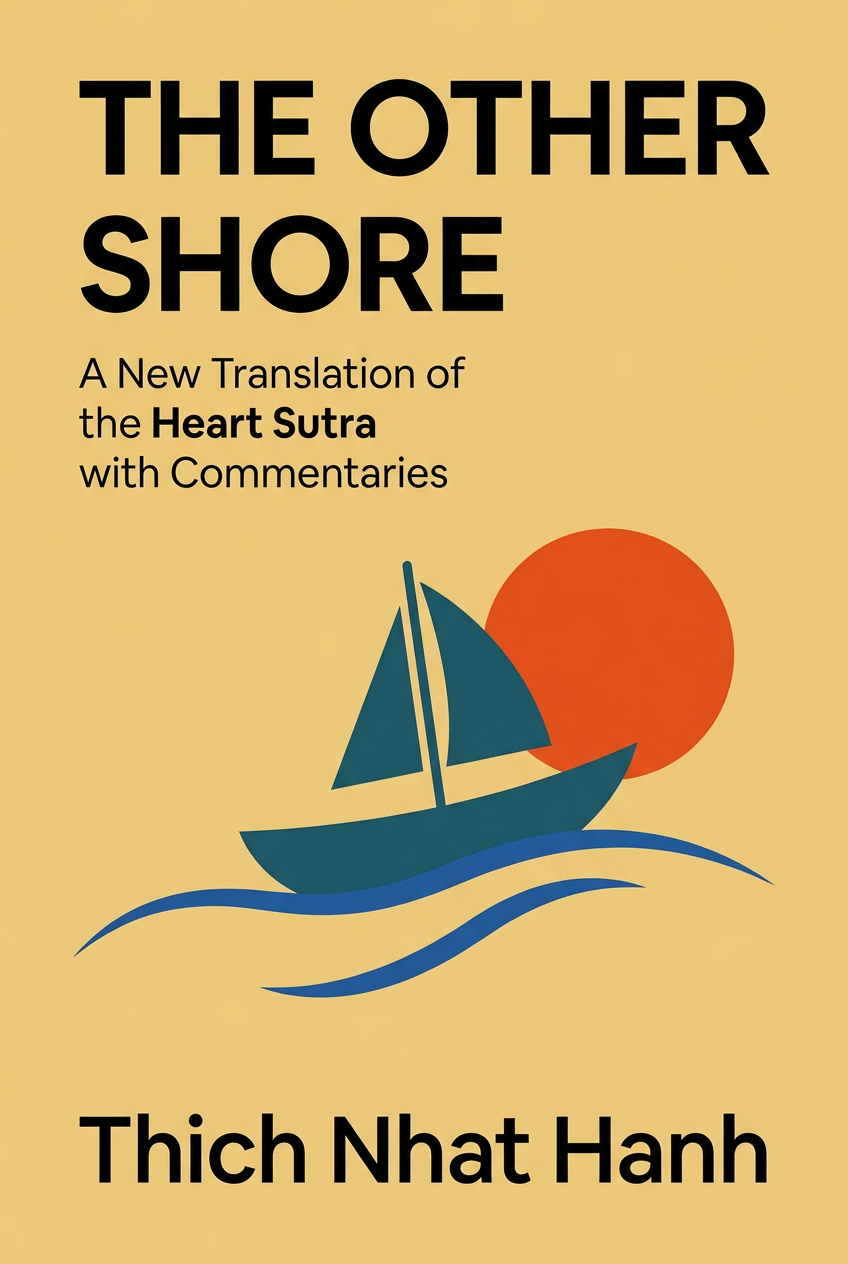
The Other Shore
A New Translation of the Heart Sutra with Commentaries
What's it about
Struggling with stress, anxiety, or the feeling of being separate from the world? Discover how an ancient Buddhist text, the Heart Sutra, holds the key to transcending suffering and finding true freedom, peace, and connection in your daily life. This summary of Thich Nhat Hanh's profound teachings unpacks the sutra's core concepts of "emptiness" and "interbeing." You'll learn practical ways to see past illusions, release fear-based attachments, and experience the liberating joy of understanding that you are deeply connected to everything and everyone.
Meet the author
Thich Nhat Hanh was a globally renowned Zen Master, peace activist, and spiritual leader, nominated for the Nobel Peace Prize by Martin Luther King Jr. A Vietnamese Buddhist monk, he dedicated his life to making ancient wisdom accessible, founding monasteries and practice centers worldwide. His profound understanding of Buddhist texts, honed through decades of scholarship and teaching, allowed him to offer this fresh, insightful translation of the Heart Sutra to help people find peace in the present moment.
Opens the App Store to download Voxbrief

The Script
You are on a riverbank, looking across the water at what seems to be a solid, separate shore. From your vantage point, the people over there appear distinct, their lives entirely their own, their joys and sorrows contained within themselves. You see this shore, the one you stand on, as your own island of existence—your thoughts, your feelings, your life, separate from all others. This feeling of separation is one of the most fundamental experiences of being human. It’s the source of our loneliness, our fear, and our craving for connection. We spend our lives trying to build bridges to that other shore, to cross the river of misunderstanding and isolation, often without realizing that the very idea of two separate shores might be an illusion created by the river itself.
This profound sense of separation, and the suffering it causes, is precisely what Zen Master Thich Nhat Hanh sought to address. Having witnessed the devastation of war in his native Vietnam, where the lines between ‘us’ and ‘them’ were drawn in blood, he dedicated his life to finding a path to peace. He saw that the same illusion of a separate self that fuels personal anxiety also fuels global conflict. The Other Shore is his gentle but revolutionary re-translation of the Heart Sutra, one of Buddhism's most essential texts. He wrote it as a compassionate guide offering a way to see that the river of form and emptiness flows through everything, and that the ‘other shore’ was never truly separate from our own.
Module 1: Emptiness Is Not Nothingness, It's Interdependence
The most common mistake people make with Eastern philosophy is hearing the word "emptiness" and thinking it means that nothing exists. Thich Nhat Hanh argues this is a profound misreading. The core insight is that all things are empty of a separate, independent self. This doesn't mean they don't exist. It means they exist only in relation to everything else.
To make this concrete, he uses a simple example: a sheet of paper. Look closely at this paper. You can see the sunshine that helped the tree grow. You can see the rain cloud that watered the tree. You can see the logger who cut the tree, and the wheat that made the bread for the logger's lunch. If you remove any of these "non-paper" elements, the paper cannot exist. The paper is full of everything in the cosmos. It is empty only of one thing: a separate, isolated identity. This is the concept of Interbeing.
This brings us to the next point. True understanding requires participation. To know the saltiness of the ocean, a grain of salt must dissolve into it. To understand a person, you must put yourself in their skin. This is why abstract analysis of these ideas fails. You have to apply it. Look at your own hand. It contains your parents, your ancestors, the food you ate this morning, the air you are breathing. Your existence is a symphony of interconnected causes and conditions.
So what happens next? This insight has a powerful effect. Realizing your interconnected nature dissolves the fear of annihilation. We fear death because we believe we are a separate self that will be extinguished. But if you are not a separate self, what is there to extinguish? The cloud doesn't die; it becomes rain, a river, and the tea in your cup. The leaf doesn't die; it nourishes the tree and becomes part of the soil. Seeing your life as a continuation dissolves the fear of ending.
Module 2: Overcoming the Tyranny of Opposites
Our minds are wired to think in dualities. Good versus evil. Success versus failure. Us versus them. But the Heart Sutra argues that these pairs of opposites are illusions. They are mental constructs that create conflict and suffering.
Here’s the thing. Thich Nhat Hanh suggests that opposites like "pure" and "defiled" are interdependent and transform into one another. He offers a brilliant visual. A beautiful rose is "pure." A garbage can is "defiled." But wait a few days. The rose will wilt and become garbage. And if you are a good organic gardener, you know that the garbage, through compost, becomes rich soil that will grow a new rose. The bodhisattva, an awakened being, sees the rose in the garbage and the garbage in the rose. They don't discriminate.
This principle extends to our most entrenched conflicts. We often label ourselves as the "rose" and our perceived enemies as the "garbage." Think of political rivals or competing companies. One is "good," the other "evil." But this is a failure of seeing. Your perceived enemy inter-is with you. The wealth of one nation is often built on the poverty of another. The actions of one company create the market conditions for its competitor. Looking deeply, you see your own actions reflected in the other. Their survival and your survival are linked, like two hands of the same body.
Consequently, we must understand that assigning names and labels is the root of conflict because it creates artificial separation. We draw lines on a map and call them "America" and "Iran." We create categories like "manager" and "employee," "us" and "them." These labels are useful conventions, but we forget they are just labels. We mistake the map for the territory. The Heart Sutra reminds us that all phenomena, beneath the labels, are marked by the same nature of emptiness. By seeing this, we can dismantle the walls that our minds build.