The Practice Of Management
What's it about
Struggling to transform your team from a group of individuals into a high-performing powerhouse? Discover the timeless principles that turn good intentions into great results and make you the effective, respected leader you were meant to be. This is your guide to mastering management as a true practice. Learn Peter F. Drucker's revolutionary framework for setting clear objectives, motivating your people, and making strategic decisions that drive real growth. You'll uncover the five core operations of a manager and learn how to develop yourself and your team, ensuring your organization not only survives but thrives.
Meet the author
Widely regarded as the father of modern management, Peter F. Drucker was a legendary Austrian-born American consultant, educator, and author whose writings created the very foundation of management education. His unparalleled insights were not drawn from abstract theory alone, but from decades spent inside corporations like General Motors, observing managers and workers firsthand. This unique blend of academic rigor and practical, on-the-ground experience is what made his work, and this book, so revolutionary and enduringly relevant.
Opens the App Store to download Voxbrief

The Script
Think of the most meticulously planned, star-studded event you can imagine—a global awards show, a massive charity gala, a royal wedding. We see the final, polished product: celebrities gliding down red carpets, flawless performances, and an evening that appears to unfold with effortless grace. But behind that curtain of perfection is a different reality. There's a small army of professionals—the event producers, the security chiefs, the logistics coordinators—who aren't performing for the cameras. They are managing a volatile system of massive egos, tight schedules, and a thousand potential points of failure. Their job is to build a framework that allows the stars to shine. They practice a specific, often invisible, discipline that turns chaos into a masterpiece. This act of coordinating human effort, setting clear objectives, and measuring results is the true engine of any great achievement, yet it was once considered more of an accidental art than a professional practice.
It was this exact gap—between the critical importance of management and the lack of a coherent way to study or teach it—that troubled a Vienna-born consultant and writer named Peter Drucker. In the early 1950s, after years of advising some of the world's largest corporations, including General Motors, he noticed that while executives were brilliant in their respective fields like finance or engineering, they lacked a common language and a systematic approach to their core responsibility: managing. They were improvising, often with disastrous results. Drucker realized that management was a distinct discipline, a vital organ of society that could be defined, learned, and mastered. He wrote The Practice of Management as the first comprehensive guide for the practicing manager, turning an ambiguous function into a legitimate profession.
Module 1: The Purpose of Business and the Role of Management
Drucker opens with a radical reframing of a business's purpose. He argues that the popular idea of "profit maximization" is irrelevant and harmful. Profit is a result, a test of an enterprise's validity, not its cause or purpose.
So what is the purpose? The only valid purpose of a business is to create a customer. This insight shifts the entire focus of an organization from inward-looking metrics to outward-looking contribution. A business exists only because a customer is willing to exchange their purchasing power for a good or service. The customer alone gives economic value to resources. This leads to a powerful conclusion: a business has only two basic functions.
The first is marketing, which is the function of understanding and satisfying customer needs. True marketing is understanding the customer so well that the product or service fits them and sells itself. Drucker cites Cyrus McCormick, inventor of the mechanical reaper, as a marketing pioneer. McCormick didn't just invent a machine; he invented modern marketing tools like market research, customer financing, and service support to create and serve his customers.
The second core function is innovation, the provision of new and better economic satisfactions. Innovation can be a new product, a new process, or a new way of organizing work. It is the entrepreneur's tool for creating new value for the customer. A business that fails to innovate is sentencing itself to obsolescence.
This brings us to Drucker’s definition of management. Management is the specific organ of the business enterprise, responsible for economic performance. Management is a creative, active force that shapes the economic environment. It does this by taking conscious, purposeful action to achieve its objectives. Drucker’s view elevates management from a mere administrative function to a role of profound social and economic importance. It is the engine that converts resources into results.
Module 2: The Core Tasks of Management and the Power of Objectives
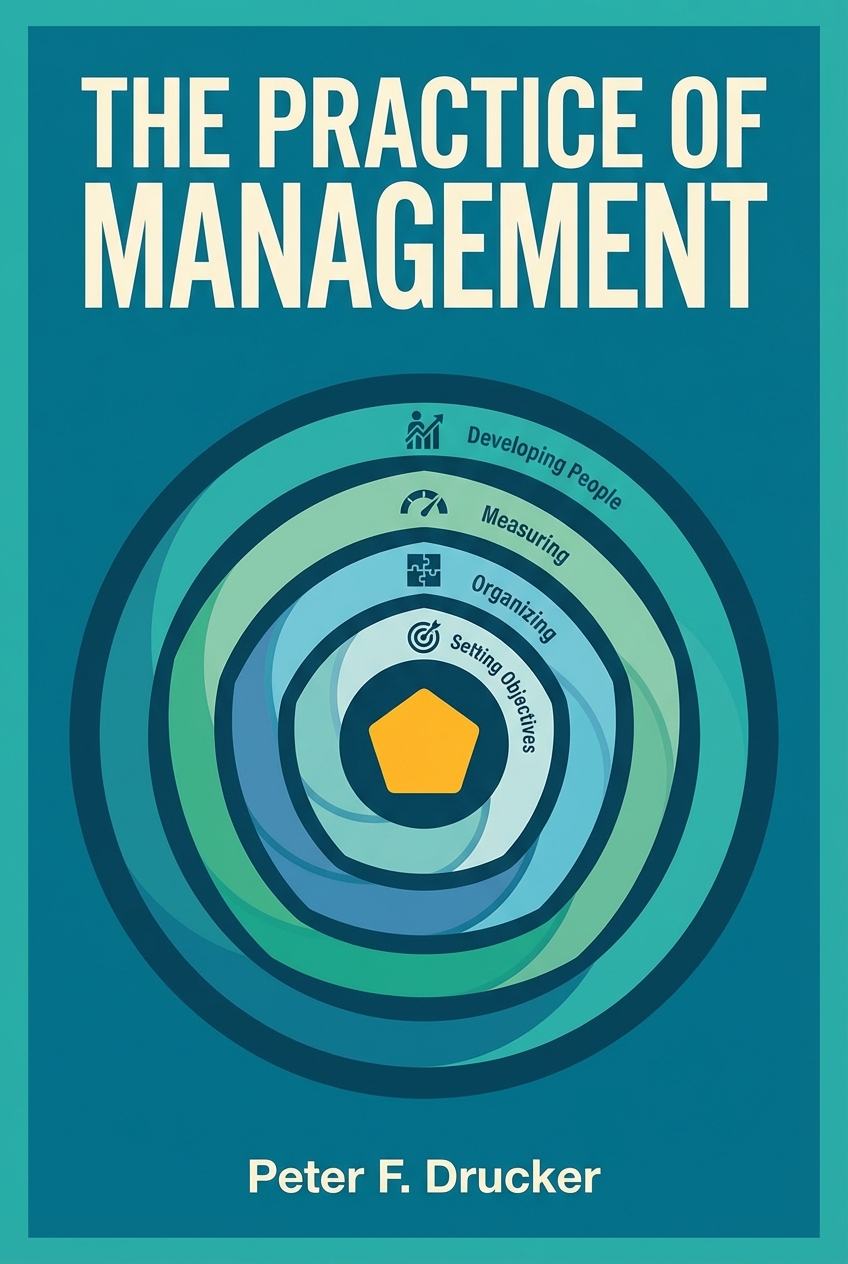
If management's job is to drive performance, how is it done? Drucker breaks the work of a manager down into five core operations. These are universal, applying to every manager at every level.
First, managers set objectives. They determine what goals need to be reached and what actions are required. This requires analytical ability to balance the needs of the present with the needs of the future.
Second, managers organize. They analyze the necessary activities, divide the work into manageable jobs, and select the right people for those jobs. This demands integrity and a deep understanding of how work flows.
Third, managers motivate and communicate. They build a team through their relationships and decisions on pay, placement, and promotion. This is the integrating function, requiring strong social skills and a sense of justice.
Next up, managers measure. They establish yardsticks for performance, both for the whole organization and for individuals. But here’s the key distinction: Drucker insists these measurements must enable self-control. When information is used to police people, it breeds fear and kills motivation.
And here’s the thing: all these tasks culminate in the fifth operation. Managers develop people, including themselves. In a knowledge economy, this task is central. A manager's own development is directly tied to their ability to develop their subordinates. This leads to a crucial insight: integrity of character is the absolute foundation of management. A brilliant, likable manager who lacks integrity is a menace. They destroy the spirit of an organization. In contrast, a demanding, even unpleasant manager who operates with integrity can build a high-performing team because they focus on what is right, not who is right.
To unify these tasks, Drucker introduces his most famous concept: Management by Objectives and Self-Control . This philosophy is designed to counter the natural forces of misdirection that pull organizations apart. Functional specialists focus on their craft, not the business. Hierarchies create mixed signals. Different levels of management see the business from different perspectives. MBO realigns everyone. It works by having managers at every level set their own objectives in contribution to the goals of the unit above them. This fosters commitment and enables self-control, as each manager has a clear target to aim for, a "compass bearing" to guide their work.