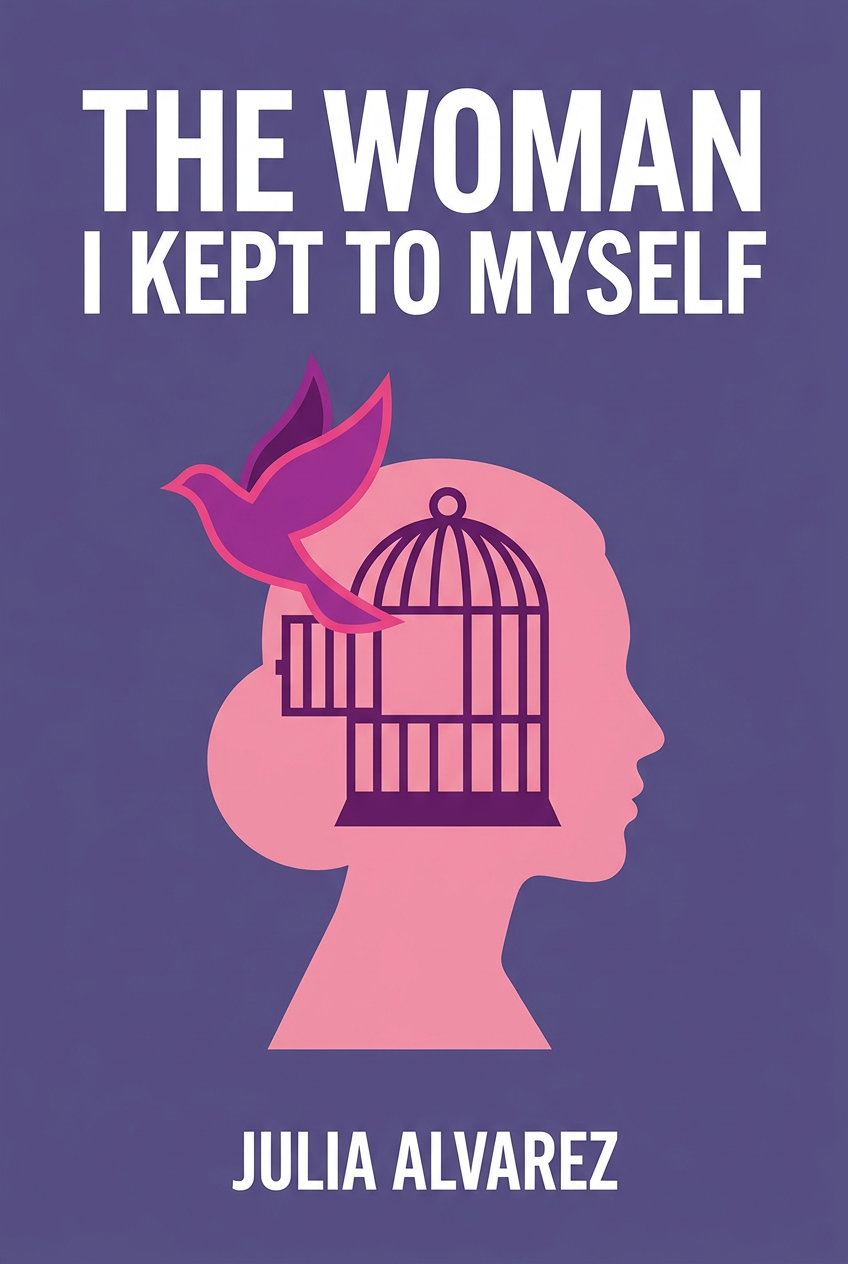
The Woman I Kept to Myself
What's it about
Have you ever felt like you're living a life that isn't truly yours, hiding your authentic self to meet others' expectations? This poetic memoir is your guide to breaking free. Discover how to shed societal pressures and finally embrace the person you were always meant to be. Through a collection of deeply personal and revealing poems, Julia Alvarez shares her journey of self-discovery. You'll learn how she navigated her identity as an immigrant, a writer, a woman, and a daughter, finding the courage to unite the public self with the private one. Let her story inspire you to find your own voice.
Meet the author
Julia Alvarez is a National Medal of Arts recipient and one of the most acclaimed Latina writers of her generation, celebrated for her novels, essays, and poetry. Born in New York City but raised in the Dominican Republic until her family fled a dictatorship, her writing powerfully explores themes of identity, cultural duality, and belonging. This intimate collection of poems reveals the personal journey of an author who has spent a lifetime navigating the borders between languages, cultures, and the public and private self.
Opens the App Store to download Voxbrief

The Script
You have a box in the attic. Inside, there are two kinds of objects. The first are the official exhibits: the framed diploma, the pristine baby shoes, the formal wedding portrait where everyone is smiling just so. These tell a clean, linear story. Then there’s the other stuff. A forgotten concert ticket stub, a smooth stone from a beach trip twenty years ago, a single, mismatched earring, a recipe card stained with something that smells faintly of cinnamon. These objects don't fit the official narrative. They are the messy, contradictory, sensory fragments of a life truly lived. If you had to tell your story, which collection would you use? Would you present the polished exhibits, or would you dare to open the box of tangled, unsorted, and more truthful artifacts?
This is the very choice Julia Alvarez confronts in The Woman I Kept to Myself. After decades of crafting celebrated novels like How the García Girls Lost Their Accents, where she gave voice to fictional characters, she turned the lens inward. She found that the public stories told about her—as a successful author, an immigrant, a Latina voice—felt like that collection of polished exhibits. They were true, but incomplete. To find the rest of herself, the woman she had kept tucked away, she turned to poetry. This book is her journey into that other box, a collection of poems written over many years, each one a fragment of memory, a question, a quiet moment, that together create a more honest and deeply human self-portrait.
Module 1: The Roots of Identity
Alvarez begins by digging into the soil of her past, showing how our identities are shaped long before we have a say in the matter. It's a powerful reminder that you can't understand where you're going without knowing where you come from.
The first core idea is that family and heritage are inescapable, even when resisted. Alvarez paints a picture of being born into a sprawling Dominican family tree, a lineage with roots in Spain and unspoken African ancestry. As a young woman in the U.S., she tries to clip herself off from this tree, becoming a "tangle-haired hippie" and an "independent woman." She wants to write sophisticated fiction in the style of John Cheever. But her heritage persists. It shows up in her children, who inherit "Mamita’s dimples," and in her own writing, which inevitably tells the story of "where I came from." This is a crucial insight for anyone who has ever tried to reinvent themselves. You can move, you can change your name, you can adopt a new culture. But the roots remain. They are a source of strength, even when they feel like a constraint.
Building on that idea, the book shows how childhood is a series of shattered illusions. Innocence is often broken in a single, searing moment. Alvarez recalls climbing a samán tree in the Dominican Republic as a child. From this perch, she gets a forbidden view of the world. She sees the poverty of squatters' camps. She sees the chilling presence of the dictator Trujillo’s elite military corps. In that same tree, her sister explains the "bloody politics of the body"—menstruation and childbirth. The tree becomes a "perch into the heart of darkness." The external political horror merges with the personal, biological reality of growing up. Innocence is gone in an instant. This is a powerful metaphor for those moments in our own lives—a shocking news event, a personal betrayal, a tough business reality—that force us to see the world as it is, not as we wished it to be.
But what happens after that innocence is lost? This brings us to another key point: we must learn to speak up in the face of prejudice. When Alvarez’s family escapes to New York, she and her sister are bullied on the playground. Kids shout "Spic!"—a slur for Hispanic people. When they tell their mother, she misunderstands. She thinks their classmates are asking them to "speak." So she encourages them to "speak up." And that's exactly what Alvarez does. Despite the continued bullying, she raises her hand in class. She keeps talking. She vows that one day, when she learns the language well, she will say what she has seen. This is a lesson in turning a moment of pain into a source of power. It’s about claiming your voice and refusing to be silenced. The professional world is full of subtle and not-so-subtle forms of exclusion. Alvarez's story is a call to find your voice and use it.
Module 2: The Labyrinth of Self-Discovery
We've explored the roots of identity. Now, let's turn to the journey of building a life on that foundation. Alvarez portrays this as a messy, confusing, and non-linear process. There is no straight path.
A central theme here is that the search for self is often a journey through confusion. As a young woman, Alvarez finds herself in a relationship she knows is wrong for her "life-story." She feels lost and alone. She compares her own uncertainty to her inability to tell the difference between trees. A maple, an oak, an elm—they all look the same to her. This mirrors her own fuzzy sense of self. She feels she can only be clearly defined "from a distance." This resonates with anyone who has felt adrift in their twenties or thirties, trying on different jobs, relationships, and identities, searching for the one that fits. Alvarez validates this confusion. She suggests it’s a necessary part of the process.
So here's what that means for us. Personal growth requires weathering periods of despair. After a divorce, Alvarez hits a low point. The guardrails of her life are gone. She’s surrounded by a hedge of arborvitae trees, a name that comes from the Latin for "tree of life." At first, this feels like a cruel joke. The hedge is a symbol of her failed love story. But later, after she has moved and started writing again, she sees a row of battered arborvitae serving as a windbreak. They are bent but not broken. And now, they seem "rightly named." They are trees of life, symbols of resilience. This is a powerful metaphor for post-traumatic growth. The very things that mark our lowest moments can become symbols of our ability to endure and thrive.
And here's the thing. This journey doesn't just happen. Artistic identity is often forged in solitude and resistance. Alvarez recalls how, as a child, her family dismissed her love of poetry. Her mother told her to "Keep it to yourself." This rejection could have crushed her. Instead, it pushed her into a "paper solitude." She retreated into a private world of writing, secretly drafting the woman she would become. This is a counterintuitive insight. We often think creativity needs constant encouragement. But Alvarez suggests that sometimes, it’s the resistance, the lack of external validation, that forces us to build a strong inner world. It forces us to create for ourselves, not for applause.
Ultimately, this leads to a surprising realization. Authentic happiness and creative work can coexist. For years, Alvarez believed that "art and happiness could never jive." She thought great art required great suffering. But in middle age, she finds herself happy. She has love, a home, a writing room. She plants locust trees for shade, but their vibrant life—the birds, the squirrels, the bees—distracts her from her work. At first, this frustrates her. But then she looks at the locust's "crooked, seemingly aimless growth" and has an epiphany. She accepts that personal growth, like the tree's, is non-linear. "We have to live our natures out," she writes. This is a liberating idea. It frees us from the romantic, and destructive, myth of the starving artist. It allows for the possibility of a life that is both creatively fulfilling and personally joyful.