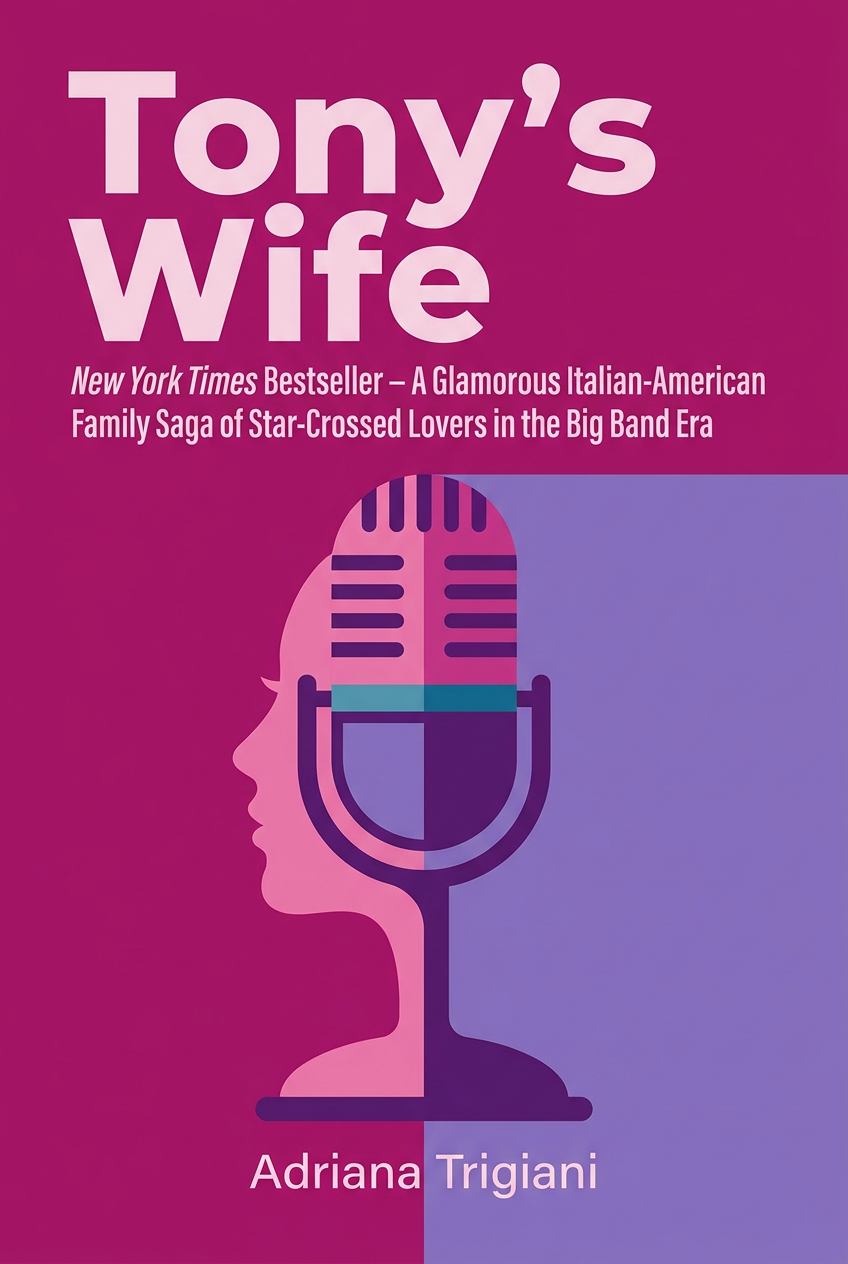
Tony's Wife
New York Times Bestseller – A Glamorous Italian-American Family Saga of Star-Crossed Lovers in the Big Band Era
What's it about
Ever wondered what it takes to build a life with a star, only to find yourself eclipsed by their shadow? Discover the passionate, turbulent story of a talented singer who must choose between her own ambitions and the dazzling, demanding world of her famous husband. This glamorous family saga transports you to the Big Band era, a world of glittering stages and hidden heartbreaks. You’ll learn how one woman navigates love, betrayal, and sacrifice in a time when a wife’s dreams often came second. Follow her journey from a small town to the heights of New York society and uncover the true price of fame.
Meet the author
Adriana Trigiani is the beloved New York Times bestselling author of twenty books in fiction and nonfiction, celebrated for her heartwarming and epic multigenerational novels. Drawing inspiration from her own close-knit Italian-American family, Trigiani masterfully captures the vibrant history, rich traditions, and profound emotional ties of her heritage. Her background as a playwright and television writer infuses her stories with sparkling dialogue and cinematic scope, bringing the glamorous Big Band era of Tony's Wife to vivid, unforgettable life.
Opens the App Store to download Voxbrief

The Script
For every couple, there are two versions of the wedding album. The first is the one on the coffee table: a heavy, leather-bound volume filled with pristine, chronological images. The first kiss, the first dance, the perfect slice of cake. It tells a clean, linear story of a day when everything went right. Then there is the second album, the one that doesn't physically exist but lives in the minds of the two people who were there. This version is a shoebox of scattered, uncurated snapshots. It remembers the argument over the seating chart that morning, the bride’s brief, panicked thought of running away, the groom’s silent, overwhelming fear at the altar. It contains the private glances, the inside jokes, and the tiny, almost invisible cracks in the foundation that no photographer could ever capture.
One story is for public consumption, a polished myth of shared destiny. The other is the lived, messy, and far more interesting truth of two separate lives attempting to merge into one. This tension—between the performance of a partnership and its private reality—is the very ground Adriana Trigiani walks in Tony's Wife. Trigiani, a bestselling author celebrated for her rich portrayals of Italian-American family life, grew up surrounded by vibrant, epic love stories that were also filled with compromise, sacrifice, and unspoken truths. She wrote this novel to explore what happens after the wedding album is put away, tracing the decades-long journey of a woman whose identity becomes intertwined with, and sometimes eclipsed by, her famous husband's career, asking what it costs to be the woman beside the man.
Module 1: The Architecture of Ambition
The story of Chi Chi Donatelli and Saverio Armandonada, who becomes the famous Tony Arma, is built on a foundation of ambition. It’s a story about two people from working-class, immigrant families who see music as an escape route. From the very beginning, we see that their creative drive is inseparable from their need for a different life.
The narrative reveals that artistic ambition requires a blend of raw talent and strategic professionalism. Chi Chi isn’t just a girl with a good voice. She’s a songwriter, a networker, and a savvy business mind in the making. She learns early that to be taken seriously, she must approach her dream with discipline. She actively seeks out band managers before shows, presenting herself as a professional, not just a fan. She understands that looking good gets you ten seconds on stage, but sounding good is what keeps you there. This mindset is her engine. It’s what drives her to turn her family’s garage into a recording studio and to relentlessly pursue a record deal.
However, this world is not a pure meritocracy. The book makes it clear that success in a competitive field often demands personal reinvention, sometimes at a great cost. Saverio is a gifted singer, but his long, ethnic name, "Saverio Armandonada," is deemed a problem. His agent rebrands him as "Tony Arma," a name that’s pithy, sexy, and marketable. Saverio agrees to the change. He wants fame too much to refuse. But the decision haunts him. He feels he’s lost a piece of his history, his very identity. He reflects that when they take a man’s name, they might as well take his conscience with it. This act becomes a central wound, creating a permanent rift between the man he was and the public persona he becomes.
Building on that idea, the story shows that true creative partnership thrives on mutual respect for professional expertise. Tony and Chi Chi’s relationship works best when they are collaborators in the studio. He relies on her sharp ear and her refusal to let him settle for anything less than perfect. She, in turn, is a confident songwriter who can direct a band and shape a song. Their chemistry is most potent when they are creating together. The recording of their hit song, "Mama's Rolling Pin," becomes a perfect example. It's a collaborative effort, with each take adding more personality and meaning. This synergy is the magic that fuels their initial success. They are a team, a family business, just like the butcher shops and restaurants in their neighborhood.
But what happens when the partnership extends beyond the studio? Here’s where the structure starts to crack. The narrative shows that balancing personal relationships and professional ambition is a constant, difficult negotiation. Tony’s romantic entanglements on the road cause professional chaos. Singers quit. Schedules are disrupted. Chi Chi, in contrast, maintains a strict boundary between her work and her personal life. She sees the double standard clearly: when a love affair goes sour, the woman leaves the tour, but the man stays on as if nothing happened. She vows to never be "some man's nothing happened." This fundamental difference in their approach to professionalism sets the stage for their future conflicts. It’s a fault line that will eventually split their world apart.
Module 2: The Unseen Labor of a Partnership
We've established the professional ambition that drives Tony and Chi Chi. Now, let’s look at the personal cost, especially for Chi Chi. The book masterfully pulls back the curtain on the unseen labor required to support a star, revealing how one partner's ascent is often built on the other's sacrifice.
The central idea here is that a "wife's" traditional role is often an invisible engine powering a "husband's" success. Chi Chi is the songwriter, the creative force, and the initial business mind. But as Tony's fame grows, her role shifts. She becomes the manager of his life. She handles the finances, raises the children, and creates a stable home front that allows him to tour the world as if he were still a bachelor. She reflects that she has shouldered all the worry and anxiety, allowing him to remain youthful and focused solely on his career. This, she believes, is her greatest act of love. But it comes at the cost of her own creative identity. Her songwriting is relegated to moments snatched between her children's naps.
This brings us to a critical insight. Financial independence is a woman's primary tool for autonomy and security. Chi Chi understands this instinctively. Even before she meets Tony, she is saving her money, buying government bonds, and reading The Wall Street Journal. She sees that money gives men the edge, so she resolves to get control of it. After their marriage, she continues to manage her own investments and copyrights. This financial acumen becomes her lifeline. When the marriage eventually fails, it’s her financial independence that allows her to protect herself and her children. She doesn't just manage the household; she manages the family's wealth, ensuring their security long after the love is gone.
So what happens next? Even with financial power, emotional rifts can be devastating. Resentment and poor communication create deep, persistent cracks in a marriage. Tony’s career keeps him away from home for long stretches. When he returns, there's a disconnect. After a long tour, he comes home to a welcome party but feels overwhelmed and distant. He is furious that Chi Chi took their newborn daughters to see his estranged father before he had the chance. This grudge poisons his homecoming. Later, he makes a massive career decision—a three-year international tour—without consulting her. It’s a power play, an attempt to "even the score" for her perceived transgressions. Their communication breaks down into a series of unilateral actions, each one driving the wedge deeper.
And here’s the thing. This dynamic reveals a painful truth. In a lopsided partnership, one person's will can become the sole tether holding the family together. Chi Chi feels this acutely. She realizes her marriage has become a fragile thing, a paper kite held aloft only by her constant effort. She agrees with Tony not out of conviction, but to avoid conflict. She fears that if she lets go, even for a moment, the entire life she has built will float away. It has become a one-woman show, and the exhaustion is setting in. She has become "Tony's Wife" in title, but in reality, she is the silent, uncredited producer of his entire life.