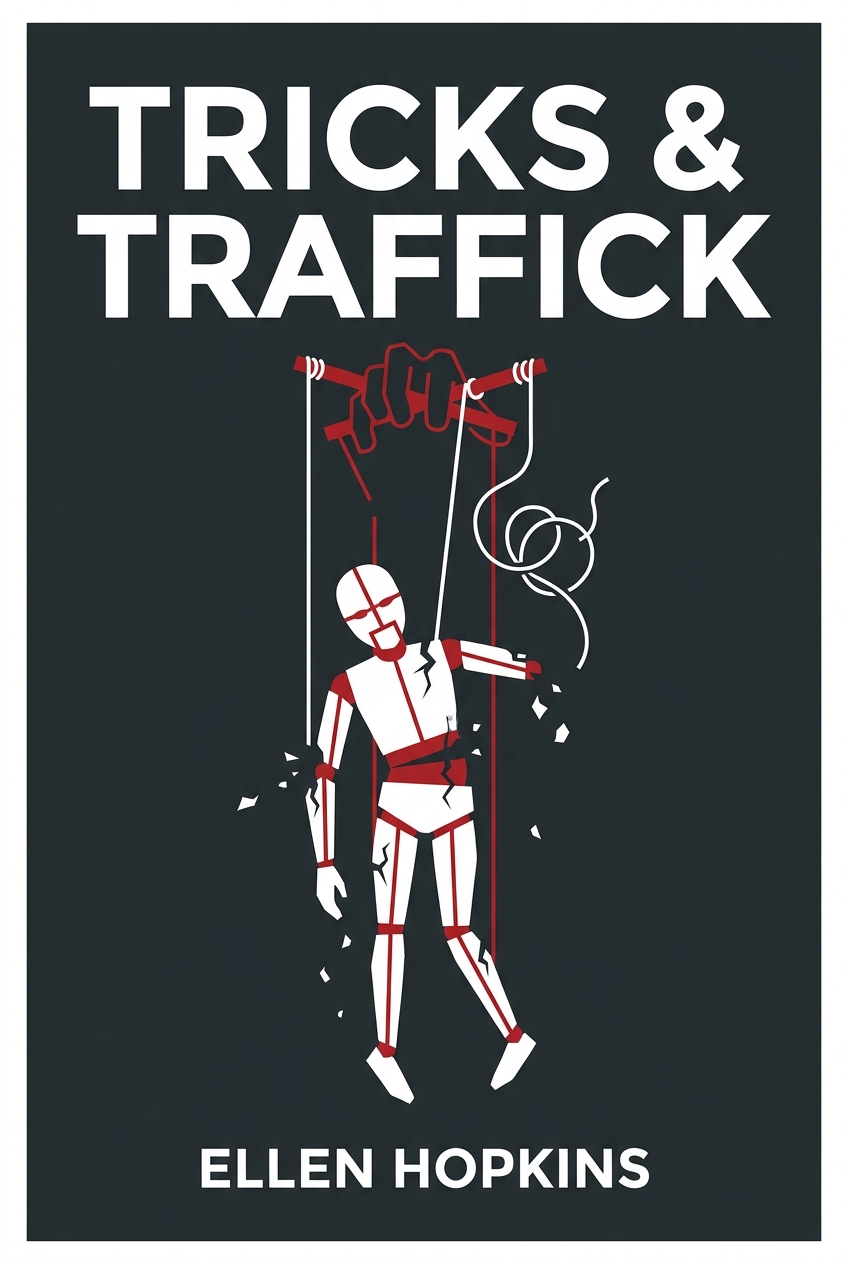
Tricks & Traffick
What's it about
Ever wonder what pushes someone to the edge, to trade one kind of trap for another? This is the story of five teenagers, each running from something, who find themselves caught in the brutal, deceptive world of sex trafficking, where the promise of freedom is just another lie. You'll follow their harrowing journeys as they navigate manipulation and danger in Las Vegas. Discover the psychological tricks used by traffickers, the impossible choices victims face, and the flicker of hope that drives them to fight for survival and reclaim their lives against all odds.
Meet the author
Ellen Hopkins is a celebrated poet and the 1 New York Times bestselling author of thirteen young adult novels that courageously tackle taboo topics. A survivor and a fierce advocate for at-risk youth, her work is born from a deep, personal understanding of the difficult realities teens face. Through extensive research and raw, lyrical prose, Hopkins gives voice to the voiceless, making her a trusted and essential figure in young adult literature.
Opens the App Store to download Voxbrief

The Script
Two people watch a magician perform a disappearing act on stage. For one, it’s a delightful, harmless illusion—a clever trick of mirrors, smoke, and misdirection. They watch the beautiful assistant step into the box, see the flourish of the cape, and applaud when she vanishes, knowing she’s safe behind a hidden panel. For the other person, the act is a horrifying reenactment. They see a transaction. The stage lights become the glare of headlights, the magician’s charming smile becomes a predator’s mask, and the disappearing box becomes the back of a van. They know that when some people vanish, there is no hidden panel. There is no applause. There is only the sickening finality of being gone, erased from one world and forced into another where the only currency is your body and the only escape is a fantasy.
This is the brutal divide at the heart of the world Ellen Hopkins explores. She saw how easily society separates the 'trick' from the 'traffick'—viewing prostitution and exploitation as distant, abstract issues or even choices, while ignoring the grim mechanics of coercion and survival behind the curtain. Hopkins, known for her unflinching verse novels that give voice to teenagers navigating addiction, abuse, and identity, felt compelled to write this story after meeting young survivors of sex trafficking. She realized that for many, the path into that life began with a series of small, desperate 'tricks'—the promise of love, the offer of a place to stay, the illusion of a better life—that slowly, almost invisibly, became a cage.
Module 1: The Architecture of Trauma
Trauma is a seismic shift that fractures a person's reality. Hopkins shows us that the initial shock is just the beginning. The real battle is fought in the mind, long after the physical danger has passed.
One of the book’s most powerful arguments is that trauma rewires your perception of the world. For the characters, ordinary places and sensations become minefields of triggers. Whitney, a survivor of trafficking, has a panic attack during a game of laser tag. The flashing lights and dark spaces instantly transport her back to the dangerous alleys of Las Vegas. Her mind can't distinguish between a game and a genuine threat. This is a physiological response. Her nervous system is stuck in high-alert, constantly scanning for danger. This hypervigilance is exhausting. It erodes trust and makes simple connection feel impossible.
From this foundation, we see a second critical insight. Trauma creates a profound disconnect between the mind and body. Cody, paralyzed from a gunshot, initially denies his injury. He jokes about the "excellent dope" a morphine cocktail provides, even as he pinches his unresponsive legs. His mind refuses to accept what his body already knows. For Whitney, her body becomes a source of shame. After her experiences, she feels "disgusting" and questions if anyone "sweet" could ever want her. She sees her body as a commodity that has been used and devalued. This internal split is a core feature of trauma. It’s a survival mechanism that allows the mind to distance itself from unbearable physical or emotional pain.
This leads to a devastating consequence. Trauma makes you feel like an alien in your own life. Whitney looks at her old friends and feels a chasm of experience separating them. She wonders, "How am I supposed to have fun goofing around with friends who have no concept of reality?" Her trauma has given her a brutal education that makes normal teenage concerns seem trivial. Similarly, Ginger, living in a group home, struggles with pretending to be "normal." She finds more solace with other "imperfect" girls because their shared experience of non-normative life is the only community that feels real. This sense of alienation is one of trauma's cruelest tricks. It isolates you at the very moment you need connection most.
Module 2: The Mechanics of Exploitation
Now that we've seen the internal landscape of trauma, let's turn to the external forces that create it. Hopkins is meticulous in deconstructing the systems of exploitation. She shows it's a business model that preys on specific vulnerabilities.
A key point the book makes is that exploiters use connection first. Traffickers are expert at identifying a need and filling it. For Whitney, a predator named Bryn doesn't kidnap her. He "rescues" her from a party. He promises a modeling career. He offers a way out. He builds a relationship based on what she desperately wants: validation and escape. This grooming process is insidious. By the time the demands escalate from webcam work to prostitution, the victim is already emotionally and psychologically entangled. The line between love and control has been blurred beyond recognition. Whitney admits a "schizo" part of her remains in love with Bryn, even after all the abuse. This is a testament to the power of psychological manipulation.
Building on that idea, Hopkins reveals that exploitation thrives on pre-existing vulnerabilities. Predators target those who have already been failed by their support systems. Seth is kicked out by his father for being gay. With no resources, he becomes dependent on older men for survival. Miranda is sold to a pimp by her own brother to settle a drug debt, after her mother rejected her for reporting abuse. Eden is sent to a harsh "reform school" by her evangelical parents, where an apostle sexually exploits her under the guise of offering an escape. In each case, the trafficker isn't the first person to cause harm. They are simply the most opportunistic, stepping into the void left by family rejection, poverty, or institutional abuse.
And here's the thing. Economic dependency is the cage that keeps victims trapped. Seth wants to leave his benefactor, David, and build a real life with Micah, the boy he loves. But he's paralyzed by a simple question: How? David provides housing, money, and a lifestyle. Leaving means facing unemployment and homelessness. This is the calculated design of exploitation. It's about controlling a person's economic reality. Ginger and her friend Alex turn to an escort service because they are underage runaways with no money. As Ginger states, "sometimes it comes down to survival." The illusion of choice masks a reality of coercion.
Finally, the book shows that substance abuse is both a tool of control and a consequence of trauma. Bryn gets Whitney addicted to heroin, making her even more dependent on him. For other characters, drugs are a way to numb the pain. Seth uses cocaine to manage his anxiety. Whitney uses pills and heroin to escape the "hollow space" inside her. This creates a vicious cycle. The trauma leads to substance use, and the substance use makes it harder to escape the exploitative situation causing the trauma.