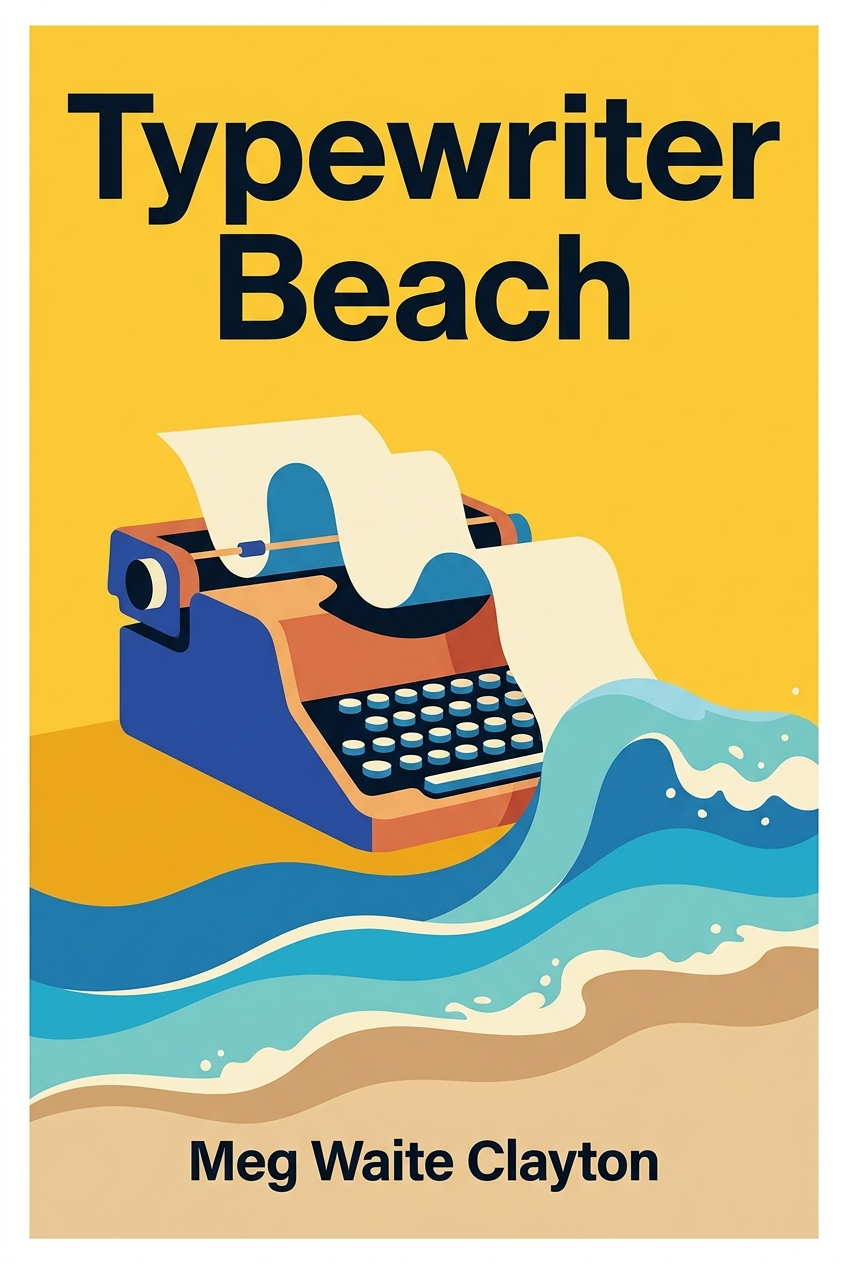
Typewriter Beach
A Historical Fiction Novel about the Friendship Between a Screenwriter and a Hollywood Actress
What's it about
Ever wondered what it takes to forge a genuine friendship amidst the glamour and backstabbing of Old Hollywood? Discover the powerful bond that can form when two women dare to support each other's ambitions in a world designed to pit them against one another. This summary of Typewriter Beach reveals the true story behind the unlikely friendship of a screenwriter and a Hollywood starlet. You'll learn how they navigated treacherous studio politics, personal betrayals, and the pressures of fame to build a partnership that defied expectations and changed their lives forever.
Meet the author
Meg Waite Clayton is the New York Times bestselling author of eight novels, including the international bestseller The Last Train to London, celebrated for its meticulous historical research. A former attorney, her deep fascination with untold stories of women in history and her own experience living near the California coast inspired this tale of Hollywood's golden age. Her work vividly brings to life the friendships and struggles of women navigating extraordinary times, making the past feel immediate and deeply personal.
Opens the App Store to download Voxbrief

The Script
Two women stand before a wall of typewriters in an antique shop, each drawn to an identical model. The first woman, a collector, assesses the machine’s condition. She checks the platen for cracks, tests the key tension, and looks for rust on the typebars. For her, the typewriter is a historical artifact, a beautiful object whose value lies in its preservation and its past. The second woman, a writer, barely glances at the mechanics. Instead, her fingers hover over the keys, sensing the ghost of a story waiting to be told. For her, the machine is an instrument, a conduit for a voice that has not yet spoken. Its value lies in what it could become.
This difference between an object's history and its potential is what animates the work of Meg Waite Clayton. She found herself captivated by the story of a clandestine propaganda organization that weaponized these very machines during World War II, turning ordinary typists into soldiers in a war of information. A bestselling novelist known for excavating the forgotten stories of women in history, Clayton saw more than just a historical footnote. She saw the human drama inside the machine: the courage, the sacrifice, and the quiet, persistent clicking of keys that could change the course of a war, one word at a time. That fascination became the seed for her novel, "Typewriter Beach."
Module 1: The Studio System as a Machine of Control
The Hollywood of the 1950s was a factory. And the product it manufactured was the star persona. This module explores how the studio system exerted near-total control over its actors, often at great personal cost.
The first step in this process was physical transformation. Studios reshaped an actor's body and image to fit a marketable ideal. For the young actress Isabella Giori, known as Iz, this began immediately. The studio changed her hair to a "Hitchcock blond" before she even had a screen test. Her contract stipulated she maintain a weight of 118 pounds, enforced through daily weigh-ins. It even required her to undergo cosmetic surgery to narrow her nose. This was about molding her into a pre-approved commodity. Her very identity was negotiable. The studio and gossip columnists marketed the twenty-two-year-old as "sixteen and innocent," a persona she was contractually obligated to perform both on and off screen.
Building on that idea, the audition process was a dehumanizing ritual of judgment. When Iz auditioned for the legendary Alfred Hitchcock, she never read a single line. Instead, Hitchcock filmed her eating steak in twelve different outfits. He scrutinized her posture and her mannerisms. Iz felt intensely self-conscious, interpreting a tiny splatter of steak juice on her glove as a catastrophic failure. Hitchcock later revealed his philosophy: "The best actors are those who can do absolutely nothing extremely well." He was testing her ability to be controlled, to maintain a perfect physical presence under pressure.
Finally, this system was built on a foundation of humiliation and forced complicity. Actors with less power were expected to silently endure objectification. After the bizarre steak audition, studio executives Benny Thau and Eddie Mannix laughed at Iz. She was expected to laugh along with them, even though she was the butt of the joke. This dynamic reinforced her powerlessness. Her career decisions, from the roles she played to the money she earned, were made entirely by studio heads. Young actresses like Iz were seen as interchangeable. A director once threatened to replace her mid-scene, asking, "Can’t we get some pretty girl who can say the lines?" This constant threat of being replaced kept actors compliant, trapped in a system that valued their image far more than their humanity.
Module 2: The Blacklist and the Price of Conscience
The glamour of 1950s Hollywood concealed a dark undercurrent of fear. The House Un-American Activities Committee, or HUAC, was on a witch hunt for communists, and the Hollywood blacklist was its most notorious weapon. This module dissects the impossible choices faced by artists caught in this political storm.
The blacklist created a pervasive atmosphere of paranoia. Careers could be destroyed by a mere whisper or an unfortunate association. Everyone lived in fear. Screenwriter Leo Chazan, a central character, saw the community crumble around him. Where there were once five hundred writers under contract at his studio, the purges left only one hundred. Solidarity collapsed. Stars like Humphrey Bogart, who initially opposed HUAC, were pressured into recanting their positions to save themselves. The message was clear: conform or be destroyed.
This pressure forced individuals into an impossible moral corner. Artists had to choose between betraying their principles or facing professional ruin. Leo Chazan outlines the three grim options for a witness. First, refuse to answer on First Amendment grounds and go to jail. Second, "name names" of suspected communists to save your own career. Or third, plead the Fifth Amendment, which protected you from self-incrimination but guaranteed you'd be blacklisted. Leo chose the Fifth. He refused to name names but avoided prison. The cost was immense. His income plummeted, and he was forced into a shadow economy of ghostwriting for a fraction of his former pay. He became a professional ghost, his name erased from his own work.
And here's the thing: The anti-communist crusade was driven by political opportunism. Leo correctly identifies politicians like Richard Nixon and industry figures like Ronald Reagan as men who used the witch hunt for their own gain. The studios, to protect themselves, made cheap, "shamelessly moralizing" anti-communist films they knew would flop. It was a cynical payment of dues to appease the fanatics in Congress. In a final act of defiance, the blacklisted writer Dalton Trumbo won an Oscar under the pseudonym "Robert Rich." He couldn't claim his award, but his win was a quiet rebellion. It proved that even when silenced, true talent could not be completely erased.