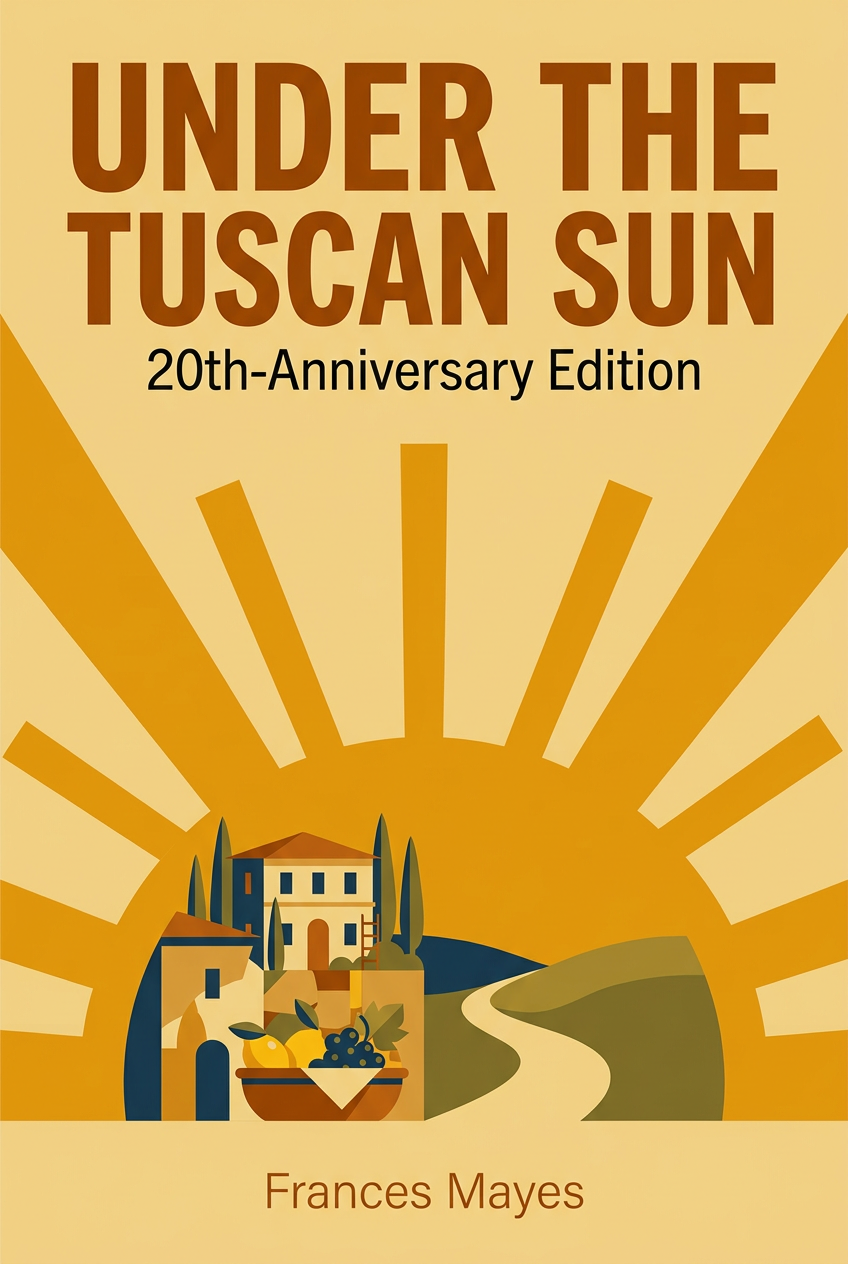
Under the Tuscan Sun
20th-Anniversary Edition
What's it about
Ever dreamed of escaping the daily grind and starting a new, more vibrant life? Discover how one spontaneous decision to buy a dilapidated villa in Tuscany can be the catalyst for profound personal transformation, teaching you to find joy, beauty, and purpose in the unexpected. This summary of Frances Mayes's beloved memoir guides you through her journey of restoring an Italian farmhouse, Bramasole. You'll learn how embracing slow living, savoring local food and culture, and tackling new challenges can help you rebuild not just a house, but your own sense of self. Get ready to be inspired to create your own version of a life lived more fully.
Meet the author
Frances Mayes is the internationally bestselling author whose beloved memoir, Under the Tuscan Sun, inspired a generation to embrace the beauty of Italian life and culture. A poet, essayist, and novelist, Mayes transformed her own experience of spontaneously buying and restoring an abandoned villa in Tuscany into a worldwide phenomenon. Her lyrical prose and passion for food, wine, and travel continue to capture the hearts of readers, inviting them to discover the magic of a life lived with spontaneity and joy.
Opens the App Store to download Voxbrief

The Script
Two people inherit identical, antique wooden chests. The first heir, a meticulous historian, begins by cataloging its contents. He documents the wood type, the construction date, the provenance of the tarnished brass latch. He photographs every faded letter and pressed flower, creating a perfect, searchable archive of the chest's past. For him, the chest is a closed system, a historical record to be preserved and understood from a distance. The second heir, upon receiving her chest, throws the lid open and lets the scent of cedar and old paper fill the room. She runs her hands over the dovetail joints, feeling the maker’s skill. She reads the letters for their stories of heartbreak and joy, then uses the chest to store her own favorite sweaters and new journals. She inhabits the chest, weaving its history into the fabric of her own ongoing life.
This choice—between treating a life as a finished artifact to be analyzed or as an open vessel to be filled—is the quiet heart of "Under the Tuscan Sun." Frances Mayes, a poet and university professor, found herself at a crossroads after a painful divorce. The life she had carefully built felt like a sealed chest from the past. Instead of simply cataloging the loss, she made a wildly impulsive decision. On a vacation in Tuscany, she bought a dilapidated, 300-year-old villa named Bramasole, or “to yearn for the sun.” The book is a sensory journal of the life she was actively building—of restoring stone walls, planting a garden, navigating a new language, and discovering that a home is something you create, not just acquire.
Module 1: Restoration as a Metaphor for Life
The core idea Mayes presents is that transforming our physical space can fundamentally transform us. The project of restoring a house becomes a project of restoring the self. She and her partner, Ed, arrive at Bramasole, an abandoned villa in Tuscany. It’s a wreck. The land is overgrown. The walls are crumbling. But they dive in, not as experts, but as willing apprentices to the process.
This brings us to a crucial insight. You must embrace the fullness of your ignorance to truly learn. Mayes doesn’t pretend to know how to fix a stone wall or prune an olive tree. Instead, she and Ed learn by doing, by asking locals, by making mistakes. They learn from a vintner that burying a grape tendril can spur new growth. She immediately sees this as a metaphor for personal change. To move forward, we sometimes need to bury the old and trust that something new will emerge from it. The restoration is about responding to what the house and land need.
Next, this process forces a reckoning with the past. To build a new life, you must first clear out the old debris. Before they can paint a wall, they must haul away truckloads of junk left by previous owners. They scrub away decades of neglect. This physical act of clearing out someone else’s history is cathartic. It’s a tangible way of making space, not just in a room, but in one's own life. Each decision—what to keep, what to discard—is a small act of defining a new identity. This is about intentional creation.
From this foundation, we see how the work itself becomes a source of profound connection. True satisfaction comes from direct, hands-on engagement with your environment. Mayes finds immense joy in the simplest tasks. Digging up potatoes for dinner feels like finding Easter eggs. Cooking a simple pasta dish on a makeshift counter feels "divine." This is about finding pleasure and meaning in the daily, physical work of creation. It's a powerful reminder for any of us, especially those in knowledge work, of the deep fulfillment that comes from making something tangible with our own hands.
So what happens next? This immersion teaches a powerful lesson about a different way of living. Adopting a philosophy of "make haste slowly" is essential for meaningful change. The Italian phrase festina tarde becomes a guiding principle. The restoration is plagued by delays. A contractor breaks his leg. A wall threatens to collapse. The bureaucracy is maddeningly slow. Yet, through this frustration, Mayes learns patience. She learns to work with the local rhythm, not against it. This shift is crucial. It moves her from the mindset of a tourist, who wants things to happen on a schedule, to that of a resident, who understands that meaningful work takes time.
Module 2: A Deeper Connection to Place and Time
Now, let's move to the second key theme. Mayes discovers that living in Tuscany is about inhabiting a place with deep, living layers of history. This changes her perception of time itself.
The book shows how the past constantly shapes and enriches the present moment. Mayes feels this everywhere. When she walks her property, she’s walking on a Roman road. Her house is built near an Etruscan wall. A neighbor reveals his brother was shot on her land during the war. Suddenly, the idyllic landscape is charged with memory and tragedy. She realizes she is the newest layer on a palimpsest that stretches back thousands of years. This awareness brings a profound sense of humility and connection. It reframes daily life as a small part of a much larger story.
Building on that idea, the book suggests that a genuine sense of place is built through sensory experience. Mayes fills notebooks with lists of wildflowers, new Italian words, sketches, and recipes. This act of attentive observation is a way of being "alive twice." She tells time by the way the sun moves across the walls of her house. She learns the local dialect by listening at the weekly market. This is a powerful lesson. To truly know a place, or even a project or a team, you have to immerse your senses in it. You have to notice the small details that guidebooks and reports leave out.
And it doesn't stop there. Mayes finds that the natural world offers its own potent language of beauty, omen, and comfort. A terrifying thunderstorm is followed by the mystical appearance of a small owl on her windowsill. She accepts it as a message from the hill itself. The overwhelming bloom of red poppies stops all work, demanding to be admired. This is about being open to wonder. It's about recognizing that the world is constantly communicating with us, if we only slow down enough to listen. For anyone stuck in a cycle of pure logic and data, this is a reminder of the power of intuition and the wisdom found in the non-rational world.
And here's the thing. This connection to place culminates in a profound sense of belonging. True community is forged through shared rituals and simple acts of generosity. The restoration of Bramasole is a community effort. Neighbors offer advice. A friend gives them furniture. The local bar owner toasts their new home with his family. The most meaningful connections are built on shared meals, exchanged stories, and the simple, unspoken understanding that comes from living side-by-side. The house becomes a home when it is filled with people.