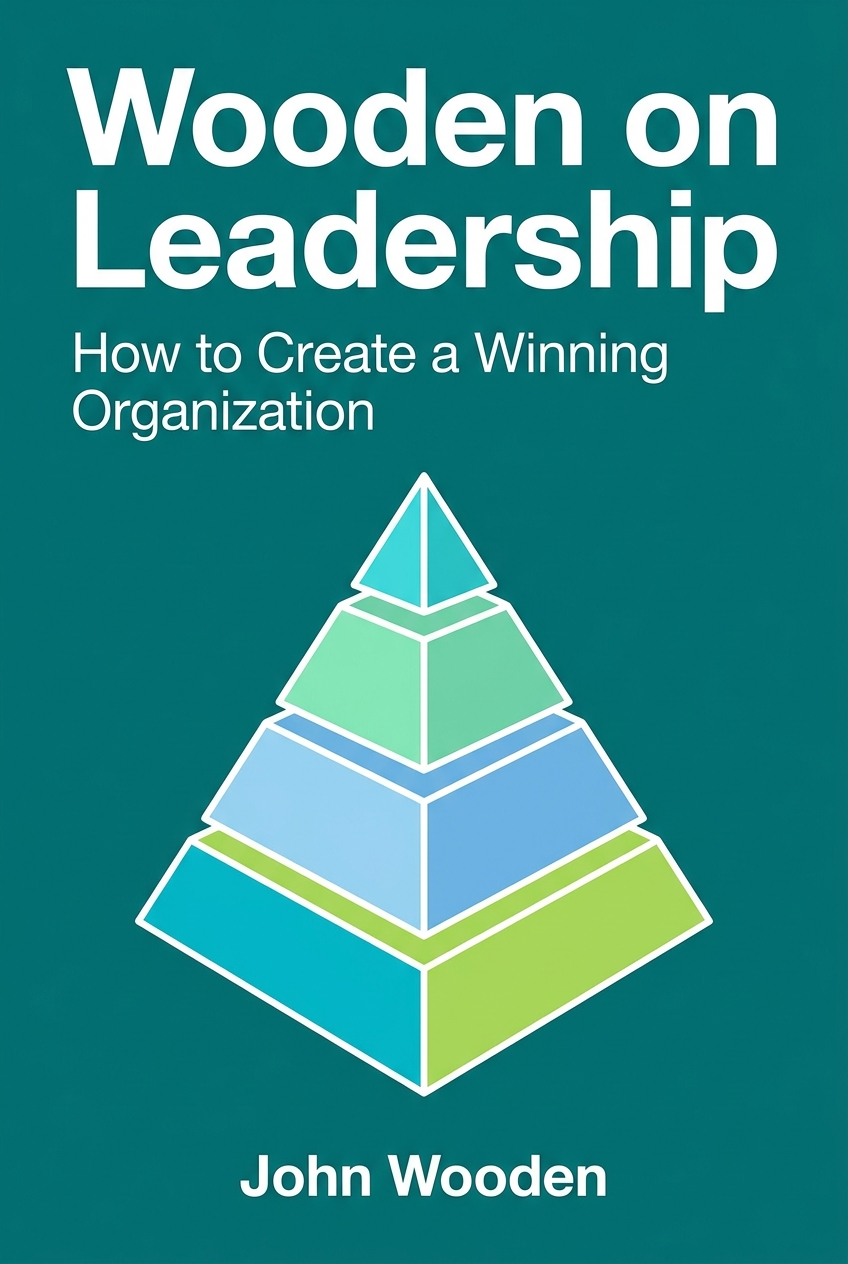
Wooden on Leadership
How to Create a Winning Organization
What's it about
Want to build a team that's not just successful, but legendary? Discover how John Wooden, one of the greatest coaches in history, built a dynasty not by chasing wins, but by focusing on character, effort, and the daily pursuit of personal excellence. Learn his iconic Pyramid of Success, a 15-block blueprint for creating a winning culture. You'll get practical, step-by-step leadership lessons on communication, motivation, and discipline that you can apply immediately to inspire peak performance in your own organization, on and off the court.
Meet the author
John Wooden is widely regarded as the greatest coach in sports history, having led the UCLA Bruins to an unprecedented ten NCAA men's basketball championships. His legendary success was not built on just winning games, but on his core philosophy of the "Pyramid of Success," a timeless model for leadership, personal excellence, and character. This book distills the powerful principles he used to mentor countless players and build one of the most dominant dynasties in all of sports.
Opens the App Store to download Voxbrief

The Script
When director James Cameron was filming Titanic, the most expensive film ever made at the time, he was notorious for his fanatical attention to detail. He controlled every aspect, from the historical accuracy of the dinner plates to the precise way an actor delivered a line. The result was a colossal success, but the process was famously grueling, a top-down, command-and-control operation. Contrast this with the set of Saving Private Ryan. Director Steven Spielberg, known for his own brand of meticulous filmmaking, famously refused to storyboard the iconic D-Day landing sequence. He wanted the cameraman, and by extension the audience, to react with the same chaos and confusion as the soldiers on screen. He was establishing a core principle—authenticity—and trusting his team to execute it under pressure.
This tension between micromanagement and trust, between dictating actions and teaching principles, is the central puzzle of effective leadership. It's a puzzle that one of the most successful coaches in history spent his entire career solving. Before he was an author, John Wooden was a teacher—first of high school English, then of basketball at UCLA. He built his dynasty by refining a different approach, one focused on instilling fundamental values and behaviors, from how to properly put on socks to avoid blisters to the importance of being on time. He believed that if he taught his players how to be good people and dedicated workers, the winning would take care of itself. This book is the culmination of that lifelong experiment, a distillation of the principles he used to win ten national championships and shape countless lives.
Module 1: Redefining Success and Character
The first thing to understand about Wooden's philosophy is that it completely redefines the goal. In a world obsessed with scoreboards and stock prices, Wooden offers a radical alternative. He argues that true success is the peace of mind that comes from knowing you made the maximum effort to become the best you are capable of becoming. This is a strategic shift. When you adopt this internal standard, you stop competing against others and start competing only against your own potential. You control the input—your effort—so success is always within your grasp, regardless of the outcome.
Wooden learned this from his father, who told him, "Don't worry about whether you’re better than somebody else. Never cease trying to be the best you can become." As a coach, Wooden rarely used the word "win." Before every game, he told his players he wanted their heads held high when it was over. And the only way to guarantee that was to give everything they had.
This leads to a crucial distinction. A leader must prioritize character over reputation. Your reputation is what others think you are. It's based on external results, like a win-loss record. Your character is what you really are. Only you truly know it. Wooden points to his 1960 UCLA team, which had a mediocre 14-12 record. Critics grumbled. But Wooden considered it one of his most successful seasons. Why? Because that team, with its limited talent, came incredibly close to maximizing its potential. He felt he did some of his best coaching that year. In contrast, when his 1964 team went 30-0 and won the national title, the world declared him a genius. But in his own mind, he was no more successful than he had been four years earlier. His internal standard never wavered.
And here's the thing. Good values attract good people, and it's the leader's job to protect those values. Wooden believed an organization's character acts like a magnet. He tells a story about a talented recruit who, during an interview, snapped rudely at his own mother. Wooden ended the meeting right there. No scholarship. He knew that someone who disrespected his mother would never respect his coach or his team under pressure. He chose to protect his team's culture over acquiring a star player. This was a strategic decision to maintain the integrity of the organization.