A Beginner's Guide to the Best Macroeconomics Books
By VoxBrief Team··6 min read
Do you ever feel like economic news is written in a foreign language? Headlines about GDP, interest rates, and global trade can feel distant and abstract, yet these forces quietly shape our daily lives—from the price of coffee to the health of the job market. Understanding them is not just an academic exercise; it's a crucial skill for navigating the modern world. This guide will demystify the essential concepts, drawing insights from some of the best macroeconomics books to make the topic accessible, especially for those just getting started.
So, what is macroeconomics? In simple terms, it's the study of the economy as a whole. Instead of focusing on individual businesses or consumers (which is microeconomics), macroeconomics looks at the big picture: national output, unemployment rates, inflation, and how governments and central banks try to manage it all for stable growth.
Why Is Macroeconomics Important for You?
It’s easy to dismiss macroeconomics as a topic for politicians and Wall Street analysts, but its principles have a direct impact on your personal finances, career, and future. Understanding why is macroeconomics important is the first step toward using its insights to your advantage. Whether you're in your 20s planning a career or a millennial navigating the housing market, these concepts are your roadmap.
When you hear the central bank is raising interest rates, it directly affects the cost of a mortgage or a car loan. When you read about rising inflation, you see it reflected in your grocery bill. Understanding the forces behind these changes empowers you to make smarter financial decisions. It helps you anticipate economic shifts, protect your savings, and identify opportunities.
Furthermore, a grasp of macroeconomics provides crucial context for your career. Knowing which industries are likely to grow during an economic expansion or which are resilient during a downturn can inform your professional path. It transforms you from a passive observer of economic tides into a strategic participant.
Core Concepts from the Best Macroeconomics Books
To truly grasp the subject, it helps to lean on the frameworks developed by leading thinkers. The world's most insightful books on macroeconomics don't just present data; they offer mental models to help you interpret it. By understanding these core ideas, you can start to connect the dots between headlines and your own reality.
The Vital Signs: GDP, Inflation, and Unemployment
Just as a doctor checks a patient's vital signs, economists monitor a few key indicators to gauge an economy's health. In Macroeconomics For Dummies, Manzur Rashid explains that the three most important are Gross Domestic Product (GDP), inflation, and unemployment.
GDP measures the total value of all goods and services produced in a country. A growing GDP signals a healthy, expanding economy with more jobs and income. A shrinking GDP, on the other hand, indicates a recession.
Inflation is the rate at which the general level of prices for goods and services is rising, eroding purchasing power. While a small amount of inflation is considered normal, high inflation can destabilize an economy and hurt households.
Unemployment measures the percentage of the labor force that is without jobs but actively seeking employment. It’s a key indicator of economic hardship and underutilized potential.
Watching these three metrics is one of the most fundamental macroeconomics tips for any beginner. They provide a quick, high-level snapshot of where the economy stands and where it might be heading.
The Policy Toolkit: Monetary and Fiscal Policy
When the economy's vital signs are poor—for instance, during a recession with high unemployment—policymakers have tools to intervene. Rashid also outlines these as two main toolkits: monetary policy and fiscal policy.
Monetary Policy is managed by a country's central bank (like the Federal Reserve in the U.S.). Its primary tools are controlling interest rates and the money supply. To fight a recession, the central bank can lower interest rates to encourage borrowing and spending. To combat high inflation, it can raise rates to cool the economy down.
Fiscal Policy is controlled by the government and involves taxation and public spending. To stimulate the economy, the government can cut taxes or increase spending on infrastructure and social programs. To reduce inflation, it might raise taxes or cut spending.
Understanding the interplay between these two toolkits is crucial for deciphering government responses to economic challenges.
Understanding Economic Cycles and Global Forces
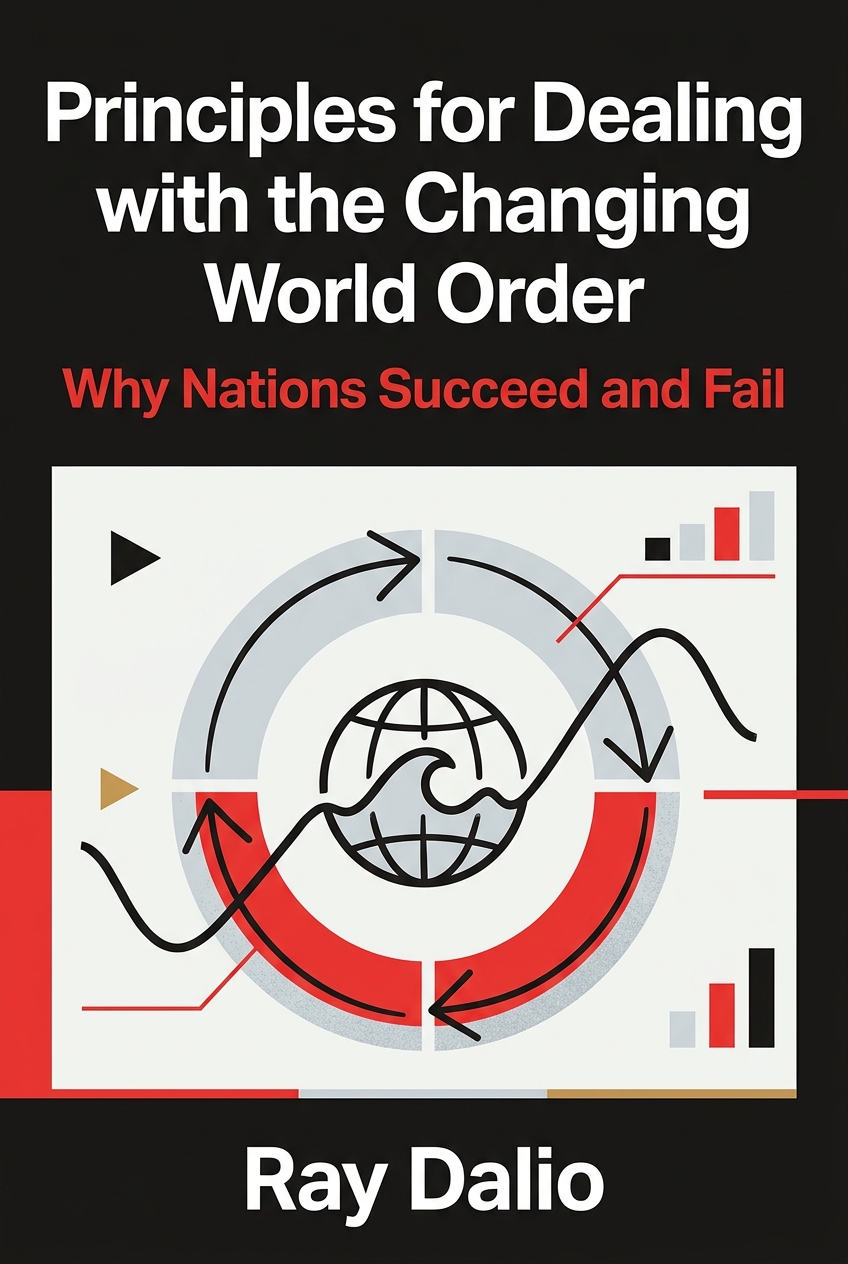
The economy rarely moves in a straight line; it expands and contracts in patterns known as economic cycles. For a grander perspective on this, Ray Dalio's Principles for Dealing with the Changing World Order offers a powerful historical lens. Dalio introduces his data-driven model of "The Big Cycle," which shows how nations and empires rise and fall over long periods.
Dalio argues that history rhymes, and by studying the long-term debt cycles, internal conflicts, and external challenges that have shaped empires of the past, we can better understand our present moment. He identifies three major forces driving these cycles: the massive buildup of debt, internal polarization within a country, and the rise of a competing external power. This framework helps place short-term events like a stock market dip or a political dispute into a much larger, more meaningful context.
The Three Pillars: Output, Money, and Expectations
For those new to the field, the sheer number of economic variables can be overwhelming. In A Concise Guide to Macroeconomics, Harvard Business School professor David A. Moss simplifies this complexity into three core pillars: Output, Money, and Expectations.
Output: This is what an economy can produce, fundamentally determined by its labor, capital, and technology. It represents the economy's supply side or its long-run potential.
Money: This is the tool that facilitates transactions. The central bank's management of money and interest rates heavily influences an economy's short-term path.
Expectations: Perhaps the most human element, our collective beliefs about the future can become self-fulfilling prophecies. If businesses expect a recession, they may cut investment and lay off workers, thereby causing the recession they feared. Conversely, optimistic expectations can fuel growth.
This framework is an excellent tool for analysis. When you read an economic headline, you can ask: Does this affect our ability to produce (Output), the cost and availability of credit (Money), or our collective confidence (Expectations)?
How to Start Building Your Macroeconomic Knowledge
Learning how to start macroeconomics is a journey of building mental models and then applying them to the world around you. It's less about memorizing statistics and more about developing a new way of seeing. The goal is to build a solid foundation of macroeconomics knowledge you can rely on.
Common Macroeconomics Mistakes to Avoid
As you begin, it’s helpful to be aware of common pitfalls that can lead to flawed conclusions. One of the biggest macroeconomics mistakes to avoid is judging a policy by its stated intentions rather than its actual results. In Basic Economics, Thomas Sowell powerfully argues that we must look at the incentives and consequences an economic policy creates. A policy intended to help may end up harming if it creates perverse incentives.
Another common error is confusing the short run with the long run. As Manzur Rashid highlights with his "two clocks" concept, the forces driving short-term economic fluctuations (like consumer spending) are different from those driving long-term growth (like productivity and innovation). A policy that provides a short-term boost might have negative long-term consequences, and vice-versa.
Practical Macroeconomics Tips for Everyday Life
Building your understanding is an ongoing process. Here are a few practical habits to cultivate:
Follow the Vital Signs: Make a habit of checking monthly reports on inflation, unemployment, and GDP. This keeps you attuned to the economy's pulse.
Read Broadly: Don't limit yourself to one news source. Read analyses from different perspectives to get a more complete picture and avoid confirmation bias.
Connect to Frameworks: When you hear about a major economic event, try to analyze it using the models you've learned. Is this a monetary or fiscal policy action? How does it relate to Dalio's Big Cycle or Moss's Three Pillars? This practice turns passive consumption of news into active learning.
By demystifying its core principles and learning from the frameworks in the best macroeconomics books, you can transform a complex subject into a practical and empowering tool. Understanding the big picture isn't just for experts—it's for anyone who wants to make better decisions and navigate our ever-changing world with greater confidence.
Master key ideas in 15 minutes
Listen to audio summaries of these books on VoxBrief
You can start learning macroeconomics with little money by leveraging free resources. Public libraries offer access to foundational books, and many reputable economic news outlets, university websites, and podcasts provide free, high-quality analysis and educational content.
Quite the opposite. The knowledge itself is not risky; it's a powerful tool for reducing risk in your personal and financial life. Understanding the broader economic environment helps you make more informed decisions about your career, savings, and investments, making it riskier to ignore.
The best macroeconomics strategy for beginners is to first focus on core concepts before diving into complex theories or market predictions. Start by understanding GDP, inflation, and unemployment. Exploring some of the best books on macroeconomics for beginners can provide a structured path to build your confidence and knowledge systematically.