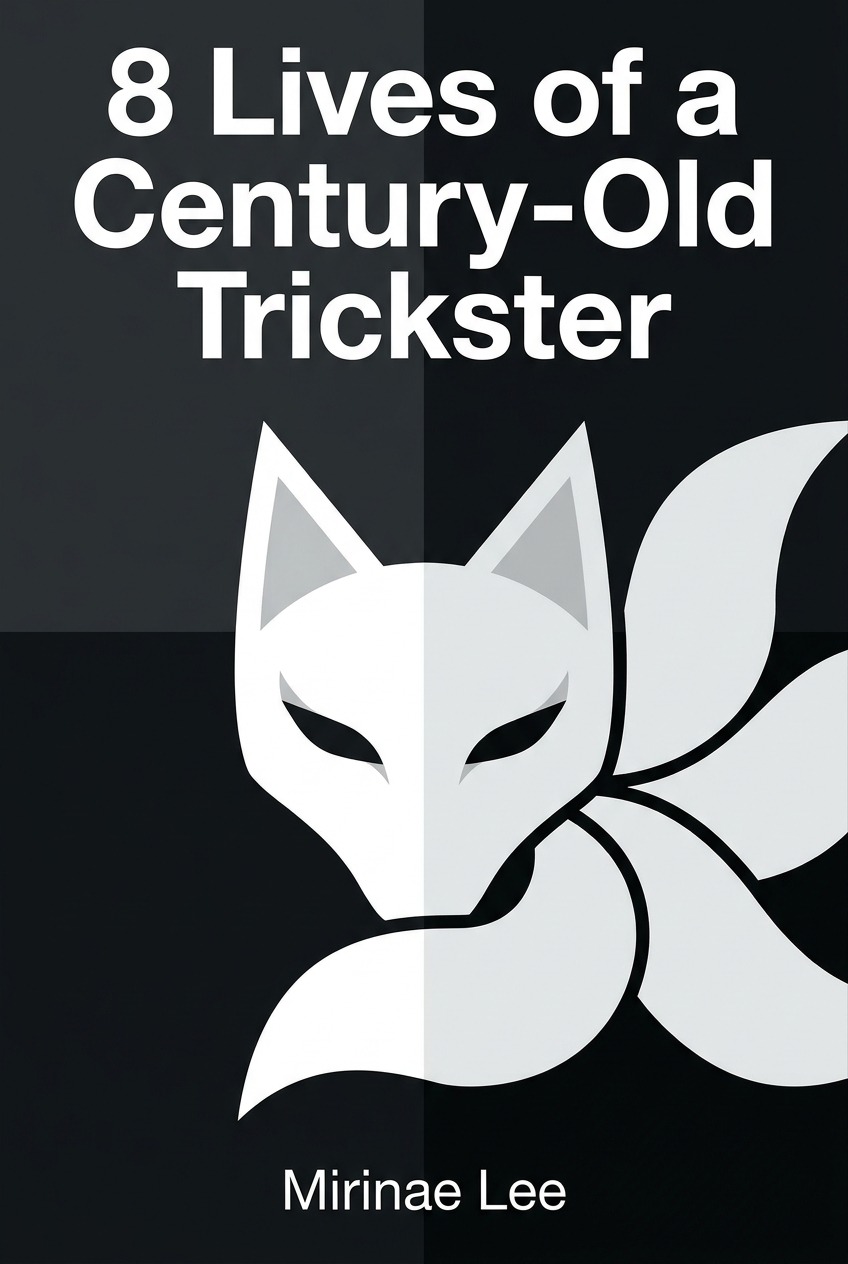
8 Lives of a Century-Old Trickster
Saroyan Prize Winner – A Gripping Korean Family Saga of Love, War, and Survival
What's it about
Ever wondered how ordinary people find the strength to survive extraordinary hardship? Discover the gripping story of a century-old trickster, a woman who navigates the brutal history of 20th-century Korea with cunning, resilience, and an unbreakable will to live, no matter the cost. You'll follow her through eight distinct lives—from a slave to a spy, a murderer to a mother. This award-winning family saga reveals the shocking choices and clever deceptions one woman used to protect her loved ones through war, poverty, and profound loss, offering a powerful lesson in survival.
Meet the author
Mirinae Lee is the acclaimed author of 8 Lives of a Century-Old Trickster, the winner of the prestigious William Saroyan International Prize for Writing. Inspired by her own great-aunt, one of the oldest women to escape North Korea, Lee weaves a breathtaking saga drawn from deep personal history and meticulous research. Her background as a former journalist and her unique family connection give her an unparalleled perspective on the Korean diaspora, resilience, and the enduring power of storytelling.
Opens the App Store to download Voxbrief

The Script
Think of an old family trunk, the kind lined with faded paper, smelling of cedar and time. Inside, two things tell the story of a life. The first is a set of eight immaculately preserved porcelain dolls, each dressed in the costume of a different era, their painted faces serene and unchanging. They represent the official story: the survivor, the mother, the refugee, the patriot. Each role is distinct, cataloged, and presented as a complete chapter. But underneath them, in a tangled heap, is the second thing: a collection of mismatched buttons, frayed ribbons, a single silk stocking with a run in it, a tarnished silver spoon, and a child’s tooth. These are the messy, contradictory artifacts of a life actually lived. They don’t fit the clean narrative of the dolls. The stocking suggests a story of vanity or desperation, the spoon hints at a stolen meal, the ribbons are remnants of moments too fleeting or private to be named. The dolls tell you what a person was. The pile of scraps makes you wonder who she was, and what she had to do to become each of those dolls.
This gap between the polished story and the messy truth is the space Mirinae Lee explores. Her own family history was filled with these two kinds of heirlooms. She grew up hearing the grand, heroic tales of her maternal grandmother’s survival through the tumultuous 20th century in Korea. But alongside these official stories, there were whispers, fragments, and silences—the emotional scraps that didn't quite fit the polished narrative of resilience. Lee, a writer and graduate of the MFA program at the University of Michigan, felt compelled to understand the woman behind the myth. She began a series of interviews with her grandmother, to dig into the contradictions and ask about the moments that had been edited out. 8 Lives of a Century-Old Trickster is the result of that excavation, a novel born from the attempt to reconcile the pristine dolls of family legend with the complicated, human truth found in the tangled artifacts of a long and difficult life.
Module 1: The Power of the Unreliable Narrator
The story begins in a nursing home. An obituary writer meets a century-old woman named Mook Miran. Ms. Mook resides in the Alzheimer's wing. But her mind is razor-sharp. She makes a stunning claim. She offers to tell the writer her life story. It is a story of eight distinct lives. This immediately sets up the core dynamic of the book. You must question every story you are told.
Ms. Mook begins to share her past. She claims to be a slave, an escape artist, a murderer, a spy, a lover, and a mother. The list is shocking. It's designed to be. She describes killing her abusive father with poison. She talks about assassinating soldiers during the war. She hints at a secret deal with South Korean intelligence. The writer, and by extension the reader, is forced to ask a simple question. Is any of this true?
Here's where the author's genius shines. She provides just enough conflicting evidence to keep you off-balance. The nursing home director reveals Ms. Mook has an inoperable brain tumor. This could explain her elaborate stories. It could be a symptom of her condition. Or, her stories might be the absolute truth. A person's identity is a performance, constructed for survival. Ms. Mook's performance is masterful. She tells her stories with such conviction. She shows no remorse for the violence she claims to have committed. She frames it all as necessary. As self-defense. As the only way to protect herself and others.
Ultimately, the book suggests that the literal truth is secondary to the legacy being handed down. Ms. Mook has written seven secret notebooks. She gives them to the writer, entrusting her with the full story. In the end, Ms. Mook orchestrates her own death. She disappears from the nursing home and is found in the woods, having ingested a poison she described in her stories. Her final act is a masterpiece of control. Embrace ambiguity; the most compelling truths live in the gray areas. The book leaves you with the notebooks. It leaves you with the legend of the trickster. And it asks you to decide what to believe.