All Books
Self-Growth
Business & Career
Health & Wellness
Society & Culture
Money & Finance
Relationships
Science & Tech
Fiction
Topics
Blog
Download on the App Store

At Dusk

Longlisted for the International Booker Prize 2019

13 minHwang Sok-yong

What's it about

Have you ever wondered if the life you built was worth the sacrifices you made? Get ready to explore the haunting cost of success and the ghosts of a past you can't escape. This is a story about confronting the choices that define you. Follow a successful architect as he returns to his impoverished childhood neighborhood, now a gentrified slum. You'll uncover a tangled web of memories, lost love, and the stark reality of modern inequality. Discover how a nation's rapid development can leave its most vulnerable people behind, and what it truly means to find your place in a world that has forgotten you.

Meet the author

Hwang Sok-yong is one of South Korea’s most renowned authors, a recipient of its highest literary honors, and a powerful voice for the marginalized. His own life of exile, imprisonment for pro-democracy activism, and tireless work for peace and reconciliation on the Korean peninsula deeply informs his writing. This rich, often turbulent, personal history provides the authentic foundation for his novels, including the Man Booker International-longlisted At Dusk, which masterfully explores themes of memory, regret, and the rapid pace of societal change.
Listen Now

Opens the App Store to download Voxbrief

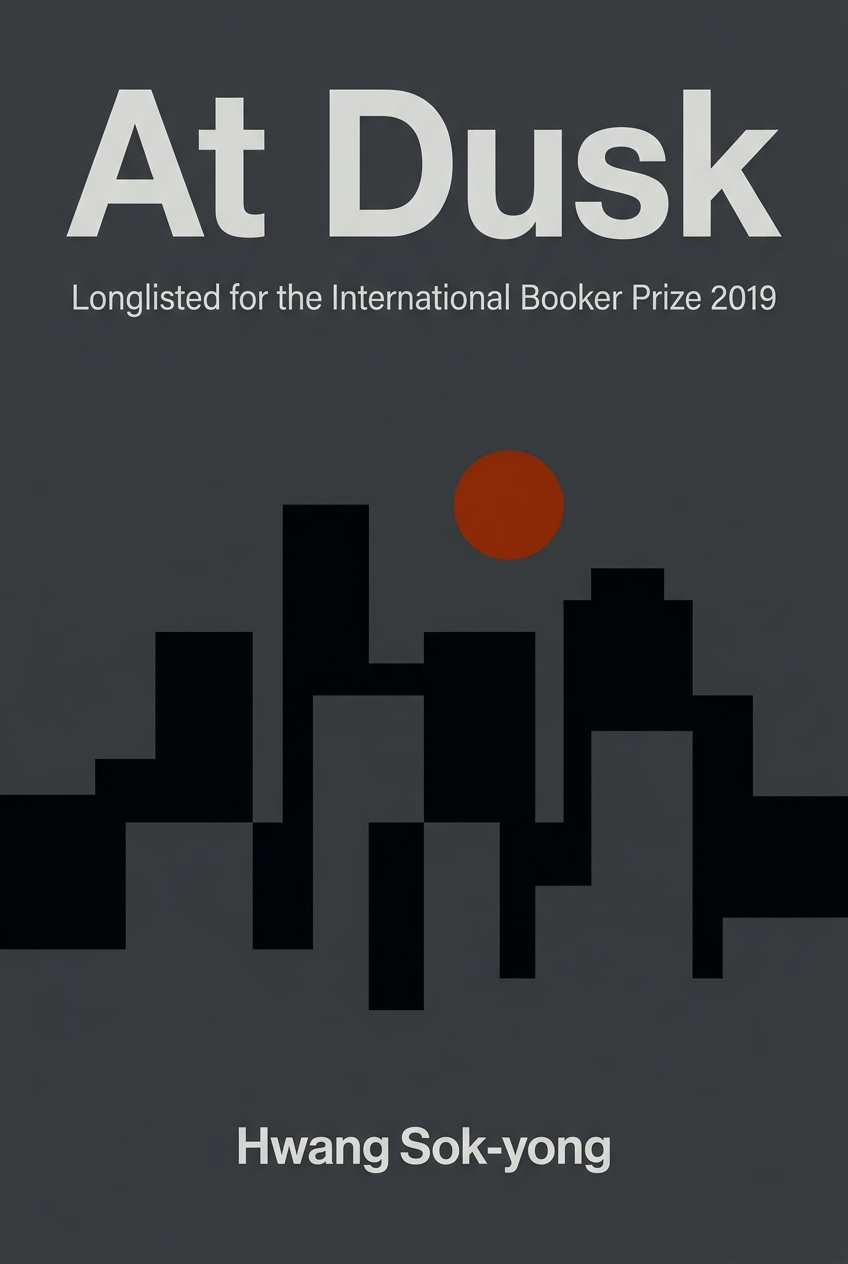
At Dusk book cover

The Script

A man sits in the corner of a fast-food restaurant, watching the evening crowd. He notices a young woman meticulously arranging her tray, placing her burger just so, aligning the fries, and centering the soda. She photographs her meal from several angles before taking a single, small bite. Then, she pushes the tray away, gathers her things, and leaves the nearly untouched food on the table. The man, a successful architect in his sixties, feels a strange, hollow echo of his own life in her actions. He has spent decades constructing a perfect public image—a life arranged just so, full of accolades and visible success. But as dusk settles outside, he is consumed by the feeling that he, too, has barely taken a bite, leaving the real substance of his life—a forgotten love, a buried friendship, a daughter he barely knows—to grow cold on the table.

This sense of a life meticulously curated but fundamentally unlived is the quiet engine of Hwang Sok-yong’s novel, At Dusk. Hwang, a monumental figure in Korean literature who has lived a life of political exile, imprisonment, and activism, often explores the vast gap between a society’s polished surface and its turbulent, hidden depths. He wrote At Dusk as a quiet, piercing meditation on the personal cost of Korea’s rapid, relentless modernization. Drawing from the bittersweet melancholy of his own generation, who built a prosperous nation only to find themselves strangers in the world they created, Hwang gives voice to the ghosts of choices not made and the faint, flickering hope of finding one’s way back to a life of genuine substance before the light fades completely.

Module 1: The Two Koreas of the Soul

The novel operates on two parallel tracks, telling two stories that are decades apart but thematically linked. It’s a powerful narrative choice that reveals a fundamental truth about modern life.

First, we meet Park Minwoo. He is a successful, aging architect in present-day Seoul. He lives alone, estranged from his wife and daughter. His life is a series of professional obligations and lonely evenings. His past is something he has deliberately buried.

Then, we meet Jung Woohee. She is a young, struggling playwright. She works a graveyard shift at a convenience store to support her art. She lives in a damp, semi-basement apartment, a world away from Park Minwoo’s high-rise life. Woohee represents the precarious reality for a generation chasing dreams in an unforgiving city.

Here’s the core idea. These two characters represent the two Koreas of the soul: the one that "made it" and the one left behind. Park Minwoo is the embodiment of the nation's economic miracle. He escaped poverty and built the gleaming towers of modern Seoul. Woohee represents the human cost of that miracle. She is part of the precariat, the generation struggling in the shadows of those towers. They are two sides of the same coin. One’s success is built on a system that creates the other’s struggle.

The story gets going when Woohee, through a series of tragic events, finds herself connected to Minwoo’s distant past. She begins to email him, pretending to be a woman he once knew from his childhood slum. This act of digital impersonation forces Minwoo to confront the memories he has spent a lifetime suppressing. The novel asks a sharp question: what do these two disparate lives have to say to each other?

And here’s the thing. The author suggests that these two worlds are not as separate as they seem. The past never disappears; it just goes underground. For Minwoo, his past returns through emails and memories. For Woohee, her struggle is a direct consequence of the development Minwoo championed. The slums he helped erase are the predecessors of the precarious housing she now endures. The book shows that you can't build a future by simply paving over the past. The ghosts will always find a way to speak.

Module 2: The Price of the Escape Ticket

Park Minwoo's story is a classic rags-to-riches tale. He grew up in Moon Hollow, a desperately poor hillside slum in 1960s Seoul. His family was displaced from the countryside and struggled to survive. Moon Hollow was a world of improvised livelihoods and street-level justice. Fights were settled with fists, not lawyers. Status was earned through toughness and community ties.

Minwoo’s ticket out was education. He was the "scholar" of the neighborhood. He studied relentlessly, determined to escape the slum. And he did. He won a place at a top university, tutored the children of the elite, and leveraged powerful mentors to build his career.

This brings us to a critical insight. Success is often an act of severing. To climb the ladder, Minwoo had to leave his world behind. He distanced himself from his family and his childhood friends. He adopted the "cool indifference" of the professional class. He learned to play the game, to echo the words of the powerful, and to hide his true thoughts. He admits he became one of them, a successful man who felt hollowed out.

So what happens next? The book forces us to confront the moral ambiguity of this journey. Minwoo’s friend, another architect dying of cancer, accuses him of having "sins" to consider. He says their work was about the "destruction of memory," not the "delicate restructuring of people’s lives." They bulldozed slums filled with real people and replaced them with concrete apartment blocks. They made their careers on the erasure of communities like Moon Hollow.

And it doesn't stop there. The systems that enable escape demand complicity. Minwoo’s success was tied to a corrupt construction industry. He knew about the bribes, the fake tenants, and the fraudulent loans. He was part of the "food chain" of urban development that enriched a few while displacing many. He rationalized it as the price of progress. But as he sits in his lonely apartment at dusk, the ghosts of those displaced communities return to haunt him. His escape came at a cost, not just to himself, but to the world he left behind.

Read More