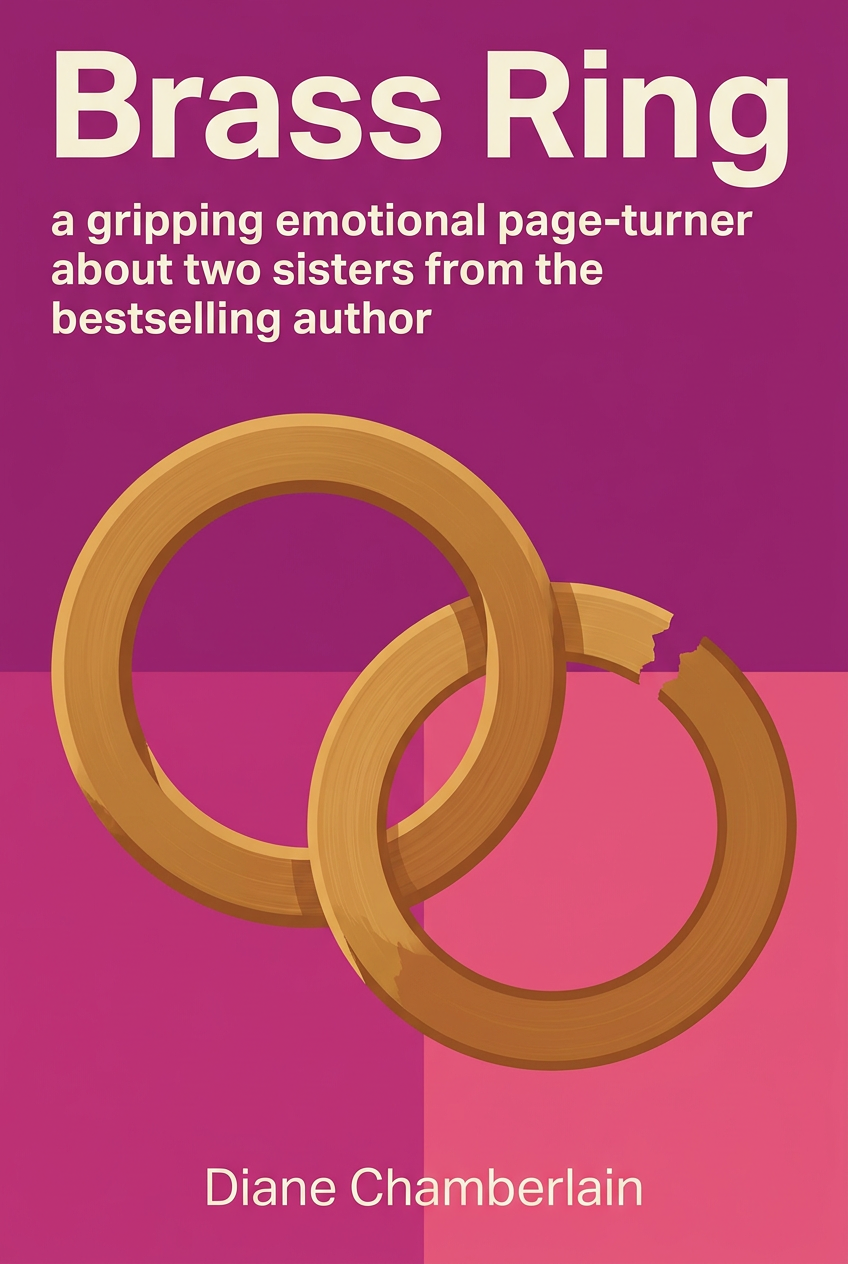
Brass Ring
a gripping emotional page-turner about two sisters from the bestselling author
What's it about
What would you sacrifice for a second chance at the life you've always dreamed of? For two sisters, this question becomes a heart-wrenching reality. Explore the devastating secret that has kept them apart for years, and the impossible choices they must now face. Discover how a single decision can ripple through a lifetime, shaping love, family, and forgiveness. You'll learn about the profound power of sisterhood and the high cost of chasing your ambitions. This gripping story will challenge you to consider what truly defines happiness and what you'd risk to reclaim it.
Meet the author
Diane Chamberlain is the New York Times, USA Today, and Sunday Times bestselling author of 28 novels published in more than twenty languages. A former social worker and psychotherapist, she brings a deep understanding of family dynamics and emotional struggles to her compelling, bestselling fiction. Her background working with adolescents and families provides the authentic, heartfelt core that has captivated readers worldwide and defines her gripping stories of love, loss, and resilience.
Opens the App Store to download Voxbrief

The Script
In a small town, there are two kinds of gravity. The first is the one that holds your feet to the familiar cracked pavement of Main Street. It’s the predictable rhythm of church bells and the high school's Friday night lights. The second kind of gravity is quieter, a personal pull that fixes on a single point in your past. For one person, it might be the worn-out bench by the river where a first love was declared; for another, the empty space on a mantelpiece where a trophy should have been. This second gravity can be stronger than the first, a force that keeps you orbiting a single moment, a single choice, a single what-if that defines the landscape of your entire life, no matter how far you travel from that town.
This invisible pull—the way a single past event can shape two entirely different futures—is a question that has long captivated author Diane Chamberlain. A former social worker and psychotherapist, Chamberlain spent years listening to the stories people tell about their lives, noticing the pivotal moments that sent them down one path instead of another. Her novel, "Brass Ring," was born from this fascination. It explores the lives of two people bound by a shared, devastating secret from their youth, examining how that one moment creates two vastly different trajectories, one spiraling toward success and the other into a quiet, desperate struggle. Chamberlain uses her deep understanding of human psychology to ask a powerful question: can you ever truly escape the gravity of the past, or does it always pull you back to where you started?
Module 1: The Illusion of Safety and the Compulsion to Act
We often build psychological walls to feel safe. We tell ourselves that lightning won't strike twice. That after one catastrophe, we've earned a lifetime of peace. This is the world Claire Harte-Mathias lives in. Her core belief is simple but powerful. Surviving one tragedy grants you immunity from another. She clings to this idea. Her husband, Jon, survived a horrific accident years ago. In her mind, that means their family has paid its dues. This belief makes her reckless. She insists on driving through a dangerous snowstorm, convinced they have "safe passage." Her logic is flawed, and it places them directly in the path of a new crisis.
This brings us to a second powerful human drive. It’s the compulsion to intervene when someone is in distress. When Claire sees a woman on the edge of a bridge, her instinct takes over. A deep-seated need to rescue others can compel you to take immense personal risks. Despite the blizzard and Jon's warnings, she gets out of the car. She approaches the woman. She tries to reason with her, to connect with her, to pull her back from the edge. It's a direct, personal, and dangerous attempt to save a stranger's life.
But here’s the thing. Intervention has its limits. The woman on the bridge is a person with her own will, her own story. You cannot save someone who is determined not to be saved. The woman’s response is calm and chilling. "Let go, or I'll take you with me." In that moment, Claire is forced to choose. She must choose her own life. She lets go. The woman jumps. This single event shatters Claire's illusion of safety. It sets her on a journey to understand not just what happened on the bridge, but the hidden fractures in her own life.
Module 2: The Ripple Effect of Trauma
We've explored how a single moment can shatter our sense of security. Now, let's look at what happens in the immediate aftermath. A traumatic event sends shockwaves through our minds and bodies. It can leave even the most composed person in a state of shock and disbelief. Claire is a crisis manager by nature. She has handled family accidents and deaths with composure. But this is different. Trauma creates a profound psychological and physical shock that overrides previous resilience. After witnessing the suicide, she can't stop shivering. Her teeth chatter uncontrollably. She becomes quiet and withdrawn, a ghost of her usually gregarious self. The event has burrowed deep, leaving a wound that platitudes and warm blankets cannot heal.
This is where intimate relationships are tested. Jon, her husband, sees her distress and immediately steps in. He draws on their shared history to pull her back from the brink. Personalized coping rituals and shared history are powerful tools for mitigating acute trauma. Jon doesn't just offer generic comfort. He tells her a specific, soothing story from her childhood. It’s a story about her grandfather’s carousel, a ritual they have used before to calm her fears. The familiar narrative works. It relaxes her body and quiets her mind. This shows how deep, long-standing bonds provide a foundation for navigating crisis. Their relationship was forged in the aftermath of Jon’s own trauma, and now that history serves as their anchor.
Consequently, the event forces a painful self-reflection. In the quiet of the hotel room, Claire’s composure breaks. Trauma can distort self-perception and lead to irrational guilt. She whispers to Jon, "I let her go." She believes she gave the woman "permission" to jump. This is the insidious nature of traumatic guilt. It twists our actions and makes us feel responsible for outcomes we couldn't control. While Jon tries to soothe her, he is also haunted. The image of the woman falling is "etched on the ceiling" of his mind. He, too, is a victim of the event, wrestling with a new and terrifying form of helplessness.