All Books
Self-Growth
Business & Career
Health & Wellness
Society & Culture
Money & Finance
Relationships
Science & Tech
Fiction
Topics
Blog
Download on the App Store

Breakfast of Champions

A Novel

13 minKurt Vonnegut

What's it about

Ever wonder if you’re just a machine, programmed to live out a life you didn't choose? This darkly comedic classic tackles that very question, exposing the absurdity of free will, societal norms, and the American Dream through a story that is as hilarious as it is profound. You’ll follow the converging paths of a wealthy but unstable car dealer on the brink of a mental breakdown and a struggling science fiction writer who believes his stories are reality. Discover how Vonnegut uses satire, simple drawings, and sharp wit to challenge everything you think you know about sanity, purpose, and what it truly means to be human.

Meet the author

Kurt Vonnegut is one of the most celebrated American writers of the 20th century, renowned for his satirical and darkly humorous novels that blend science fiction with social commentary. A former soldier and prisoner of war during the bombing of Dresden, Vonnegut's firsthand experience with human absurdity and tragedy profoundly shaped his distinct literary voice. His work, including the iconic Breakfast of Champions, challenges conventional thought and explores themes of free will, warfare, and the search for meaning with unflinching wit and compassion.
Listen Now

Opens the App Store to download Voxbrief

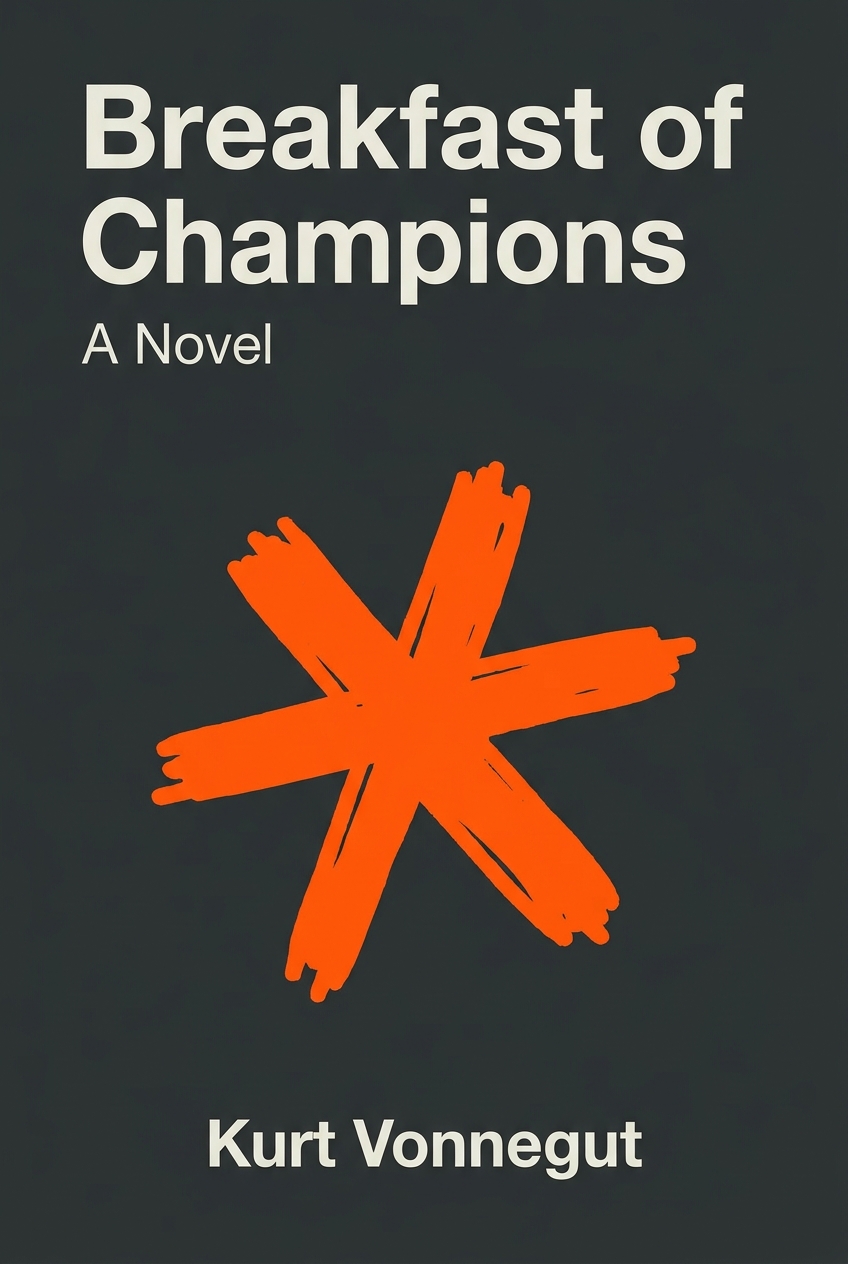
Breakfast of Champions book cover

The Script

We treat our sanity as a fortress, a high-walled castle to be defended at all costs. We build it with sturdy bricks of logic, predictable routines, and shared cultural agreements about what is real and what is not. Inside these walls, we feel safe. The world makes sense. But what if the very act of building this fortress is what imprisons us? What if the 'sanity' we so desperately protect is just a local dialect of reality, a story we've all agreed to tell, while a richer, more chaotic, and ultimately more truthful universe screams just outside the ramparts? This is a call to recognize that the most profound truths often sound like gibberish to the well-adjusted mind. The clearest view of the system sometimes requires standing so far outside of it that you appear to be completely mad.

This exact tension—between the comforting fictions of a stable society and the terrifying, hilarious chaos of actual existence—is the territory Kurt Vonnegut spent his life exploring. After returning from the horrors of World War II and the firebombing of Dresden, and after years of struggling as a writer, he decided to perform a kind of artistic demolition on his own work. He felt his previous characters and stories were becoming too predictable, too much a part of the sane fortress he no longer trusted. For 'Breakfast of Champions,' he intentionally unleashed all his recurring characters, including himself, into a single story to 'set them free.' It was his attempt to clear out the accumulated fictions of his own mind, to see what was left when an author admits his creations—and the world they inhabit—are just pictures, scribbles on a page designed to keep the madness at bay.

Module 1: The World as a Machine

The book's most jarring idea is its relentless depiction of humanity as a collection of biological machines. Vonnegut strips away our sense of specialness. He presents us as complex but ultimately programmed entities. It's a clinical, almost anatomical breakdown of human behavior. The narrator describes people as "loving machines, hating machines, greedy machines." He argues that we are all doomed to collide with each other based on our internal wiring. This perspective challenges our most fundamental beliefs about agency and choice.

One of the most powerful examples is Dwayne Hoover. He's a wealthy Pontiac dealer in Midland City. His descent into madness is portrayed as a chemical one. The book states his insanity is "mainly a matter of chemicals." This idea extends to everyone. The narrator reflects on his own mother, whose brain was "wrecked" by sleep chemicals. He even mentions his own use of pills for depression. This framing suggests our personalities and actions are the output of microscopic chemical levels. Your sanity is a fragile chemical balance, not a matter of willpower.

This mechanical view is everywhere. The narrator recalls men from his childhood with locomotor ataxia. This condition, caused by syphilis, ate away at their nervous systems. He describes them as malfunctioning machines with compromised "wires." Their struggle to move was a mechanical breakdown. The book even satirizes our attempts to find meaning in this clockwork universe. In one of Kilgore Trout’s stories, an alien tries to warn humanity about its self-destructive path. He communicates through farts and tap-dancing. The humans, unable to comprehend this bizarre message, immediately kill him. This absurd tragedy reinforces the idea that communication between differently programmed machines is often impossible. The ultimate takeaway is a difficult one. To navigate the world, you must first accept that much of human behavior is automatic and beyond rational control.

Read More