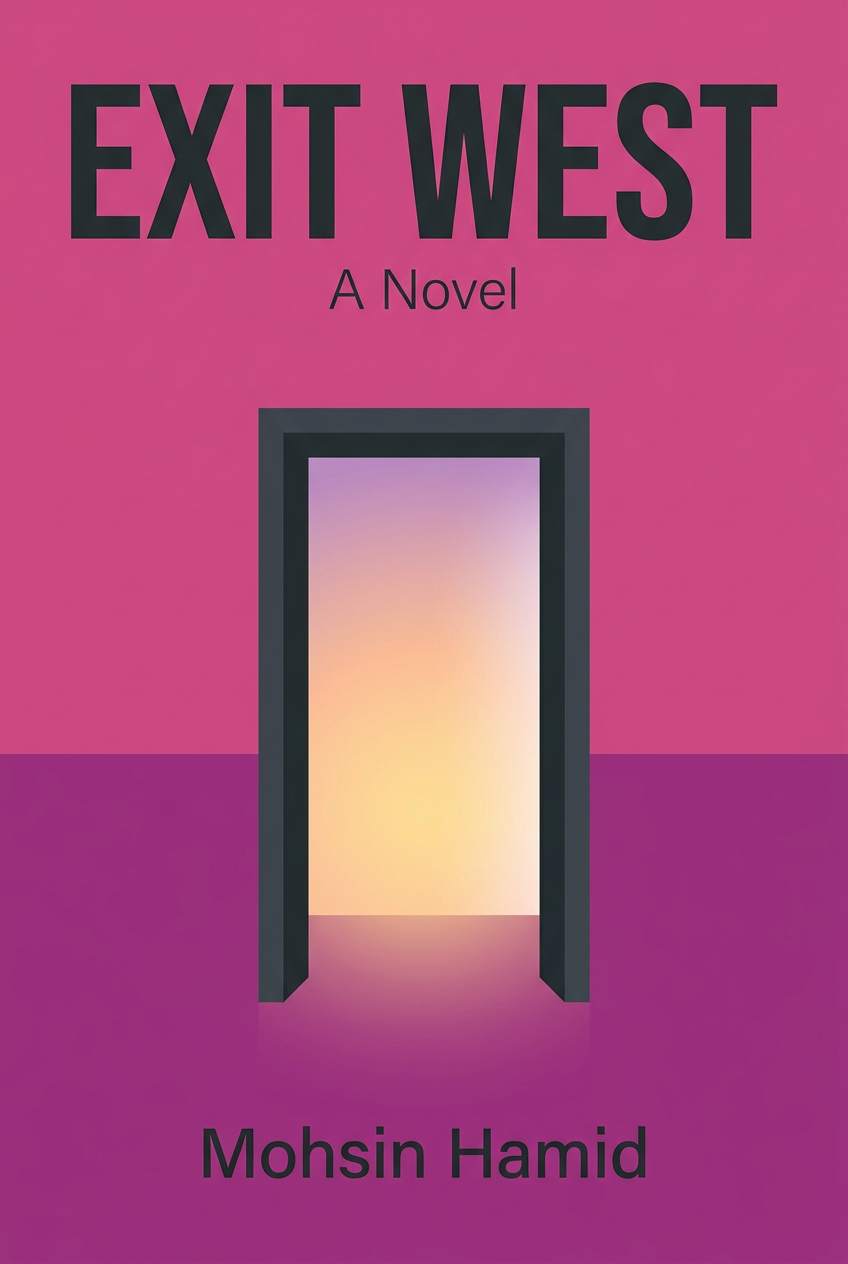
Exit West
A Novel
What's it about
Have you ever wondered what it would be like to leave everything behind for a chance at a new life? This summary explores the profound journey of two young lovers, Nadia and Saeed, who escape their war-torn city through mysterious, magical doors that open to uncertain futures across the globe. You'll discover how their relationship is tested by the trials of migration, the loss of home, and the challenge of rebuilding their identities in unfamiliar lands. Uncover the emotional and psychological toll of being a refugee and gain a powerful, humanizing perspective on one of today's most urgent global crises.
Meet the author
Mohsin Hamid is a critically acclaimed, Man Booker Prize-shortlisted author whose work often explores migration, identity, and globalization in the modern world. Having lived in Pakistan, the United States, and the United Kingdom, his own transnational experiences deeply inform the powerful, inventive, and empathetic narratives for which he is celebrated. Hamid’s writing gives a human face to the complex forces shaping our time, making him one of his generation's most essential literary voices.
Opens the App Store to download Voxbrief

The Script
In an old city, a man and a woman meet in an evening class. Their first date is coffee and a meal in a small restaurant. They text each other, their messages forming a private, shimmering architecture only they can inhabit. Soon, they fall in love. But outside the quiet glow of their phones, the city is changing. Checkpoints sprout overnight like concrete weeds. The rumble of distant violence becomes the city’s new background music. The familiar world they knew is being erased, street by street, and the simple act of getting from one place to another becomes a life-or-death calculation. Their love story, which should have been a simple, sunlit path, is now trapped inside a closing labyrinth.
As the world outside becomes impossible, rumors begin to circulate—whispers of strange, dark doors. They don’t lead to other rooms or other streets, but to other places entirely. Far away places. These doors are a physical escape, a glitch in the fabric of reality. For the young couple, the choice is no longer about which neighborhood to live in, but whether to step through a terrifying, uncertain portal, leaving everything and everyone behind for the chance to simply continue being together. It's a choice between a familiar world that will kill them and an unknown one that might save them.
This magical, yet deeply resonant, premise comes from a writer who has spent his life crossing borders. Mohsin Hamid, a Pakistani author who has lived in Lahore, London, and New York, felt the world shifting beneath his feet. After 9/11, he experienced the hardening of borders firsthand, the simple act of air travel becoming a fraught, suspicious process. He saw how easily a person’s identity could be flattened and rewritten by the anxieties of a nation. Hamid wrote “Exit West” to explore a fundamental human question: if you strip away the borders and the politics, what does it mean to be a migrant in a world where, one way or another, we are all migrating?
Module 1: The Mundane Amidst the Collapse
We often think of crisis as a single, dramatic event. A bomb blast. A declaration of war. But Hamid shows us something different. He reveals that as a city descends into chaos, everyday life persists with a stubborn, precious mundanity.
This brings us to the first core idea. Normal life continues until the very moment it can’t. Saeed and Nadia meet in an evening class on "corporate identity and product branding." This is happening while their city is already experiencing shootings and bombings. It seems strange. But as the narrator notes, "that is the way of things." Saeed still goes to his job at an ad agency. He still lives with his parents, sipping tea on the balcony. These small rituals of normalcy are a defense mechanism. They are how we cope. They are how we hold on to our sense of self when the world outside is falling apart.
But here's the thing. This persistence of the mundane also highlights our vulnerability. Safety and physical security are illusions, easily shattered. The narrator reflects on how quickly life can change: "for one moment we are pottering about our errands as usual and the next we are dying." The balcony that offers a pleasant view in peacetime becomes a terrifying vulnerability in war, "like staring down the barrel of a rifle." This is a reminder that our security is always contingent, always more fragile than we believe.
So what happens when that security shatters? This is where the story truly begins. As the infrastructure of their city collapses—no internet, no electricity, no reliable food—Saeed and Nadia are forced to make a choice. The rumors of magical doors, once a distant fantasy, become their only hope. This leads to a crucial insight. Forced migration is a sudden, violent rupture. The doors in the book are a metaphor for this. One moment, you are in your home. The next, you are spat out, bruised and disoriented, onto a foreign shore. There is no transition. There is only before and after. Nadia experiences the passage as "both like dying and like being born," a violent extinguishing and a gasping struggle. This captures the profound trauma of being uprooted. It is an amputation.
Module 2: The Refugee Camp and the New Reality
We've explored how the crisis begins. Next up: what happens after the escape? Saeed and Nadia step through a door and find themselves on the Greek island of Mykonos. They are now refugees.
The camp they find is a microcosm of a new, displaced world. It’s a chaotic, vibrant, and dangerous place. This is where we see the next key principle. In displacement, new, fragile communities form out of shared necessity. The camp is a "cacophony that was the languages of the world." Everyone is foreign, so no one is. People from their home city quickly find each other, sharing information about which doors are open and which are traps. A makeshift economy springs up. You can buy a phone charger, a blanket, or antibiotics. It’s a "trading post in an old-time gold rush." This ad-hoc society is messy, but it’s a society nonetheless. It’s humanity reorganizing itself on the fly.
However, this new reality puts immense pressure on old relationships. Sustained stress erodes even the strongest personal bonds. Saeed and Nadia survived a war. But the stress of the camp begins to change them. Saeed, once hopeful, becomes bitter. He gets angry when Nadia tries to kiss him under the open sky. She had never seen this side of him. Later, in London, they occupy a luxurious house with other migrants. The constant tension and uncertainty create a cycle of "unkindness" between them. They sleep "like a couple that was long and unhappily married." The love that was their anchor in the war is now being corroded by the peace. Their journey together is pulling them apart.
And it doesn't stop there. The book shows how even in these desperate situations, people seek connection. Small acts of humanity persist and provide surprising hope. In Mykonos, a teenage volunteer gently tends to a festering wound on Nadia’s arm. The girl holds the wound "as though it was something precious." This small act of kindness, from a stranger, ultimately leads them to another door, another chance. In a world of chaos, these moments of connection are functional lifelines. They are lifelines. This theme repeats in London, where a supportive crowd of migrants banging pots and pans forces armed police to back down. And in Amsterdam, where an elderly native and a Brazilian migrant form a deep, silent friendship that transcends language. These small connections are the glue holding this fractured world together.