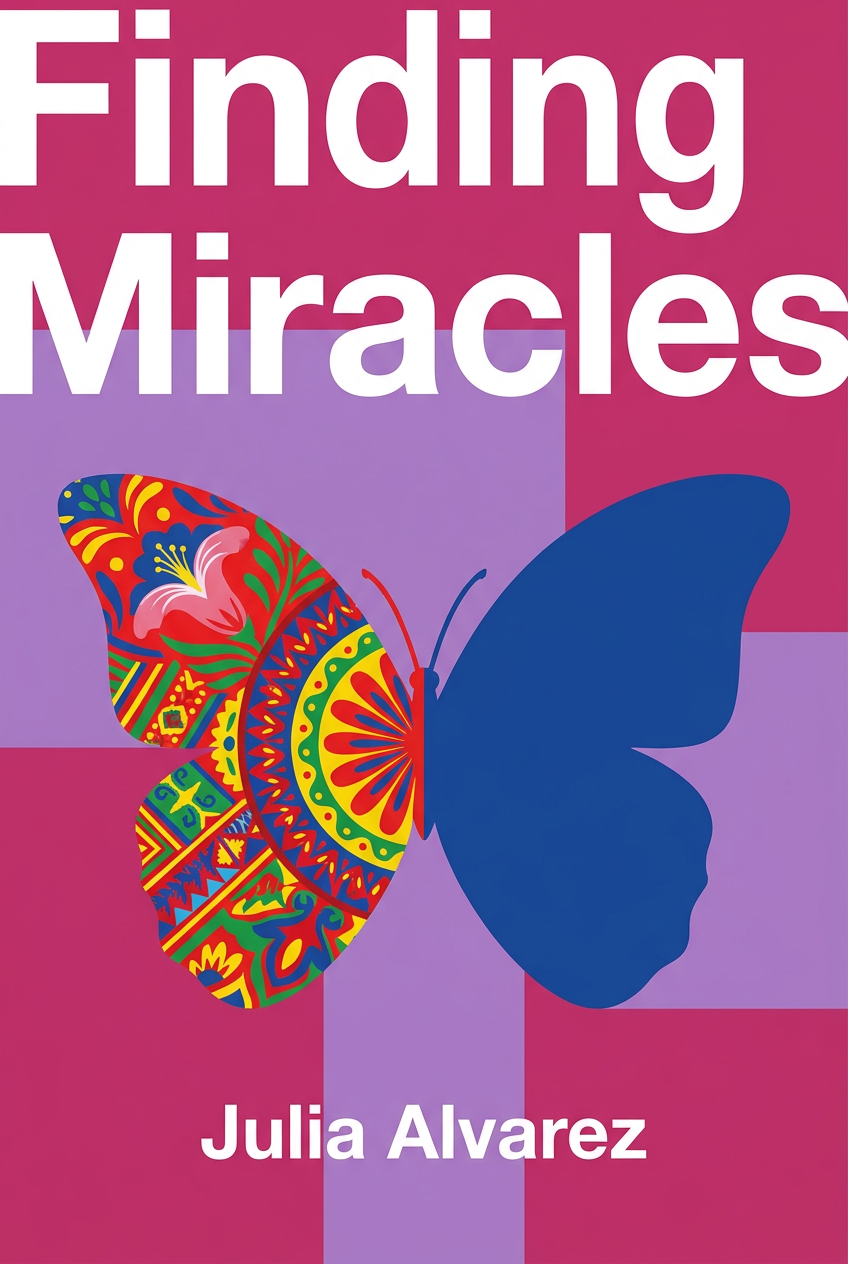
Finding Miracles
What's it about
Have you ever felt like you don't truly belong? Imagine being uprooted from everything you know and thrust into a new world where you must rediscover your identity from scratch. This summary explores the profound journey of finding your place when your past is a mystery. You'll follow Milly, a young girl adopted from an unnamed Latin American country, as she navigates life in the United States. Uncover the emotional challenges of cultural assimilation, the ache for a connection to her roots, and the shocking family secret that changes everything. This is a story about identity, family, and finding the miracles in your own history.
Meet the author
Julia Alvarez is an award-winning Dominican-American poet and novelist whose acclaimed works, including the National Book Critics Circle Award finalist In the Time of the Butterflies, explore themes of identity and cultural duality. Born in New York City but raised in the Dominican Republic until her family fled a dictatorship, Alvarez's own experiences with displacement and assimilation deeply inform her stories. Her writing gives a powerful voice to the challenges and triumphs of navigating two worlds, a central theme in Finding Miracles.
Opens the App Store to download Voxbrief

The Script
Think of a name, your name. For most, it feels like a piece of clothing worn since birth, so familiar you forget you’re even wearing it. But for some, a name is a borrowed coat, handed down by strangers. It might be beautiful, warm, and practical, but it never feels entirely your own. You can feel the shape of the original owner in the shoulders, smell a faint, unfamiliar scent in the lining. You wear it through your life, and everyone recognizes you in it, but in quiet moments, you run your fingers over the seams and wonder about the person it was made for. This borrowed coat is a constant, subtle reminder that your story began before you were in it, in a place you can’t remember, with a name you don’t know.
This feeling of living between two stories—the one you’re given and the one you’ve lost—is the emotional heart of Julia Alvarez's novel, Finding Miracles. Alvarez, a celebrated Dominican-American author known for her rich explorations of identity and family, didn't set out to write about adoption. The story found her, arriving in the form of a real-life question from a friend’s adopted daughter who was navigating her own dual heritage. The girl’s search for belonging, for a way to connect the loving home she knew with the unknown homeland of her birth, resonated deeply with Alvarez's own lifelong experience of being a cultural bridge. She channeled that profound curiosity into the character of Milly, a girl who must piece together the miracle of who she is from the fragments of two very different worlds.
Module 1: The Allergy to Yourself
We meet Milly, a teenage girl living a seemingly normal life in Vermont. She has a loving family, good friends, and a crush. But Milly has a secret. She is adopted from an unnamed Latin American country, and this fact is a source of deep, unspoken anxiety. This internal turmoil manifests physically. When confronted with your hidden past, your body will often keep the score. Milly develops an itchy, red rash on her hands whenever her origins are brought up. She calls it being "allergic to myself." The rash flares when a new student, Pablo, arrives from her birth country. It worsens when he speaks to her in Spanish. It's an involuntary physical signal of a deep internal conflict. Her father treats the rash with calamine lotion, but this only soothes the surface. It does nothing for the "itchiness inside."
This leads to a powerful coping mechanism: denial. Milly actively avoids anything that reminds her of her past. To protect a fragile identity, you may build walls of denial and avoidance. She pretends not to understand Spanish when Pablo speaks to her. She dodges her friends when they try to talk about him. She wants desperately to "pass as 100 percent American." The alternative feels too dangerous. It means confronting the "Box" in her parents' bedroom. A mahogany box from the orphanage containing the few clues to her past. For Milly, the box is "The Box," a container for all the fear, sadness, and uncertainty she keeps locked away.
This avoidance strategy, however, comes at a cost. It isolates her. She feels like a "borderliner" at school, not quite in the popular group, but not a total outcast either. Her friends, Em and Jake, exist in this same social periphery. They are acutely aware of the high school social landscape, where the popular kids claim the booths in the cafeteria, and the "borderliners" sit at the long tables. This reinforces Milly's feeling of being an outsider, even among her own friends. The drive to assimilate can create a profound sense of social and emotional isolation. Her struggle is about the universal teenage fear of being different. But for Milly, the stakes feel impossibly high.
Module 2: The Command Performance
Now, let's turn to the family dynamics that shape Milly's world. Her family is loving, but communication about her adoption is indirect and often awkward. Her mother is a therapist who tries to create "quality time" to connect. Her father is a man of action, showing his love by building things and providing practical support. But the elephant in the room—Milly's origin story—is rarely addressed head-on. This dynamic is thrown into sharp relief with the arrival of her grandmother, "Happy."
Happy is the wealthy, controlling matriarch of the family. Her visits are "command performances." Everyone must play their part to win her approval. Unspoken family expectations create a performance-based environment where authenticity is suppressed. Mom cooks an elaborate meal. The kids are on their best behavior. The family's financial dependence on Happy's "handouts" gives her immense power. She subtly criticizes everyone—Dad for leaving the family business, Kate's hair, Nate's schooling. Her approval is conditional, and the entire family feels the pressure.
This pressure cooker environment forces a painful confrontation with reality. Milly, desperate for a sense of belonging, overhears a devastating conversation. Her parents are arguing about Happy's will. Happy plans to leave Milly only a "stipend," not an equal share like her biological grandchildren. In that moment, the subtext becomes text. The unspoken difference is now quantified in legal and financial terms. A single overheard truth can shatter years of carefully constructed denial. The floor gives way. Milly realizes, "everything had changed." There is "no place to run away to anymore." The "other me"—the adopted child she kept secret even from herself—is now staring her in the face.
The fallout is immediate and heartbreaking. Her parents rush to comfort her, insisting, "It's not about you... We love you." But their words can't erase the institutional message of the will. And here's the thing. This is the catalyst Milly needs. The pain of this exclusion is so absolute that it breaks the spell of her avoidance. Confronting a painful truth, while devastating, is the necessary first step toward genuine self-discovery. The illusion of "passing" is shattered. The only path forward is to finally face the contents of The Box.