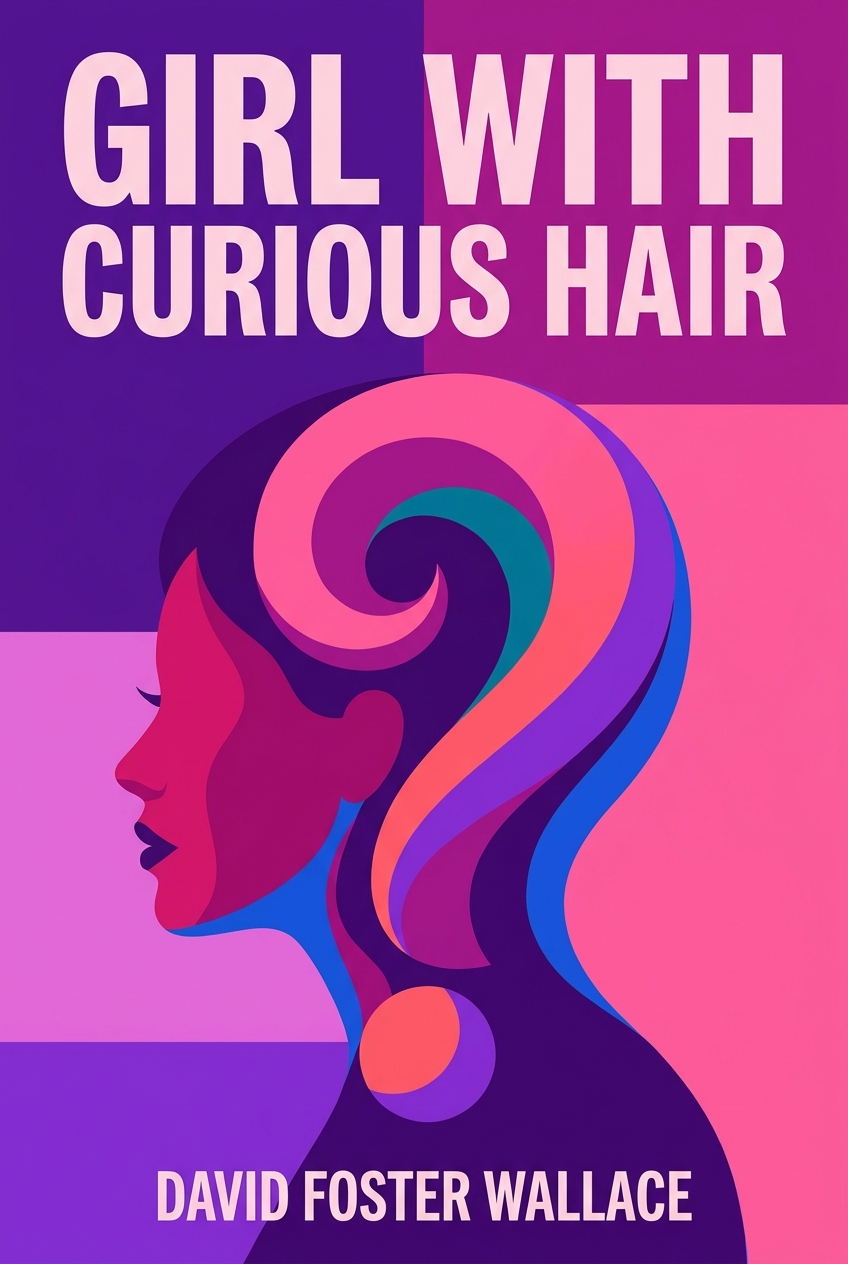
Girl With Curious Hair
What's it about
Ever feel like you're just a character in someone else's bizarre TV show? Discover how to navigate the absurdity of modern American life, a world saturated by media, celebrity, and corporate jargon, and find what's real underneath all the noise. This collection of stories pulls back the curtain on our strange obsessions. You'll explore the dark side of game show ambition, the twisted logic of political operatives, and the unsettling reality of pop culture. It's a hilarious and disturbing look at what happens when entertainment becomes our reality.
Meet the author
Regarded as one of the most influential and innovative writers of his generation, David Foster Wallace was a MacArthur "Genius" Fellow and a finalist for the Pulitzer Prize. His early work, including the stories in Girl With Curious Hair, showcases the prodigious intellect and deep empathy that defined his career. Wallace relentlessly explored the complexities of modern American life, using his signature blend of linguistic acrobatics and philosophical depth to challenge how we see ourselves and the world around us.
Opens the App Store to download Voxbrief

The Script
We tend to think of amusement as a harmless diversion, a pleasant way to recharge. But what if entertainment is an active force that consumes us? What if the televised spectacle, the game show, the celebrity profile, is actively hollowing out our culture, replacing genuine human connection with a bizarre, high-stakes performance of it? This creates a strange paradox: the more we are entertained, the more vacant we feel. Our attention becomes a commodity, our emotions a script, and our real lives start to feel like a pale imitation of the vibrant, grotesque pageant playing out on the screen. We become fluent performers in a world that has forgotten what is real, mistaking the echo for the voice.
This landscape of distorted reality and frantic performance was the primary obsession of David Foster Wallace. He saw the strange, often unsettling, consequences of a culture saturated by media, where sincerity felt like a trap and irony was the only safe ground. "Girl With Curious Hair," his first collection of short stories and a novella, was his initial, explosive attempt to capture this phenomenon. Written in the late 1980s, as he was emerging as a powerful new voice in American literature, these stories are diagnostic tools. Wallace uses them to dissect the bizarre logic of talk shows, the desperate ambitions of young Republicans, and the unsettling voids at the heart of American life, all in an effort to find what, if anything, remains authentic in a world of endless simulation.
Module 1: The Performance of Identity
The characters in these stories are constantly building, managing, and performing their identities. It's a full-time job. Wallace suggests that in a media-saturated world, authenticity is about mastering the art of the performance.
First, to survive in a mediated world, you must become a self-aware performer. In the story "My Appearance," a woman is about to appear on David Letterman's late-night show. Her husband coaches her relentlessly. The cardinal sin, he says, is sincerity. You can't be earnest. You can't seem like you take yourself seriously. Letterman's entire show is built on irony. It mocks the very idea of celebrity interviews. The only way to win is to beat him to the punch. You have to savage yourself before he can. You must perform a self-aware, ironic version of yourself that shows you're in on the joke. The woman nails the performance. She's a hit. But afterward, she insists to her husband, "I wasn't acting... I was just the way I am." The line between her 'real' self and the performance has completely dissolved.
Next, we construct elaborate, often false, narratives to justify our identities to others. In "Little Expressionless Animals," two women, Julie and Faye, are in a relationship. Faye worries about how to explain their life to others. Julie's solution is telling. She suggests they invent dramatic, traumatic stories about abusive ex-boyfriends. These stories would serve as a neat, understandable "reason" for their lesbianism. Wallace is showing us something crucial here. Identity is the story you tell about who you are. And often, that story is crafted for an audience. It's a performance designed to make your identity legible and acceptable to the outside world.
Finally, you must realize that this performance extends to our most intimate relationships, where love becomes a negotiation of masks. Julie, the "JEOPARDY!" champion, has a theory. She believes love is about trying "to get your fingers through the holes in the lover’s mask." It's a striking image. It suggests that we never truly see the person we love. We only interact with their persona, their carefully constructed public face. And the best we can hope for is a moment of connection through the gaps in that performance. This is a bleak view of intimacy. But for Wallace, it’s a realistic one in a world where everyone is always on stage.