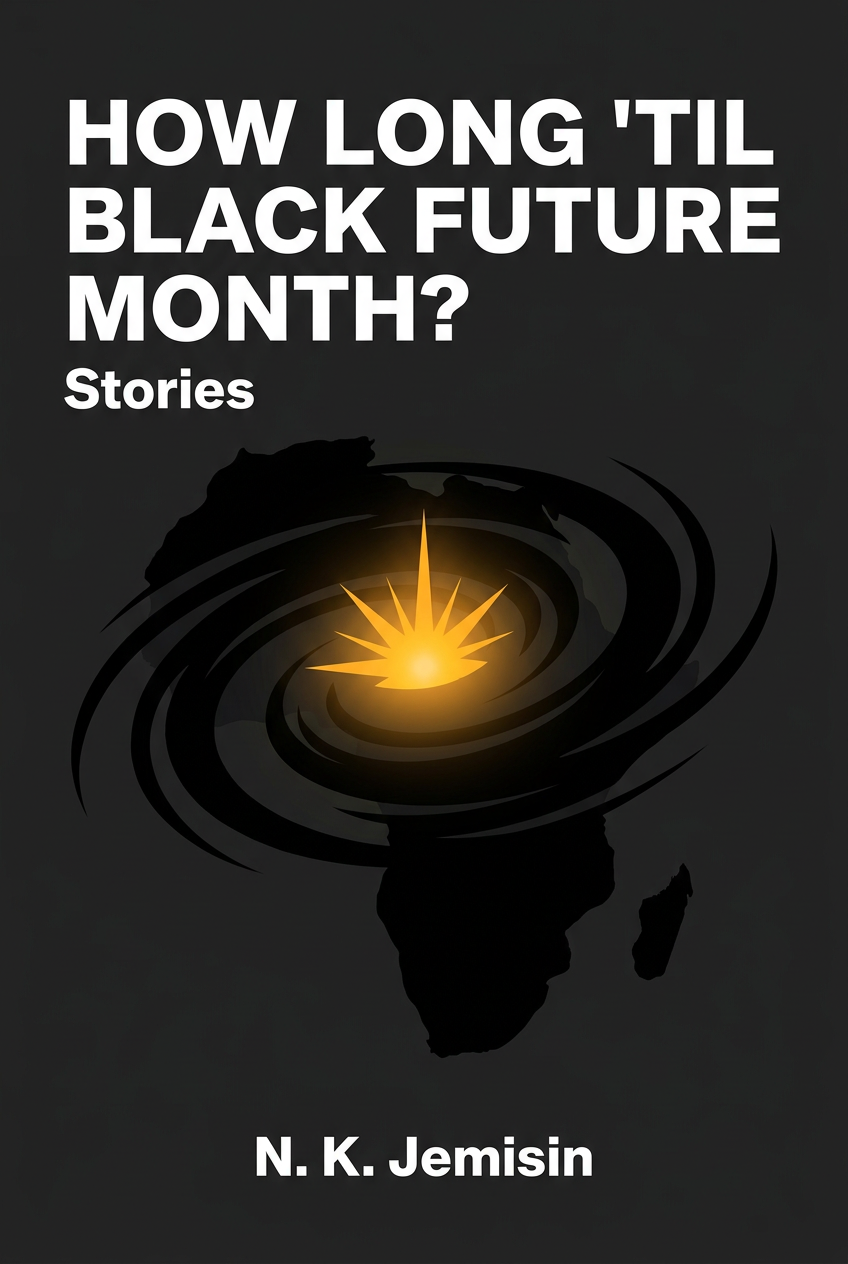
How Long 'til Black Future Month?
Stories
What's it about
Ever wonder what a world built on justice and equality could truly look like? Imagine vibrant futures and magical realities where Black voices are at the center of the story, shaping destinies and challenging the status quo. This collection gives you a glimpse into those possibilities. You'll explore breathtaking worlds crafted by a master of speculative fiction. From a city brought to life by its citizens' dreams to a chef who can taste memories, you'll discover how fantasy and sci-fi can be powerful tools for social commentary and imagining a better tomorrow.
Meet the author
N. K. Jemisin is the first author in history to win the Hugo Award for Best Novel for three consecutive years for her Broken Earth trilogy. A psychologist by training, her background in counseling and her experiences as a Black woman in America inform her speculative fiction, which explores themes of power, oppression, and cultural conflict. How Long 'til Black Future Month? collects these powerful, world-building stories, showcasing the depth and imagination that have made her a modern master of the genre.
Opens the App Store to download Voxbrief

The Script
We treat the future like a distant shoreline we're sailing toward, a fixed destination on a predictable map. We draw detailed charts of utopia and dystopia, plotting our course based on present-day fears and desires. But this entire premise is flawed. The future is a weather system we create. Every story we tell, every hero we invent, every assumption we fail to question acts as a change in atmospheric pressure, subtly altering the storm fronts and trade winds of what is to come. The most potent act of creation is seeding the clouds.
This act of 'seeding the clouds'—of creating new weather patterns for the imagination—is the life's work of N. K. Jemisin. Over a decade, she crafted dozens of fantastical worlds as laboratories for the human condition. Each story in this collection, from a dragon in a climate-changed New Orleans to spirits haunting a segregated South, was an experiment in bending the arc of the possible. Jemisin, a multi-Hugo Award-winning author, gathered these powerful narrative experiments into one volume to offer a catalog of alternate futures, demonstrating that the most effective way to change tomorrow is to radically redefine the stories we tell ourselves today.
Module 1: Worlds as Systems of Power and Resistance
Many of Jemisin's stories explore how societies are built, maintained, and challenged. They are living systems with rules, power dynamics, and breaking points. This module examines how she uses world-building to critique and reimagine social structures.
A core idea is that utopia is a continuous act of maintenance. In "The Ones Who Stay and Fight," Jemisin presents Um-Helat, a city of "steady joy." This is a society that actively works to correct its own imbalances. For instance, citizens notice a slight demographic skew in certain neighborhoods and take deliberate action to fix it. They understand that a just society requires constant, intentional effort. This vigilance extends to ideological threats. The city employs "social workers" to protect its collective happiness by containing "contagions" of hatred and inequality imported from other realities, like our own. This story directly challenges the idea that societies can be passively tolerant. To survive, a tolerant society must be intolerant of intolerance.
This brings us to a darker, more confrontational concept. Oppressive systems often commodify human life to sustain themselves. In "Walking Awake," we encounter a parasitic ruling class called the Masters. They inhabit human bodies, which are grown in "anthroproduction facilities." Children are raised like livestock, groomed for the moment a Master will take over their consciousness. The system is sustained by a carefully constructed mythology. Caregivers teach the children that the Masters are benevolent saviors who came from the sky. The truth, however, is far more sinister: the Masters were created in labs by humans. This story is a powerful allegory for how exploitation is often masked by benevolent narratives. The protagonist, Sadie, is a caregiver trapped in this system. Her journey of discovering the truth and fighting back reveals that true liberation requires dismantling the entire parasitic structure, even at a terrible cost.
But what happens when the system isn't an external force, but an internal one? In a conformist society, excellence becomes a form of rebellion. The story "Valedictorian" introduces a society living behind a Firewall, terrified of an "enemy" outside. To appease this enemy, the society sacrifices a tribute of its children each year: the 10% with the lowest test scores, and the single student with the highest. The protagonist, Zinhle, is the valedictorian. Her relentless pursuit of excellence makes her a target. Her society pressures her to be mediocre, to blend in, to survive. But Zinhle refuses. She challenges her teachers, corrects their errors, and continues to excel. Her academic achievement is an act of defiance against a system that demands conformity. Jemisin uses this world to explore a profound question: What is the cost of being your authentic self in a world that fears it?
Ultimately, these stories suggest that building a new world starts with an act of defiant imagination. In "The City Born Great," New York City is on the verge of being "born" as a living, sentient entity. Its midwife is a young, homeless, queer Black man—someone utterly marginalized by the city's human systems. He is the one chosen to protect it from an ancient, predatory Enemy that seeks to devour cities at their birth. As he fights, he uses the city itself as his weapon. He hip-checks the monster with the Brooklyn-Queens Expressway. He backhands it with Inwood Park. He claims the city as his own through a deep, fierce love. This story powerfully argues that those who are pushed to the margins often have the clearest view of a system's true nature and the greatest strength to protect it.
Module 2: The Alchemy of Art and Identity
Jemisin repeatedly explores the idea of creation, whether it’s a story, a meal, or a city. For her, the act of making is a transformative process that shapes both the creator and the world around them. This module focuses on how craft, identity, and magic intersect.
A recurring theme is that true artistry transcends conventional rules and materials. In "Cuisine des Mémoires," a chef named Franca has fallen from grace, cooking at a dead-end inn. A mysterious stranger challenges her to cook a meal from a bizarre recipe with impossible ingredients like "frava root." The resulting "frava cakes" smell like turpentine and taste foul, but they have a magical effect: they reverse aging. The stranger, an alchemist, seeks Franca's help because his own methods are crude. He needs her artistry, her understanding of subtlety and balance, to refine his ancient craft. This story beautifully illustrates that mastery is about having the integrity and curiosity to work with the unknown, transforming base materials into something magical.
So what happens next? Jemisin suggests that marginalized identity can be a source of profound strength and resilience. "Red Dirt Witch" is set in the Jim Crow South and blends African American folk magic with the harsh realities of systemic racism. The protagonist, Emmaline, uses traditional magic—rosemary, sage, and sycamore fig—to protect her family from a predatory fey creature called the White Lady. This creature is a clear metaphor for white supremacy, which seeks to steal the power and future of Black children. Emmaline's magic is rooted in her heritage, a tool of survival adapted from African traditions. Her daughter, Pauline, later channels this legacy into activism during the Civil Rights Movement. The story shows how cultural identity and ancestral knowledge are living, powerful tools for resistance and creating a better future.
And here's the thing: that creative power can be a double-edged sword. In "The Effluent Engine," we are in a steampunk version of 19th-century New Orleans. Jessaline, a spy from a free Haiti, is on a mission to acquire an engineering plan that will help her nation maintain its sovereignty. She seeks out Norbert Rillieux, a brilliant Creole inventor. However, his genius has been repeatedly stolen by white engineers. The true innovator, she discovers, is his sister, Eugenie, whose intellect is stifled because Parisian schools "do not admit women." The story is a thrilling dance of espionage, science, and romance. But at its core, it’s about the theft of intellectual property and the suppression of genius based on race and gender. The ultimate prize is Eugenie herself, who chooses to leave her life of confinement for a future in Haiti where her mind can be free.
This leads to a fascinating insight: sometimes, the most powerful act is to let go of a creation. Jemisin wrote many of these stories as a "proof of concept" for novels. In her notes, she reveals that "The Trojan Girl" was one such experiment. The story introduces a digital world called the Amorph, where sentient programs evolve and fight for survival. The main character, Meroe, is a digital entity who learns about empathy and dreaming from a mysterious, advanced "girl" program. The story set up a fascinating world, but Jemisin decided not to expand it into a novel. Instead, she concluded its narrative in the companion piece, "Valedictorian." This shows a crucial part of the creative process: knowing when a story has reached its perfect form and having the discipline to let it be. A brilliant idea's power sometimes lies in its conciseness.