All Books
Self-Growth
Business & Career
Health & Wellness
Society & Culture
Money & Finance
Relationships
Science & Tech
Fiction
Topics
Blog
Download on the App Store

Kabu Kabu

15 minNnedi Okorafor, Whoopi Goldberg

What's it about

Ever wondered what happens when African magic, futuristic technology, and everyday life collide? Prepare to be transported by a collection of stories that blend myth with science fiction, revealing a world where juju-powered shape-shifters walk among us, sentient robots explore the Nigerian desert, and magical "kabu kabu" taxis can take you anywhere you can imagine. This isn't just fantasy; it's a vibrant tapestry of what could be. You'll discover tales of powerful women, ancient spirits in modern settings, and the rich, complex soul of Nigeria. Through these twenty-one unique stories, you'll gain a fresh perspective on storytelling itself, witnessing how tradition and the future can merge into something entirely new, thrilling, and unforgettable.

Meet the author

Nnedi Okorafor is a multiple award-winning, international bestselling author of Africanfuturism and Africanjujuism for children and adults. Her Nigerian heritage deeply informs her writing, weaving Igbo cosmology and folklore into fantastical, futuristic, and magical realist narratives. Okorafor’s unique perspective, born from her experiences as a Nigerian-American, allows her to blend ancient traditions with speculative fiction, creating the vibrant and imaginative worlds found within Kabu Kabu.
Listen Now

Opens the App Store to download Voxbrief

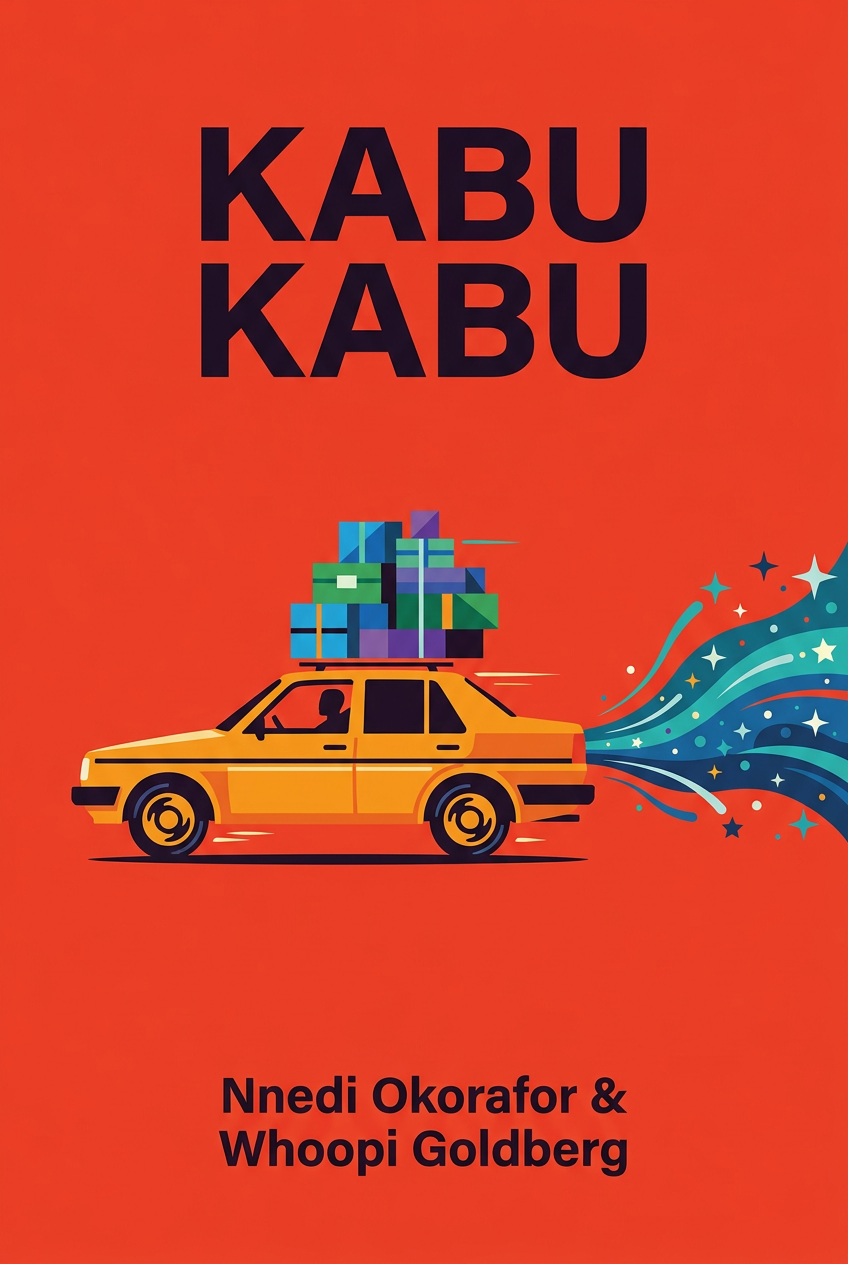
Kabu Kabu book cover

The Script

You flag down an old, dented Peugeot on a busy Lagos streetcorner, desperate to get to the airport. The driver quotes you a price and you haggle, the familiar city dance. You throw your luggage in the back and slide onto the cracked vinyl seat. The car smells of engine oil, old sweat, and something else… something like burnt sugar and ozone. The driver, a woman with eyes that seem to see more than just the traffic ahead, pulls into the endless stream of cars. But instead of fighting through the gridlock, she turns down a narrow alleyway, then another, the walls of the city blurring past. Suddenly, the rumbling engine smooths into a silent hum. The rattling of the chassis ceases. You feel a lurch not forward, but up. Looking out the window, the horns and shouts of the street market are fading below as the rooftops of Lagos shrink into a patchwork quilt. This is a kabu kabu—an illegal, unregistered cab—but it's also something more. It's a vehicle powered by juju, a vessel of pure, chaotic possibility that operates on a logic entirely separate from the paved roads and traffic laws of the world you thought you knew.

This is the world Nnedi Okorafor invites us into. She grew up between two realities: the United States and Nigeria. For her, magic wasn't confined to dusty old storybooks from another continent; it was woven into the fabric of everyday Nigerian life, existing alongside technology, tradition, and the bustling energy of a modern metropolis. Frustrated by a science fiction and fantasy landscape that rarely reflected this vibrant, complex reality—a world where juju could power a taxi and ancient spirits could haunt the internet—she decided to write the stories she was hungry to read. Kabu Kabu became her vessel, a collection of tales born from that feeling of straddling two worlds, blending Nigerian myth with futuristic speculation. It’s a literary road trip where the destination is always surprising, and the journey itself warps the very definition of reality.

Module 1: Hacking the Code of Storytelling

Okorafor doesn't just write within existing genres; she actively interrogates and subverts their rules. She takes familiar tropes, especially those rooted in prejudice, and turns them on their head. Her work is about fundamentally rewriting the source code of the stories we tell.

A prime example is her direct confrontation with a tired, offensive character type. Okorafor deconstructs the "Magical Negro" trope by giving the character agency and a voice. In the story aptly titled "The Magical Negro," the character rejects his assigned role. He is supposed to offer cryptic wisdom to the white hero, Lance the Brave, and then die sacrificially. Instead, he survives a mortal wound, looks directly at the reader, and declares the entire premise "stupidness." He then uses his power not to help the hero, but to summarily end the hero’s quest and walk away, finally free to pursue his own life. This act of narrative rebellion is a powerful statement. It declares that characters of color will no longer be mere plot devices in someone else's story.

Building on that idea, the collection asserts that marginalized characters have their own lives and priorities. Characters from marginalized backgrounds refuse to be instruments for another's journey. In that same story, the Magical Negro questions why he should sacrifice himself, exclaiming, "Like I ain't got no family of my own to risk my life fo' and shit!" This simple line is revolutionary. It gives him a backstory, a family, and personal stakes completely independent of the protagonist. He is a full person, not a tool. This theme echoes throughout the book, as characters consistently prioritize their own survival, community, and destiny over the expectations of outsiders.

And here's the thing. Okorafor also uses her fiction to expose the subtle biases embedded in traditional fantasy. The stories critique how "otherness" is often linked to corruption or evil in Western genres. In "The Magical Negro," the hero Lance internally questions if the character's dark skin and full lips are a result of him having "internalized the evil of the shadows." This exposes the racist underpinnings of many fantasy worlds, where physical features associated with people of African descent are coded as monstrous or corrupt. By making these biases explicit, Okorafor forces the reader to confront the uncomfortable legacy of the genre itself. It’s a brilliant move that challenges us to be more critical consumers of the stories we love.

This approach brings us to the most important point of this module. Okorafor’s work is an act of invitation, making speculative fiction accessible to a wider audience. In her foreword, Whoopi Goldberg reflects on this. She notes that for a long time, science fiction and fantasy "didn't feel inviting." Authors like Okorafor changed that. By centering stories in modern or future Africa and grounding magic in indigenous beliefs, she dismantles the colonial-era stereotypes that have long dominated portrayals of the continent. She creates worlds where people who look and live like her are the heroes at the center of their own epic adventures. This makes the genre feel like home for readers who have long felt like outsiders.

So, we've seen how Okorafor rewrites the rules. Next, we'll see how she blends the magical and the mundane in the story that gives this collection its name.

Module 2: The Supernatural in Everyday Transit

The title story, "Kabu Kabu," is a masterclass in blending the gritty reality of urban life with the surreal logic of folklore. It follows Ngozi, a Nigerian-American woman trying to get to the airport in Chicago for a flight to Nigeria. What begins as a stressful morning turns into a metaphysical journey, blurring the lines between the seen and the unseen.

The story immediately establishes a core theme of the collection. The supernatural is a hidden, functional layer of everyday life. Ngozi hails what she thinks is a normal taxi, but it's a kabu kabu—an unlicensed, supernatural vehicle. The interior is lined with glass beads, a living plant grows from the dashboard, and its doors only open for the driver. This is simply another way of getting around Chicago. The cab picks up other fares, including a masquerade spirit that enters as a mist and a blood-soaked man known only as "the Butcher." The driver treats them like any other passengers, remarking, "Chicago’s a big place... you pick up all kinds of immigrants." This casual acceptance frames the supernatural as just another part of the diverse, chaotic urban ecosystem.

This journey also serves as a powerful exploration of identity. The story highlights the tension between a diaspora identity and the expectations of one's cultural roots. When Ngozi tells the driver her identity—"I’m Igbo, Nigerian, and American"—he immediately corrects her: "Igbo first." He criticizes her dreadlocks and her inability to speak the Igbo language, calling her "incomplete." This interaction perfectly captures the pressure often felt by those in the diaspora. They navigate a complex identity, only to be judged by gatekeepers from their own culture for not being "authentic" enough. Ngozi's internal conflict about her sister's traditional wedding further illustrates this push and pull between obligation and personal freedom.

But flip the coin. While the supernatural elements are wild, the story remains grounded in the raw, chaotic energy of city life. The cab ride itself is a metaphor for the unpredictable and resilient nature of the immigrant experience. Ngozi’s morning is a mess of small disasters—oversleeping, stained clothes, a broken nail. Her desperation to find a cab mirrors the daily struggle for control in a hectic environment. The driver’s "lunatic" driving style, weaving through traffic with aggressive skill, is a survival tactic. Ngozi even thinks to herself, "Oh my God, I feel like I’m in Nigeria already," directly linking the chaos of Chicago traffic to the energy of her homeland. This suggests that the skills needed to navigate one are transferable to the other.

Throughout this wild ride, there's a constant, grounding presence. Music serves as a cultural anchor, connecting characters to their heritage and driving the story's rhythm. The driver plays Fela Kuti, the legendary Nigerian rebel musician. The music functions as a character in itself. It lulls Ngozi into reminiscence, provides a soundtrack to the appearance of a spirit, and fills the silences in their surreal journey. It’s a thread of cultural continuity that ties the mundane world of Chicago to the spiritual highways of Nigeria, proving that no matter how far you travel, some parts of home travel with you.

We've explored how stories can be hacked and how magic can hide in plain sight. Now let's examine what happens when that magic turns dark and dangerous.

Read More