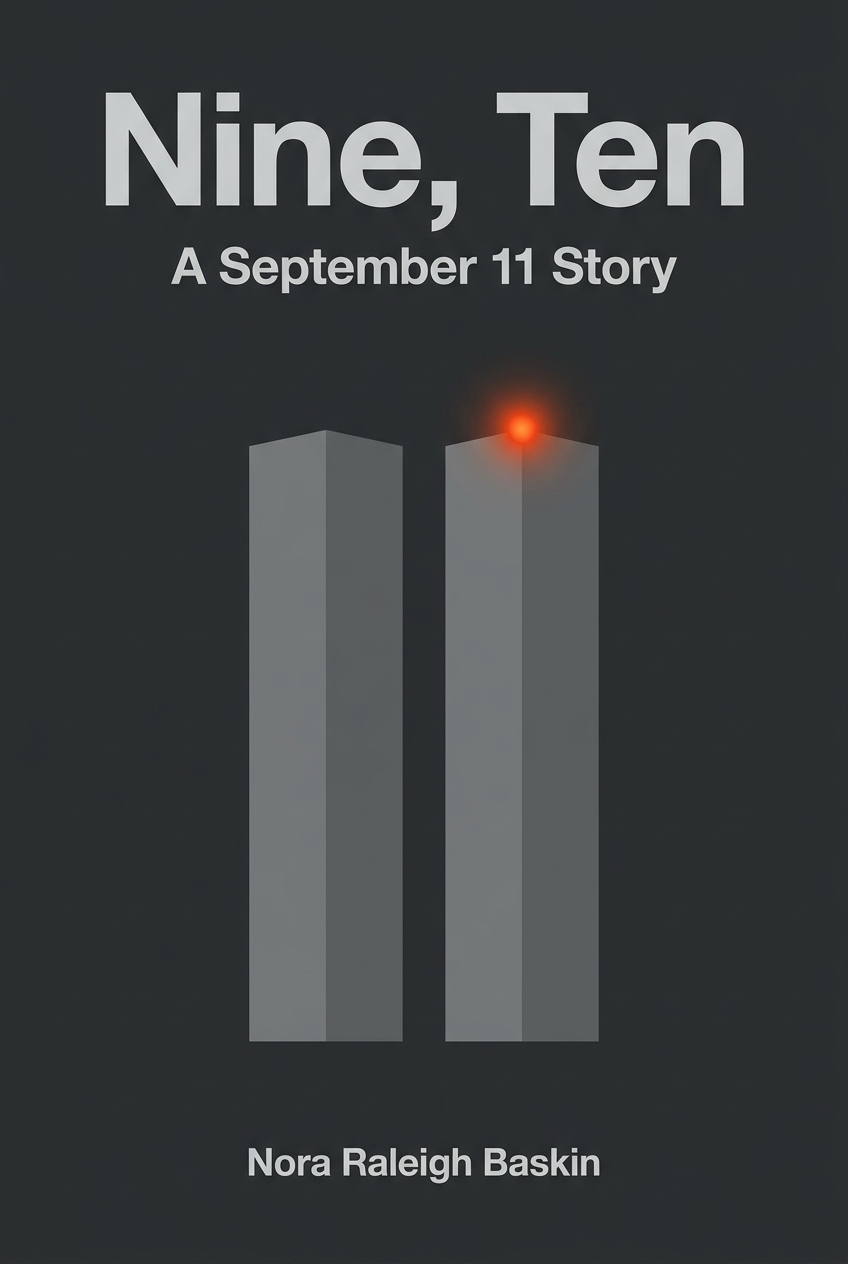
Nine, Ten
A September 11 Story
What's it about
How do you explain a world-changing event to a new generation? This moving story explores the lives of four middle-schoolers in the days just before September 11, 2001, showing how their individual struggles and hopes were unknowingly connected moments before history was forever altered. You'll follow Sergio, Naheed, Will, and Aimee as they navigate family, friendship, and identity in different parts of America. Discover how their seemingly separate paths cross in a powerful and unforgettable way, offering a unique and deeply human perspective on the day that changed everything.
Meet the author
Nora Raleigh Baskin is a National Book Award Finalist and the ALA Schneider Family Book Award-winning author of more than twenty novels for young readers. Living in Connecticut on September 11, 2001, she experienced the day's profound impact on her community and family firsthand. This personal connection, combined with her deep empathy for the inner lives of children, allowed her to explore the event's complex emotions and far-reaching consequences through the interwoven stories of young people in Nine, Ten.
Opens the App Store to download Voxbrief

The Script
Four different jigsaw puzzles lie on four different tables in four different homes. The first puzzle, made in a Chicago apartment, is a picture of a city skyline, but the pieces are all shades of blue and gray, hard to distinguish. The second, in a Pennsylvania town, depicts a sprawling green farm, but the box is missing and the final image is a mystery. The third, assembled on a California floor, is a vibrant, chaotic street scene, but a crucial corner piece is gone, leaving a frustrating gap. The fourth, in a New York City bedroom, is a simple map of the United States, but the pieces don't quite fit together, their edges warped by humidity.
Each person building their puzzle is completely absorbed in their own small world of shape and color, unaware of the others. They don't know that the puzzles are fragments of a single, much larger image, and a moment is coming that will slam them all together, forcing the disparate pictures to become one. The jagged edges won't fit perfectly—they will grind and break against each other—but they will be irrevocably connected, part of a new, shared, and fractured whole.
That feeling of separate lives about to collide was the driving force for author Nora Raleigh Baskin. She was a mother of two young sons on September 11, 2001, and as they grew, she realized they had no personal memory of that day. For them, it was just a story in a history book, a distant event. She wanted to write a book that captured the feeling of the before—the ordinary, individual lives being lived in the days leading up to the tragedy. Baskin, a seasoned writer for young adults who often explores the inner lives of children, crafted "Nine, Ten" as a book about the moment just before the world changed, connecting four kids who had no idea they were already part of the same story.
Module 1: The Ordinary World on the Edge of Tomorrow
The story begins on September 10, 2001. We meet four kids scattered across the country. Each one is navigating the complex, often messy world of early adolescence. Their problems feel enormous. They consume their entire reality. The narrative masterfully weaves these individual stories together, showing us that private struggles define our reality until a public crisis makes them small.
Take Aimee, for instance. She just moved from Chicago to Los Angeles. Her mom took a big banking job. Aimee is terrified her parents are getting a divorce. She feels lost and invisible at her new school. The kids there seem like "miniature grown-ups." Her own clothes feel childish. Her world has shrunk to a single, burning anxiety: keeping her family together.
Then there's Will, who lives in Shanksville, Pennsylvania. His world has already been shattered. His father died a year earlier in a roadside accident. Everyone calls his dad a hero. But Will just feels angry and abandoned. He’s lost interest in video games, in his friends, in everything that used to bring him joy. He’s wrestling with a grief that feels isolating and permanent.
Meanwhile, in Brooklyn, Sergio is a bright kid who just won a math award. But his home life is a storm. His father is unreliable and manipulative. His grandmother is fiercely protective but full of anger. Sergio feels caught in the middle. After a painful encounter with his father, he decides to skip school. He just needs to escape the pressure. He needs to breathe.
Finally, in Columbus, Ohio, we meet Naheed. She is a young Muslim girl. She wears a hijab, a headscarf that is part of her identity. But in middle school, it makes her a target. She’s navigating the confusing social hierarchies of sixth grade. She just wants to fit in. She wishes she could just be "Naheed," not "Naheed the Muslim girl."
These four lives are separate. They are filled with the normal, painful, and beautiful struggles of growing up. But Baskin uses dramatic irony to create a constant, humming tension. The reader knows what’s coming. The characters do not. This leads to the second key insight: our most personal moments are often set against a backdrop of history we can't see. When Aimee’s mom mentions her meeting the next morning at the World Trade Center, it’s a throwaway line for Aimee. For the reader, it’s a gut punch. When Will plays with his friends in a field in Shanksville, it’s just an empty field. The reader knows it will soon be the crash site of Flight 93.
So, as we see them navigate their lives, a powerful theme emerges. Individual identity is a constant negotiation between who we are and how the world sees us. Sergio is just a boy who loves math. But to strangers, he’s a "black kid" who might be trouble. Naheed is a girl trying to make friends. But to her classmates, her hijab is a curiosity or a target. Their internal worlds are rich and complex. The external world, however, often reduces them to a single label. This tension is at the heart of their journey, even before the world changes. The book reminds us that on any given day, millions of private dramas are unfolding, each one feeling like the most important story in the world. Until, suddenly, it isn't.
Module 2: The Cracks in the System
The world of "Nine, Ten" is not a perfect place, even before the attacks. The characters are already dealing with systems that feel broken or unfair. Baskin shows how these small-scale failures of trust and connection create deep wounds. This exploration reveals a crucial idea: mistrust in authority is often learned through personal experience.
Sergio’s story is a powerful example. While skipping school, he jumps a subway turnstile. A man in uniform stops him. Sergio’s body tenses. His mind floods with a learned script for survival. "You didn’t run. You had to cooperate. You had to give in." He remembers his cousin being humiliated by police. He thinks about how the world has "never served nor protected him." His fear is palpable. It is rooted in a history of negative encounters between his community and law enforcement.
But here’s the twist. The man is a firefighter named Gideon. This encounter introduces a counterpoint. Authority exercised with compassion can rebuild trust and inspire hope. Gideon doesn't want to punish Sergio. He’s just a guy who wonders why a kid isn't in school. Later, they meet again on a stalled train. A man is bleeding. Gideon takes charge. He is calm, competent, and kind. He doesn't just give orders; he enlists Sergio’s help. "Give me your T-shirt," he says. Then, "Come and help me."
In that moment, Sergio is transformed. He’s no longer a truant kid feeling powerless. He’s part of a team. He helps save a life. Gideon's authority is about service. For Sergio, it cracks a door open "to a hallway he had never seen before." It shows him a different kind of manhood, a different way of being in the world. It’s a powerful reminder that while systems can fail, individual human connection can offer a path forward.
This theme extends to the classroom. Naheed feels the social system of middle school is a brutal racetrack. You are either a winner or a loser. When boys tease her about her hijab, she feels cornered. To deflect the attention, she joins in on teasing another girl, Eliza. She instantly feels terrible. Her action reveals another hard truth: social pressure can lead good people to make painful moral compromises. Naheed didn't want to hurt Eliza. She just wanted the spotlight off of her. She wanted to survive. The guilt eats at her. She knows she did wrong. Her story shows how the desperate need to belong can override our better judgment.
The book doesn't offer easy answers. It just shows the complex reality these kids face. Their worlds are filled with flawed systems and imperfect people. Yet, within those cracks, moments of grace appear. A firefighter shows unexpected kindness. A principal offers a second chance. These small acts of connection become lifelines in a world that often feels chaotic and unjust.