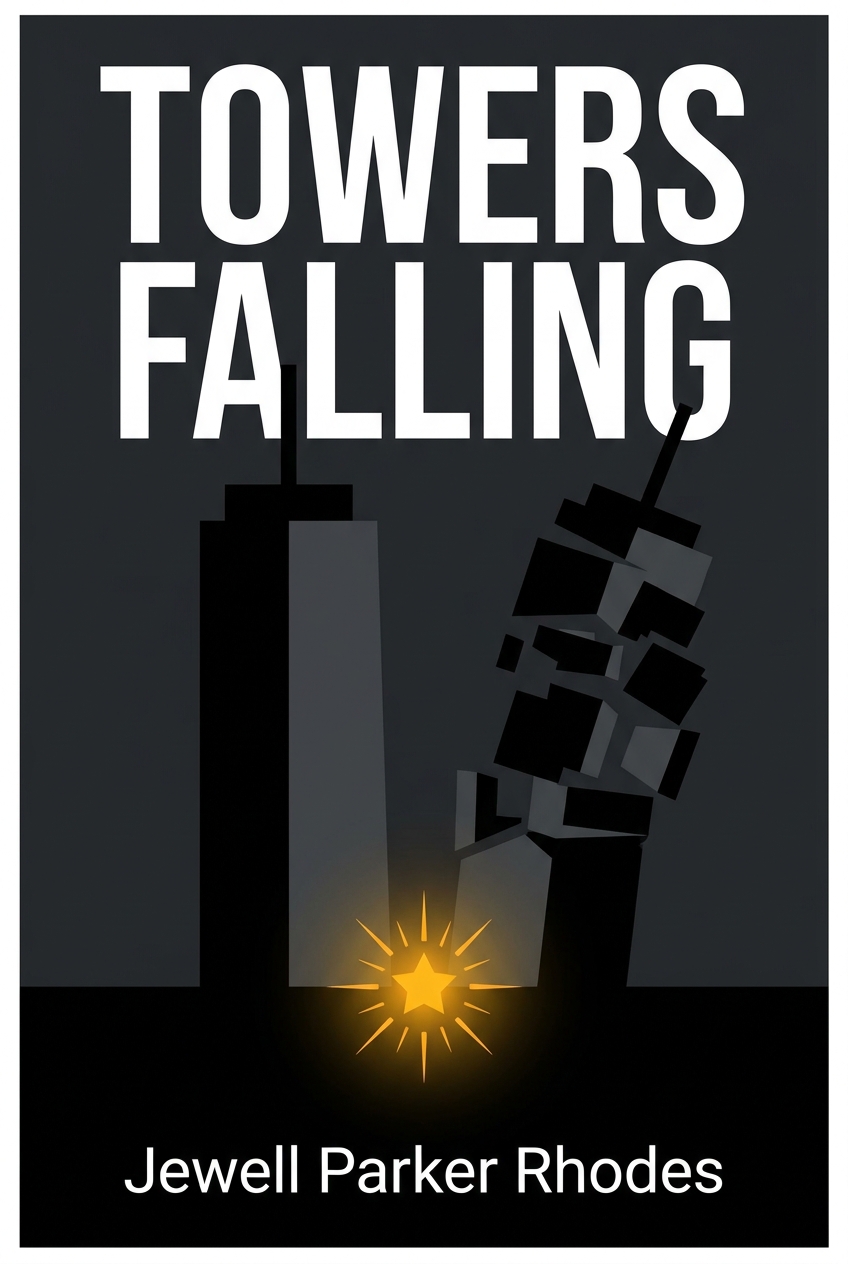
Towers Falling
What's it about
How do you explain a tragedy that happened before you were born? For fifth-grader Deja, September 11, 2001, is just a date. But as she starts at a new school, she discovers the event has shaped her world, her family, and her future in ways she never imagined. Join Deja as she pieces together the history of the Twin Towers and the day they fell. You'll learn why understanding the past is crucial for building a better future and discover how community, friendship, and empathy can help heal even the deepest wounds of history.
Meet the author
Jewell Parker Rhodes is an award-winning author and the founding artistic director of the Virginia G. Piper Center for Creative Writing at Arizona State University. Drawing from her own experiences growing up in a diverse community, she writes to inspire social justice, hope, and an understanding of our shared American identity. Her work, including the powerful novel Towers Falling, encourages young readers to explore complex history and find their own voices to create a better world.
Opens the App Store to download Voxbrief

The Script
Think about the family stories you know by heart. Maybe it's the one about how your grandparents met, a tale polished smooth with retelling. You know the funny parts, the romantic twists, the satisfying end. But what if there was another version of that story? It's a parallel truth—one held by the quiet uncle who was also there, who saw a rescue instead of a romance, an escape instead of a meet-cute. His version doesn't erase the first; it complicates it, adding shadows and weight. Both stories are true, but only one is told. The other lives in the silence, an invisible history shaping the family in ways no one ever talks about.
What happens when a child stumbles upon that second story? The one nobody meant for them to hear? This is the space Jewell Parker Rhodes explores. As a writer and educator, she noticed a profound silence surrounding the September 11th attacks, especially for the generation of children born after the event. For them, it was history as distant as the fall of Rome, a story with missing pieces and unspoken emotions. Rhodes wrote Towers Falling to fill that silence with the complicated, human truth of how the past lives inside the present—how it shapes our friendships, our communities, and who we believe we are, even when we don't know the full story.
Module 1: The Invisible Weight of the Past
The story opens with Dèja Barnes, a fifth-grader whose world is defined by instability. She and her family live in a single room at the Avalon Family Residence, a homeless shelter. Her father, Pop, is a ghost in their lives. He’s crippled by a mysterious illness. He suffers from debilitating headaches, a severe cough, and nightmares that leave him unable to work. Dèja’s anger simmers just below the surface. She resents her family’s poverty. She resents having to be the adult for her younger siblings. And she resents her father’s seeming weakness. This sets up the book's central mystery: What broke Pop?
The first insight is that unaddressed trauma creates a cycle of family instability. Pop's condition is the anchor weighing his family down. His inability to work forces them into homelessness. His emotional withdrawal creates a tense, silent home. Dèja recalls their eviction, their belongings broken on the street. She remembers living in their car for a month. These experiences are deep emotional wounds that affect Dèja's ability to trust, learn, and connect with others. Her tough exterior is a shield against a world she expects to disrespect her.
This brings us to a related point. Poverty creates social and educational barriers that feel insurmountable. On Dèja's first day at her new school, Brooklyn Collective Elementary, she is acutely aware of her worn-out clothes. She expects rejection. When her teacher, Miss Garcia, assigns an essay about summer vacation, Dèja plans to leave it blank. Her summer was an eviction. The assignment feels irrelevant, a painful reminder of everything she doesn't have. For children like Dèja, school is about navigating a world where they feel like outsiders.
But here’s the thing. Even in this harsh reality, connection is possible. Unexpected kindness can break through walls of isolation. Despite Dèja’s hostile demeanor, two new classmates reach out. Ben, a boy in cowboy boots, offers her a pencil. Sabeen, a girl in a headscarf, offers her paper and a warm smile. Dèja is initially suspicious. She sees Ben as "wimpy" and is wary of Sabeen. Yet, their simple, genuine gestures begin to chip away at her defenses. These small acts of kindness are lifelines. They suggest that this new school, unlike her old one, might offer a community where she doesn't have to fight to belong. It’s a glimpse of hope in an otherwise bleak landscape.