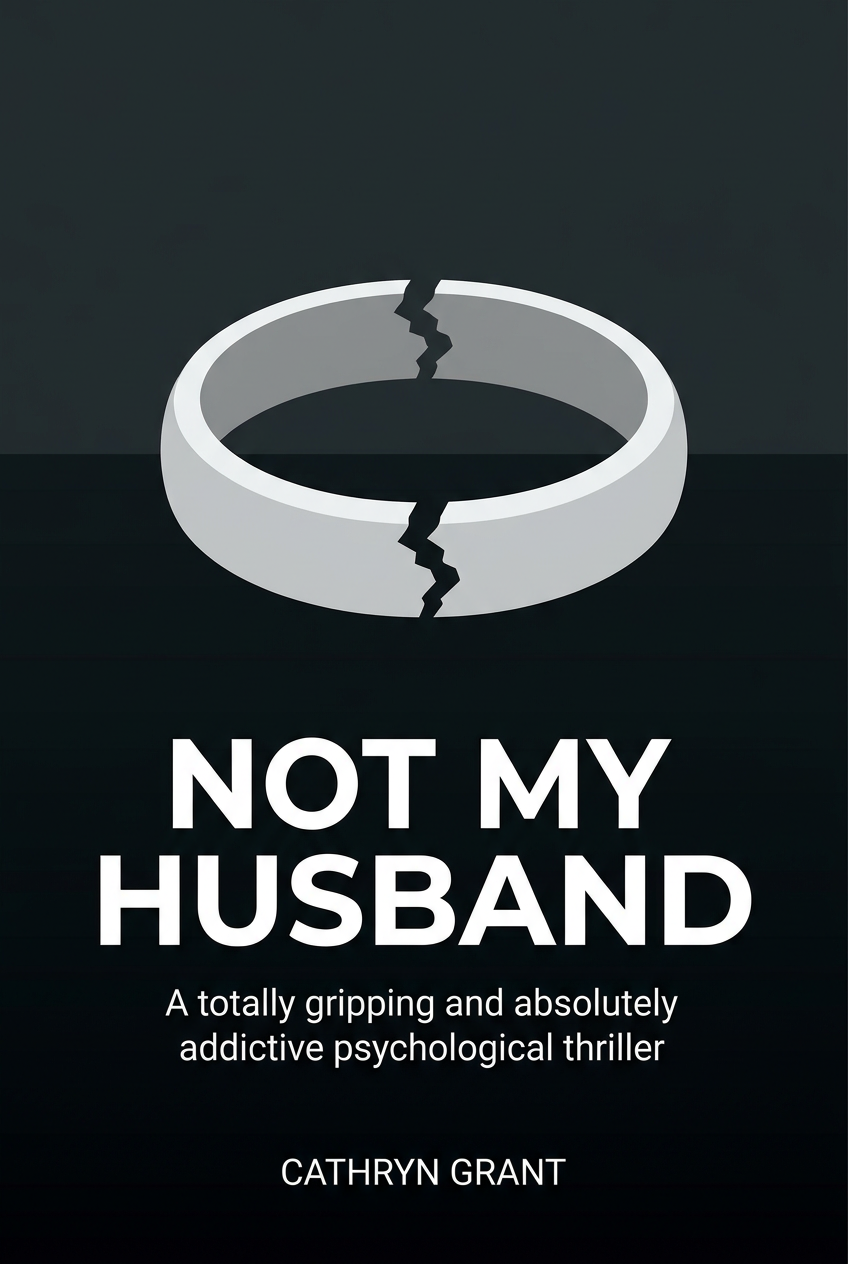
Not My Husband
A totally gripping and absolutely addictive psychological thriller
What's it about
Ever wonder if the person you love is hiding a terrible secret? Imagine your perfect husband suddenly isn't the man you married. This summary plunges you into a marriage built on lies, where every anniversary gift could be a clue and every loving gesture a threat. Discover how one woman unravels the dark truth about her husband's past. You'll follow her desperate search for answers as she pieces together a puzzle of deceit and danger, forcing her to question everything she thought she knew about love, trust, and survival.
Meet the author
Cathryn Grant is a USA Today bestselling author whose gripping psychological thrillers have captivated over a million readers worldwide, consistently hitting the top of the charts. A lifelong fascination with the dark complexities of human relationships and the secrets people keep led her to write suspenseful stories. She draws inspiration from observing the seemingly perfect lives of others, masterfully exploring what truly lies beneath the surface in her addictive and twist-filled novels.
Opens the App Store to download Voxbrief

The Script
You’re sitting across the breakfast table from someone you have loved for a decade. The light from the kitchen window hits their face in the same way it has a thousand times before. They pick up their coffee mug, but something is wrong. They hold it with their index finger looped through the handle, when for ten years, you've only ever seen them grip the body of the mug with their whole hand. It’s a tiny, insignificant detail. A meaningless twitch in the fabric of your shared life. You dismiss it. But then another detail snags your attention—the way they laugh at a joke on the radio, a sharp bark where there used to be a low rumble. Suddenly, your home feels like a perfectly constructed stage set, and you are the only one in the audience who can see the props are all wrong.
This creeping dread, born from the accumulation of small, almost imperceptible changes in a loved one, is the central terror that author Cathryn Grant set out to explore. Grant, a writer known for her sharp, suspenseful short stories, found herself fascinated by the psychological horror of not being believed. She wondered what would happen if a person’s closest relationship became the source of their deepest uncertainty. What if the person everyone trusts is the one person you know you can't? This question became the driving force behind "Not My Husband," a novel that turns the quiet comfort of domestic life inside out to examine the terrifying possibility that the person you know best is, in fact, a complete and dangerous stranger.
Module 1: The Honeymoon Horror
The story begins with Chelsea on what should be the happiest day of her life. She’s just married Jay, a man she met online who seems absolutely perfect. Their wedding in Hawaii is picturesque, a dream come true. But a single, jarring moment punctures the bliss. During the reception, Jay takes a phone call. His expression shifts from joy to fear. He becomes tense, his voice sharp. He quickly dismisses it as a work issue, but the image of his panic sticks with Chelsea. This tiny crack in the perfect facade is the first sign that something is terribly wrong.
The next morning, the crack shatters her entire world. Chelsea wakes up to a complete stranger lying beside her in bed. Her immediate reaction is pure terror. But the horror deepens when the stranger acts as if nothing is wrong. He calls her by her nickname. He knows intimate details about their wedding night, their conversations, their plans. He calmly insists that he is Jay.
This is the central, terrifying premise of the book. A perpetrator can inflict profound psychological terror by meticulously impersonating a loved one. The stranger is a replacement. He has Jay’s wallet, complete with a driver's license showing Jay's name and their home address, but the photo is of the stranger. This impossible contradiction sends Chelsea into a spiral of disbelief and self-doubt. Is she having a mental breakdown? Is this a sick joke? The stranger's calm, confident demeanor is the ultimate form of gaslighting. He acts so normal that Chelsea is forced to question her own sanity. She knows this man is not her husband, but every piece of external evidence, and his own unnerving performance, suggests she is wrong.
As she flees the room in a panic, another critical vulnerability is exposed. Modern dependence on technology creates a single point of failure for our entire support system. Chelsea’s phone was accidentally destroyed at the wedding. Without it, she is completely cut off. She can't call her family. She can't text her friends. She can't pull up photos to prove what her real husband looks like. Her entire life, her connections, her evidence—all gone. This technological isolation amplifies her helplessness, leaving her trapped in a nightmare with no way to call for help or verify her own reality. The stranger even uses this against her, reminding her of their shared agreement to have a "phone-free honeymoon," a detail only her real husband should know. His possession of this private knowledge is a weapon, making his deception feel inescapable.
Module 2: The System Fails
We've just seen Chelsea's world implode. Now, let's explore what happens when she turns to the very institutions designed to protect her.
Chelsea, in a state of shock, rushes to the hotel's front desk. She explains her husband is missing and an imposter is in her suite. The staff's reaction is the first layer of a systemic nightmare. The receptionist and the manager, Shep, treat her as a problem to be managed. Their questions are dismissive, even insulting. They suggest she might be drunk, confused, or that this is all just a prank. Their priority is maintaining the resort's placid atmosphere.
This leads to the core insight of this section: Institutional figures often default to dismissing a woman's distress as irrational or hysterical. When Officer Almi of the local police arrives, this pattern intensifies. He listens to her story, laughs, and calls it "unusual." He immediately suggests she might be hallucinating due to wedding stress or drugs. The imposter, meanwhile, remains calm and charming. He presents the doctored ID. He acts like a concerned husband worried about his "confused" wife. Faced with a hysterical woman and a calm man with seemingly valid identification, the officer takes the path of least resistance. He sides with the imposter.
The officer’s decision effectively legitimizes the gaslighting. He tells Chelsea she seems "overtired and confused" and that her story is "very difficult to believe." He validates the imposter's reality over hers, leaving her utterly abandoned. The resort manager, Shep, eagerly aligns with the officer’s assessment. The system has officially failed. It has actively taken the side of her tormentor.
The result is a terrifying new reality for Chelsea. When formal institutions fail to provide protection, a victim is forced into a state of hyper-vigilance and self-reliance. She is now trapped in her honeymoon suite with a man she knows is a dangerous stranger, but who the world now recognizes as her husband. There is no one to call. No one believes her. Her attempts to persuade others have failed. Her survival now depends entirely on her own actions. This forces a critical shift in her mindset. She stops trying to convince others and starts planning how to survive. She secretly buys a knife for protection, a stark symbol of her complete loss of faith in any external safety net. She is truly, terrifyingly alone.