All Books
Self-Growth
Business & Career
Health & Wellness
Society & Culture
Money & Finance
Relationships
Science & Tech
Fiction
Topics
Blog
Download on the App Store

On a Quiet Street

An Edgar Award Nominated Psychological Thriller and Mystery Novel

15 minSeraphina Nova Glass

What's it about

Ever wonder what secrets your neighbors are hiding behind their perfect smiles and closed doors? Get ready to uncover the shocking truth lurking beneath the surface of a seemingly idyllic cul-de-sac, where one woman's suspicion about her husband's infidelity spirals into a dangerous obsession that could cost everyone everything. You'll join three women as they forge an unlikely and risky alliance to expose the dark realities of their neighborhood. Learn how they use cunning, surveillance, and sheer nerve to peel back the layers of deception, revealing a web of lies, betrayal, and murder that proves no street is as quiet as it seems.

Meet the author

Seraphina Nova Glass is an Edgar Award nominated author and a professor of playwriting and screenwriting at the University of Texas, Arlington. Her academic and creative expertise in dramatic structure provides the foundation for her masterfully plotted psychological thrillers that explore the dark complexities of human relationships. Drawing from a deep understanding of character and suspense, Glass crafts compelling narratives that keep readers on the edge of their seats, questioning everything they think they know about the people next door.
Listen Now
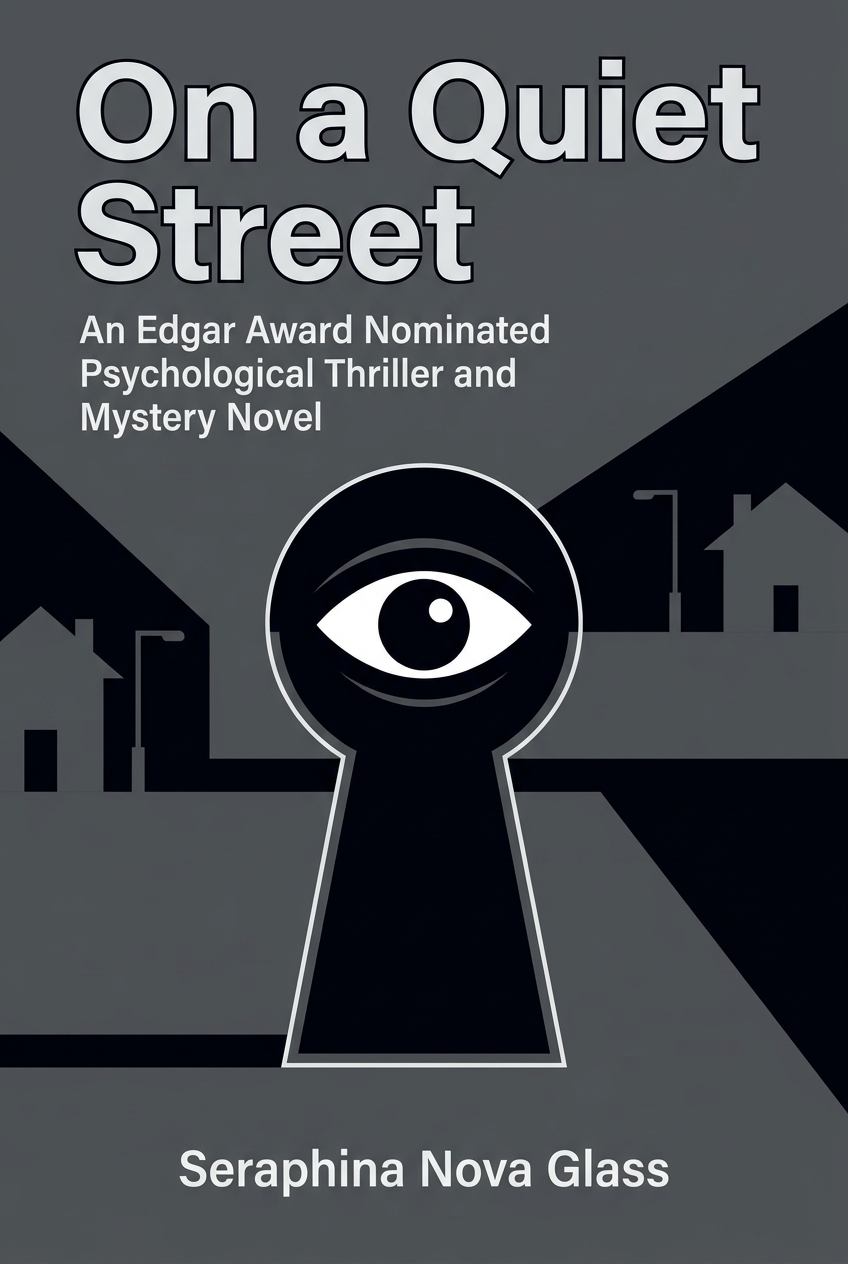
On a Quiet Street book cover

The Script

You’re in the car, stopped at a red light on a familiar street in your own neighborhood. You glance over and see a neighbor—someone you wave to, someone whose dog you know by name—in the car next to you. They're on the phone, their face a mask of fury and desperation, a complete contrast to the person who just last week was complimenting your hydrangeas. In that fleeting moment, the polite veneer of suburban life cracks, and you catch a glimpse of the raw, private drama underneath. The light turns green, the cars move on, and the mask is back in place. But the image stays with you. You start to notice other things: the blinds that are always drawn, the couple that never seems to speak, the late-night visitor who parks a block away. You begin to wonder what other secrets are humming just beneath the surface of your manicured, quiet street.

This exact feeling—the unsettling curiosity about the hidden lives playing out behind closed doors—is what drove author Seraphina Nova Glass to write "On a Quiet Street." As a playwright and professor of writing, Glass has always been fascinated by the gap between our public personas and our private realities. She was intrigued by the idea that the most terrifying threats can fester in the most ordinary, seemingly safe places. Glass wanted to peel back the layers of a picture-perfect community, one house at a time, to explore the desperate choices people make when their secrets are about to be exposed.

Module 1: The Illusion of Perfection

The book opens on a quiet street in Brighton Hills, a community that sells an illusion. It's a place where, on the surface, "nothing ever happens." But this tranquility is a carefully constructed facade. The author's first major point is that affluent communities often mask desperation and moral decay behind a veneer of perfection.

For example, we see fathers buying cocaine from a high school student to cope with jobs they hate. We hear about wives ignoring their husbands' affairs in exchange for Gucci and Birkin bags. This is the currency of the neighborhood. The unspoken agreement is to look the other way. As long as the lawns are mowed and the charity galas are attended, the hidden scandals can continue. This creates a world where everyone is performing a role, and the pressure to maintain that performance is immense.

This leads us to Cora, a protagonist who embodies this neighborhood ethos. Her core belief is that maintaining domestic rituals creates a sense of order, even when they are meaningless. She meticulously prepares a large Sunday breakfast she knows her family won't eat. She insists on family dinners that are tense and silent. For Cora, these rituals are about things looking "tidy and put together and right." It's a way of exerting control in a world that feels increasingly chaotic. But this obsession with appearances comes at a cost. It isolates her and prevents her from seeing the real problems brewing in her own home.

So what happens next? This focus on external perfection breeds deep internal insecurity. Cora’s personal anxieties about her age and body are projected onto others, particularly her new neighbor, Georgia. Cora finds Georgia’s beauty and aloofness threatening. She initially judges her as a snob, thinking she’s “better than us” because she’s English. This is a classic defense mechanism. When we are insecure, we often project judgment onto others to rationalize our own feelings. It’s easier for Cora to believe Georgia is arrogant than to confront her own envy and dissatisfaction. The quiet street is a collection of individuals managing their own private anxieties, often by scrutinizing their neighbors.

Read More