All Books
Self-Growth
Business & Career
Health & Wellness
Society & Culture
Money & Finance
Relationships
Science & Tech
Fiction
Topics
Blog
Download on the App Store

Termination Shock

A Novel

15 minNeal Stephenson, Edoardo Ballerini

What's it about

What if one person's radical plan to reverse climate change sparked a global war? This near-future thriller plunges you into a world on the brink, where a rogue billionaire's geoengineering scheme forces nations, and individuals, to choose a side in a conflict that will reshape the planet. Discover the intricate web of politics, power, and personal ambition driving this epic story. You'll follow a cast of unforgettable characters—from a Comanche hog hunter to the Queen of the Netherlands—as they navigate the chaotic fallout of a world-altering event and fight for their vision of the future.

Meet the author

Neal Stephenson is the 1 New York Times bestselling author of speculative fiction classics like Snow Crash and Cryptonomicon, renowned for his prophetic explorations of technology and society. His background in physics and geography, combined with his work as a futurist for companies like Blue Origin, provides the deep scientific and geopolitical authenticity that powers Termination Shock. Edoardo Ballerini is the acclaimed narrator who brings Stephenson's intricate world to life with his award-winning vocal performance.
Listen Now

Opens the App Store to download Voxbrief

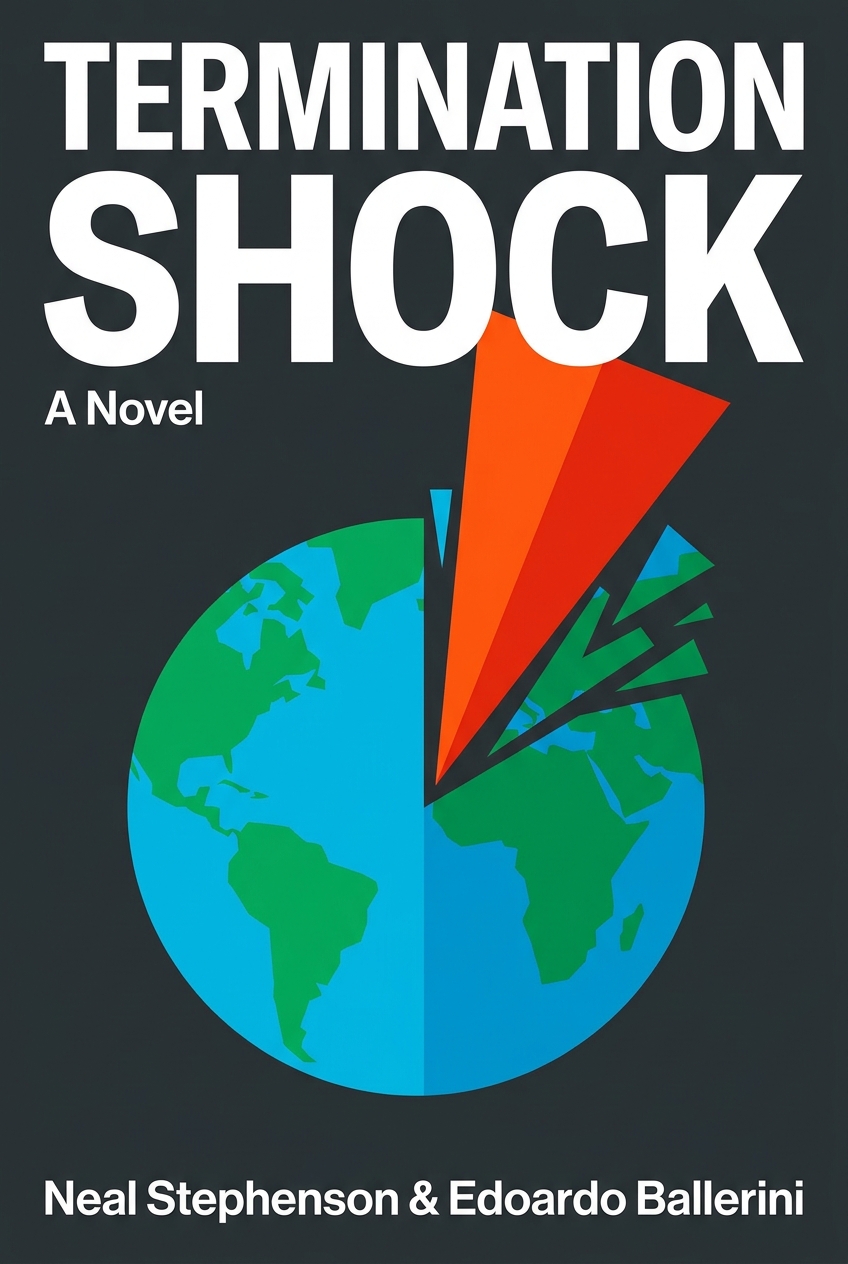
Termination Shock book cover

The Script

The most dangerous catastrophes are the ones that seep into the background noise of daily life. We've grown accustomed to seeing the slow-motion crisis of climate change as a problem for committees, a line item on a budget, a debate for future generations. We assume that when the real disaster strikes, it will be announced, televised, and managed by designated experts. This belief in an orderly, top-down solution is perhaps the most comforting, and most perilous, fiction of our time. It allows us to treat a planetary emergency like a leaky faucet that someone, eventually, will get around to fixing. What happens when that 'someone' isn't a government or a global consortium, but a rogue billionaire with a giant gun and a terrifyingly simple plan?

This is the chaotic, high-stakes premise that drives Neal Stephenson's work. A master of speculative fiction known for coining terms like 'the metaverse' decades before they became household names, Stephenson has built a career exploring the collision of technology, culture, and human ingenuity. For 'Termination Shock,' he moves from the digital frontier to the very real, and very messy, world of climate engineering. He was drawn to the idea that our most celebrated trait—our ability to solve problems—might become our most catastrophic liability when scaled to a planetary level. Voiced by Edoardo Ballerini, the story becomes an immersive exploration of what happens when the official response to a crisis is too slow, and the unofficial response is dangerously fast.

Module 1: The New Normal is Broken

The world of Termination Shock isn't a dystopia. It’s our world, just a few degrees warmer and a lot more unpredictable. Stephenson grounds the narrative in tangible, cascading failures. This is about systems breaking down in ways that feel both absurd and terrifyingly plausible.

One of the most vivid examples is the "Great Relay Shortage" in Houston. A specific weather pattern causes a fire ant population boom. Rising water pushes the ants toward human settlements. The ants, drawn to the ozone from air-conditioning relays, swarm and destroy them. This triggers a mass failure of AC units across the city. But here’s the kicker. The replacement relays are stuck in a supply chain bottleneck from China. The result? Houston becomes uninhabitable. Hundreds of thousands become "Relayfugees," fleeing the heat. Climate change is a series of cascading system failures. It's a tiny insect and a globalized supply chain collapsing under environmental pressure.

This leads to another core idea. The line between "natural" and "engineered" is blurring. The Netherlands is presented as a prime example. It’s described as "an engineered contraption that would kill a lot of Dutch people if they didn’t keep pushing the right buttons." Survival depends on constant maintenance of a human-built system. The same is true in Texas, where the feral hog problem is a direct result of centuries of human intervention. Spanish conquistadors introduced domestic pigs. European hunters imported wild boars. Modern agriculture bred "monster domesticated" pigs. These have all hybridized into a destructive new force of nature. So what happens next? Humanity is already geoengineering the planet, just accidentally and chaotically. Stephenson’s novel suggests that the debate is about whether we can engineer the climate with intention and control.

In this chaotic world, a new form of legitimacy emerges. It is based on competence. The Dutch Queen, Saskia, finds her legitimacy in her ability to safely land a jet. Piloting is an activity that "would get you killed if you did it wrong." It cannot be faked. This act of pure skill becomes a modern "public blood oath," proving she is competent and grounded. Similarly, the character Rufus transforms his personal tragedy into a highly effective feral swine mitigation business. He succeeds because he develops deep, practical expertise. He studies genetics. He masters drone surveillance. He understands animal behavior. In a world of systemic failure, practical competence becomes the ultimate currency. It’s the ability to get things done when the old systems can no longer be trusted.

Module 2: The Rogue Solution and Its Global Ripple Effects

We've explored the problem. Now, let's turn to the solution, or at least, a solution. A wealthy Texas oilman named T.R. Schmidt decides he has had enough of climate talk. He builds a massive gun complex called "Pina2bo." The name is a direct reference to the 1991 eruption of Mount Pinatubo, a volcano that cooled the planet by injecting sulfur dioxide into the stratosphere. T.R.'s plan is to replicate this effect mechanically. He will fire shells filled with sulfur high into the atmosphere to create a reflective veil, turning down the global thermostat.

His motivation is brutally pragmatic. He owns a vast real estate portfolio in Houston. He calculates that preventing sea-level rise will increase his property values by more than enough to pay for the entire project. This is a business decision. And here's the thing. T.R. doesn't ask for permission. He recognizes that seeking consensus from global powers like China or India would lead to endless debate and inaction. So he builds his gun in secret, leveraging his own land and resources. Unilateral action becomes the only path forward when global consensus is impossible. He bypasses the gridlocked political system entirely.

The moment the gun fires, the world changes. Climate modeling becomes a new global arms race. Governments around the world scramble to run simulations on cloud computing platforms. They need to know how this intervention will affect them. The demand for virtual machines skyrockets, creating a shortage similar to the run on toilet paper during the pandemic. This illustrates a crucial point. Every large-scale climate intervention will create winners and losers. Alastair, a statistician in the book, explains that nothing can be good for everyone, everywhere. A geoengineering project that cools the Netherlands might disrupt the monsoon in India, threatening the "Breadbasket" of the Punjab with famine.

This leads to the book's central concept, the "termination shock." What happens if the gun is ever turned off? The climate could rebound with catastrophic speed. This potential disaster becomes a powerful geopolitical lever. T.R. can use the threat of a termination shock to force reluctant nations to support his project. It creates a new form of mutually assured destruction. The world becomes dependent on a single facility in West Texas, run by a private citizen. And it doesn't stop there. The success of one rogue geoengineering project inspires others to act. The Venetians, desperate to save their city from rising seas, begin planning their own sulfur-injection facility in Albania. The Saudis develop high-altitude aircraft to do the same. The game is about controlling the thermostat for national advantage.

Read More