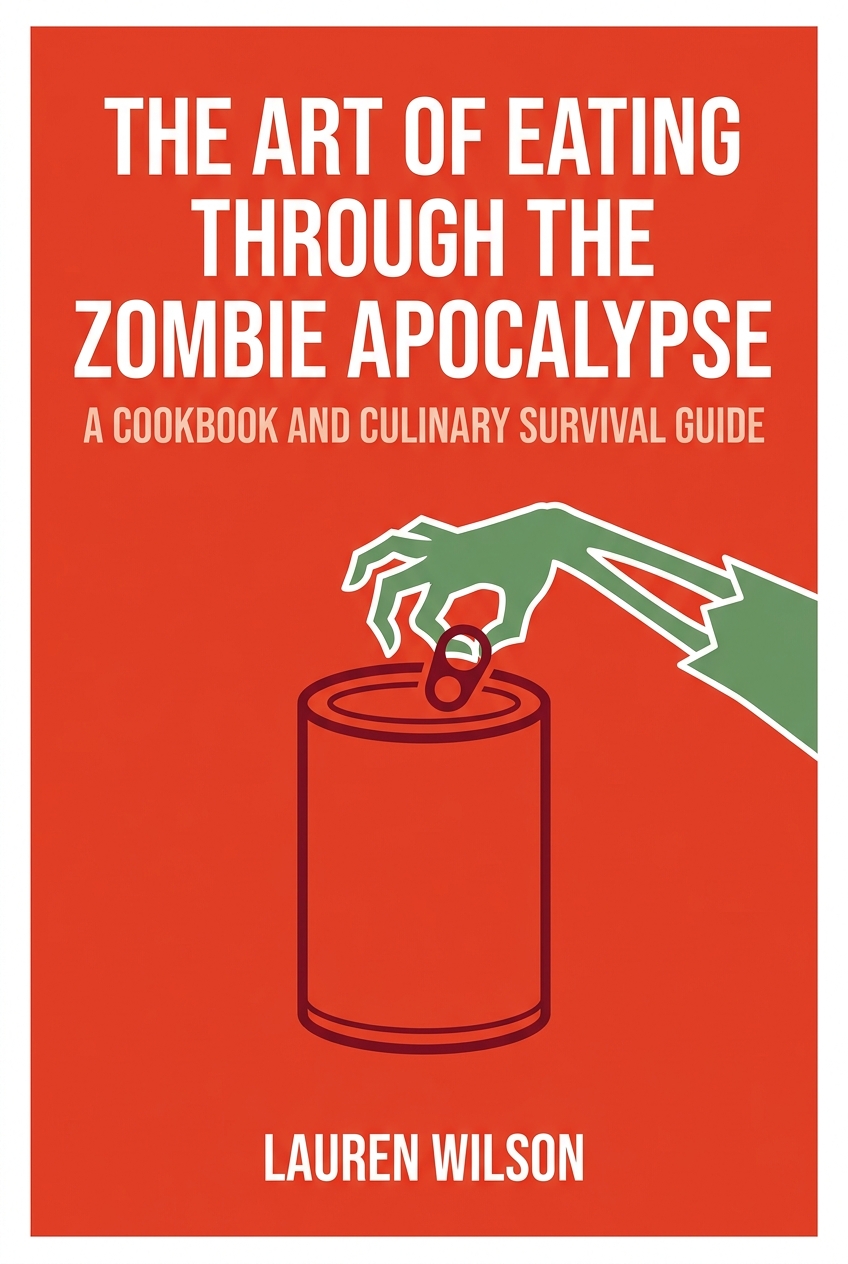
The Art of Eating Through the Zombie Apocalypse
A Cookbook and Culinary Survival Guide
What's it about
What will you eat when the undead rise and the grocery stores are empty? This guide is your key to not just surviving, but thriving culinarily. Learn to forage, hunt, and cook your way through the end of the world with delicious, life-saving recipes. You'll discover how to identify edible plants in your backyard, master basic butchering techniques, and even set up a defensible kitchen. Forget canned beans—this is your chance to turn dystopian dread into a gourmet adventure, ensuring you eat well no matter what’s shuffling outside.
Meet the author
Lauren Wilson is a classically trained chef and foraging instructor who has taught wilderness survival skills from the Pacific Northwest to the Appalachian Mountains. Her unique expertise in both culinary arts and outdoor self-sufficiency led her to explore the ultimate hypothetical: how to eat well even after civilization collapses. This book combines her professional kitchen experience with a deep knowledge of wild edibles, food preservation, and off-grid cooking, offering a practical yet imaginative guide for any worst-case scenario.
Opens the App Store to download Voxbrief

The Script
The power goes out. Your phone is dead. Outside, the familiar sounds of your neighborhood have been replaced by an unsettling, shuffling silence punctuated by distant screams. You check the pantry. A half-eaten bag of chips, three cans of beans, and a jar of pickles. You have water, for now. But as the hours stretch into days, a primal question, one our ancestors faced daily but we’ve long forgotten, begins to echo in your stomach: what will you eat tomorrow? And the day after? This is about staying alive. Every choice—what to forage, how to cook without a stove, what’s safe to eat when the world is anything but—becomes a matter of survival.
That chilling scenario is the one Lauren Wilson found herself contemplating, not out of fear, but out of a unique blend of professional curiosity and creative fascination. As a chef and forager with a deep respect for the skills our modern world has allowed us to neglect, she saw the zombie apocalypse as the ultimate culinary challenge. It was a thought experiment that forced her to strip cooking down to its bare essentials: finding fuel, securing food, and making it edible without the safety net of civilization. This book is the result of that exploration—a practical, often humorous, guide born from her expertise in both the kitchen and the wild, designed to equip anyone with the forgotten knowledge needed to eat well, even at the end of the world.
Module 1: The New Rules of Survival Cuisine
When civilization collapses, our entire relationship with food is reset. The convenience of grocery stores and food delivery vanishes overnight. Survival becomes the new full-time job. The book's first major insight is that this new reality demands a complete shift in priorities, blending hard skills with a resilient mindset.
First, you must accept that food is now a critical tool for psychological resilience. This is about more than just calories. The author draws a parallel to the U.S. military's development of MREs, or Meals, Ready-to-Eat. The military learned that a hot, decent meal dramatically boosts soldier morale. The same principle applies when you're dodging zombies. A thoughtfully prepared meal provides a link to your past humanity. It offers comfort and a sense of normalcy in a world of chaos. The author promises that with a little creativity, your diet won't be limited to squirrels and canned spam. Finding pleasure in food becomes a radical act of defiance against despair.
This leads to the next point. You must master the survival "Rule of 3s" to prioritize your actions. In any crisis, your immediate needs follow a strict hierarchy. Humans can survive roughly three minutes without air, three days without water, and three weeks without food. This rule dictates your every move. Before you even think about your next meal, you must secure a source of clean water. The book details how to find it, from scavenging bottled water in the initial chaos to identifying natural sources like streams and lakes in the wild. And once you find water, you must purify it. Boiling is the fail-safe method, but the book also covers portable filters and improvised filtration systems using sand and charcoal. Only after water is secured does food become the priority.
From this foundation, you can begin to build your new skillset. Survival requires a blend of practical "hard" skills and creative "soft" skills. The hard skills are the non-negotiable foundations. These include finding water, making fire, scavenging, foraging, hunting, and field dressing an animal. These are the technical competencies that keep you alive. But the soft skills are what allow you to thrive. This is the "art" in the book's title. It's the ingenuity to see an abandoned office lunchroom as a treasure trove of non-perishables. It's the creativity to turn pantry staples into a comforting meal. The book is structured around teaching both, ensuring you have the technical ability to find food and the culinary imagination to make it worth eating.
And here's the thing about finding that food. To scavenge successfully, you must avoid the obvious targets. Your first instinct might be to raid the nearest grocery store or big-box retailer. That's a mistake. These places will be picked clean and dangerously crowded within hours. Instead, the author suggests a counterintuitive approach. Think about the places others will overlook. Office breakrooms often have coffee, tea, and snacks. Elementary schools stock non-perishables for student lunches. Abandoned homes, restaurants, and community gardens are far more likely to yield supplies than a looted supermarket. Successful scavenging is a game of strategic thinking.