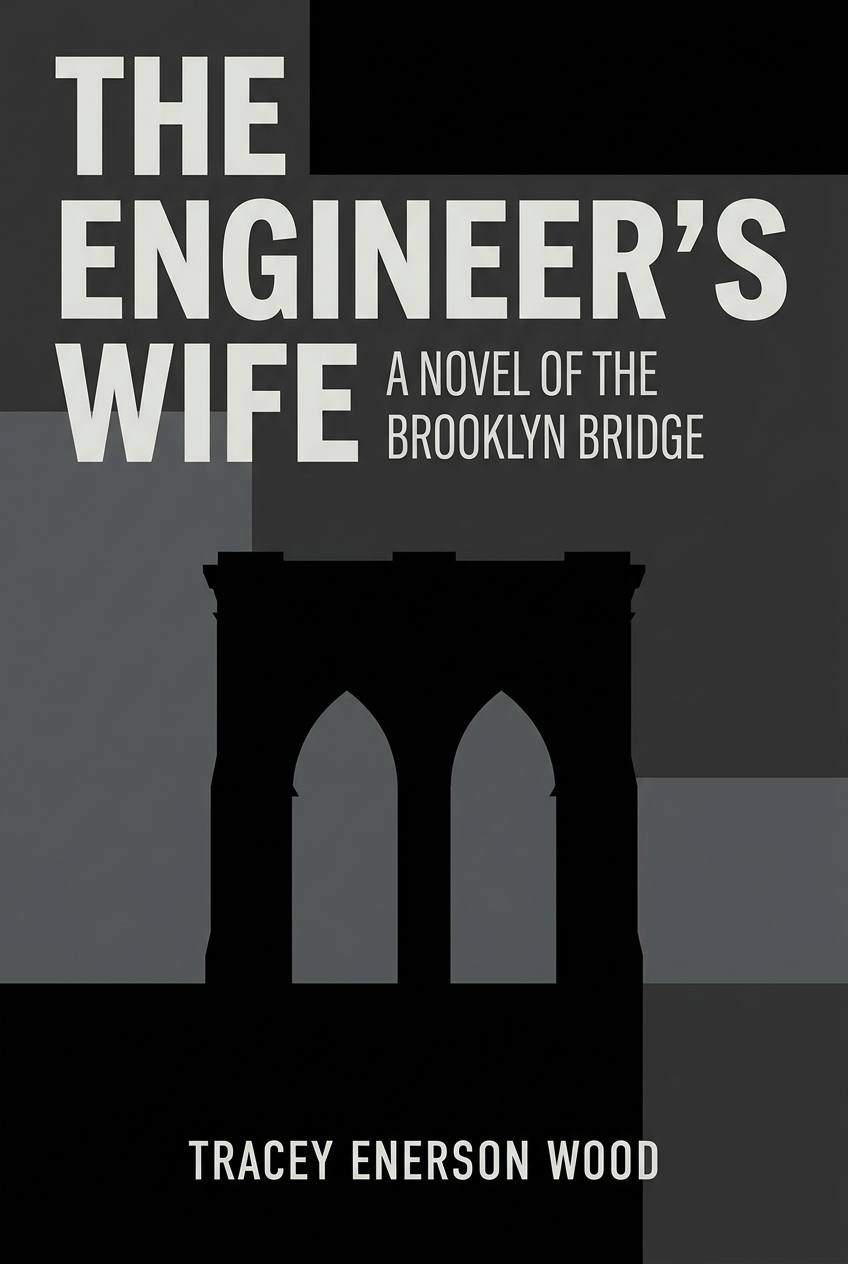
The Engineer's Wife
A Novel of the Brooklyn Bridge
What's it about
Ever wondered about the hidden story behind one of the world's most iconic landmarks? Discover the untold tale of Emily Warren Roebling, the brilliant woman who stepped up to complete the Brooklyn Bridge when her husband, the chief engineer, fell ill, defying the expectations of her time. You'll learn how Emily secretly mastered civil engineering, managed skeptical workers, and navigated treacherous political schemes to ensure the bridge's completion. This is the inspiring story of a woman's fight for her family's legacy and her own identity against all odds in 19th-century America.
Meet the author
Tracey Enerson Wood is an award-winning author and a former registered nurse whose passion for research uncovers the forgotten stories of historical women in science and technology. Her own background in a traditionally male-dominated field, combined with a playwright's gift for drama, gives her a unique lens to bring figures like Emily Warren Roebling to life. Wood's meticulous work celebrates the unsung heroines whose strength and intellect shaped our world, inspiring readers with their resilience and determination.
Opens the App Store to download Voxbrief

The Script
In the archives of any great historical monument, there are two distinct sets of records. The first is the official one: the blueprints, the ledgers, the public speeches, the newspaper clippings celebrating the triumph. It’s a story of steel and stone, of budgets and timelines, of celebrated men whose names are carved into plaques. This record is clean, linear, and heroic. But then there is a second, far messier archive, one rarely cataloged. It exists in the margins of letters, in the hurried annotations on a blueprint, in the receipts for household remedies, and in the unrecorded conversations that took place in sickrooms far from the construction site. This second record tells a story of human will and private sacrifice.
This hidden archive is where we find the true, astonishing story of the Brooklyn Bridge. It’s the story of a woman who, through a twist of fate, found herself holding both sets of records. She was the one managing the household accounts while also deciphering complex engineering diagrams, the one soothing a fevered husband while also negotiating with skeptical politicians and steel suppliers. The gap between the public monument and the private life required to build it fascinated Tracey Enerson Wood, a writer with a passion for uncovering the forgotten women of history. Wood stumbled upon a photograph of a woman confidently riding in a carriage across the newly completed bridge, a rooster—a symbol of victory—in her lap. Discovering this was Emily Roebling, the chief engineer's wife, sparked a years-long obsession. Wood realized that the official story of the Brooklyn Bridge was missing its most crucial, human component, and she wrote "The Engineer's Wife" to build that missing part of the story, giving a voice to the woman who quietly, brilliantly, finished one of the world's great wonders.
Module 1: The Collision of Ambition and Convention
The story opens by throwing us into the central conflict of Emily Warren's life. It’s the height of the Civil War, and she’s at an Officers’ Ball. But this isn't a glamorous affair. The ballroom is a repurposed hospital, smelling of blood and sweat. Wounded soldiers line the walls. Right away, the narrative establishes a stark contrast between polite society and brutal reality. Emily, a young woman from a sheltered background, feels the pull of both. She knows the rules. It’s improper for a lady to ask a man to dance. Her mother disapproves of her dress. Yet, something else is driving her. A person's true character is revealed when their personal ambition clashes with societal rules.
Emily wants more than a quiet, respectable life. She craves amusement, engagement, and a sense of purpose. This desire leads her to break convention, first by attending the ball unchaperoned, and later by performing a dramatic split in her gown to the cheers of the soldiers. It’s a moment of pure, rebellious joy. This is also where she meets Captain Washington Roebling, an engineer full of confidence and bravado. Her first impression isn't great. She finds him arrogant. But as they connect, her judgment softens. This brings us to a key insight: First impressions are often just incomplete data points. Through genuine conversation, Emily sees past Wash's swagger to the person underneath. He admits to sneaking peeks at her. He holds her like a "treasured gift." By the end of the night, she is captivated. This entire sequence serves as a microcosm of Emily’s journey. She is constantly navigating what is expected of her versus what she truly wants.
So, how does this apply to our world? We all operate within systems of rules, both spoken and unspoken. In a startup, it's the culture. In a large corporation, it's the hierarchy. The author suggests that our most defining moments come when our inner drive forces us to test those boundaries. This is about calculatedly pushing the envelope to create an opportunity, make a connection, or simply feel alive.
Module 2: Forging a Partnership in the Shadow of War
Following the ball, Emily and Wash's relationship accelerates. Their courtship is forged under the intense pressure of war. Wash is on a short leave, and every moment is precious. This urgency strips away the usual formalities. Their connection deepens through shared experiences, from a chilly picnic to quiet evenings playing chess. A powerful theme emerges here. Extraordinary circumstances can accelerate trust and commitment. The constant threat of Wash's return to the front lines compresses their timeline. There is no time for games. This intensity culminates in a sudden marriage proposal. Emily, despite her own ambitions for independence and her involvement in the women's suffrage movement, says yes. She realizes she can no longer imagine her life without him.
But their partnership is immediately tested by the powerful force of family legacy. Wash’s father, John Roebling, is the brilliant, domineering patriarch and a world-renowned engineer. He has a singular dream: to build a bridge across the East River. This project is a family destiny. Wash explains that his entire life has been shaped by his father's ambition. This introduces another critical concept. Personal ambition is often inherited, a legacy passed down that can be both a gift and a burden. For Wash, the bridge is his purpose. For Emily, it becomes the force that will define her life in ways she cannot yet imagine.
John Roebling is skeptical of Emily. He sees her as a potential distraction, a society girl unsuited for the gritty world of engineering. He makes it clear that a woman’s place is not on a construction site. This sets up the next major conflict. Emily must decide if she will be a passive supporter or an active partner. And it doesn't stop there. The war has left its mark on Wash. He returns with what was then called "soldier's heart," the hollow-eyed trauma we now know as PTSD. Emily must navigate not only a formidable father-in-law but also a husband haunted by the ghosts of war.