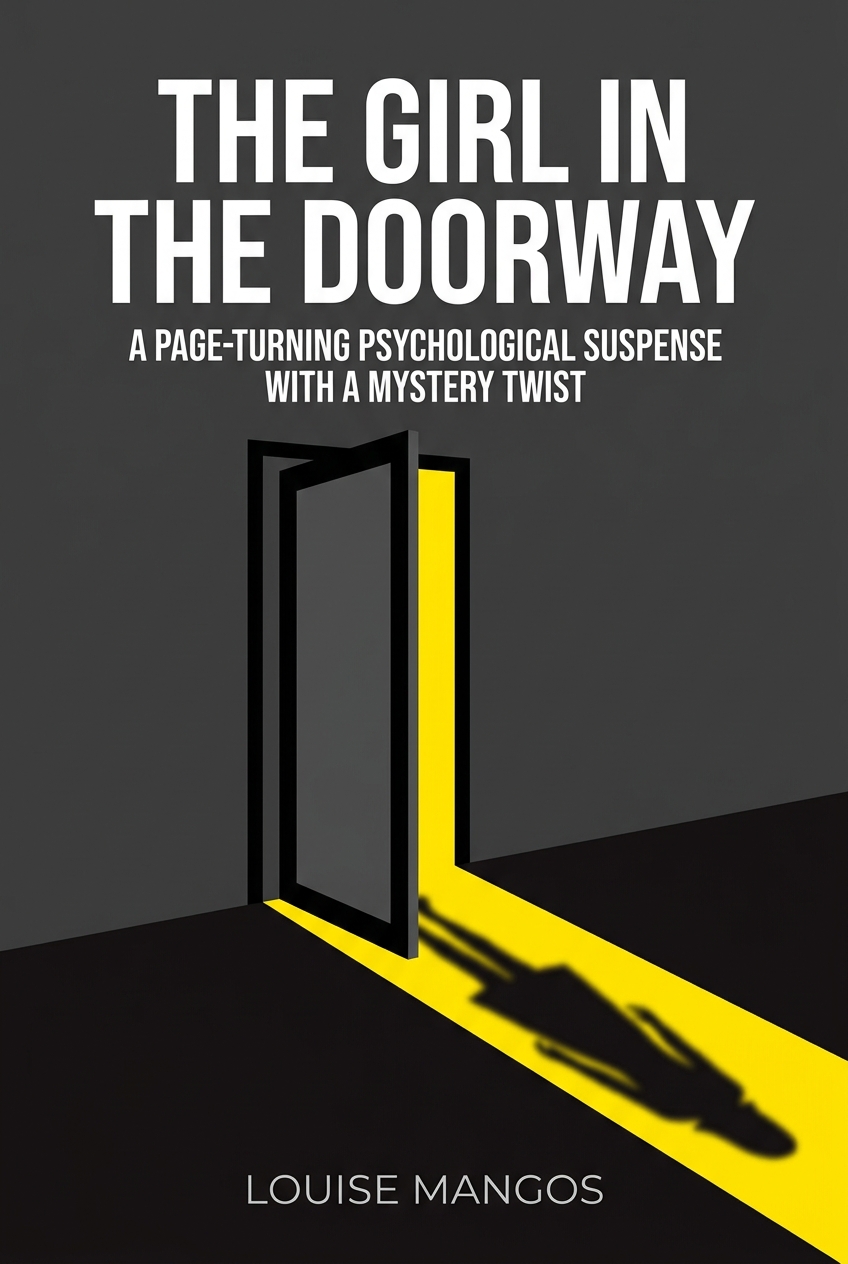
The Girl in the Doorway
A Page-Turning Psychological Suspense With A Mystery Twist
What's it about
Ever wondered how far you'd go to protect your family's perfect life? This gripping tale plunges you into a world where one small lie spirals into a devastating web of secrets, forcing you to question everything you thought you knew about trust and betrayal. Discover what happens when a stranger's arrival shatters a peaceful existence. As the lines between victim and villain blur, you'll uncover the dark truths hidden behind closed doors and learn how quickly a dream can morph into a living nightmare when the past refuses to stay buried.
Meet the author
Louise Mangos is an award-winning author whose debut novel won the Grindstone International Novel Prize, establishing her as a formidable voice in psychological suspense. A Swiss-Brit with a background in journalism and a fascination with the complexities of the human mind, she draws on her keen observational skills to craft compelling, character-driven mysteries. Her experiences living across continents fuel the authentic, intricate settings and relatable dilemmas that make her page-turning stories resonate so deeply with readers worldwide.
The Script
The young woman stood in the doorway, a silhouette against the fading afternoon light, holding a single, crumpled piece of paper. It was a birth certificate. Kate’s name was on it, next to the word ‘Mother.’ In that instant, Kate’s carefully constructed world—the loving husband, the beautiful home, the two young sons playing in the garden—began to fracture. The stranger, Maddy, looked just like her. She had the same eyes, the same hair. And she claimed to be the daughter Kate had given up for adoption nearly two decades ago, a secret Kate had buried so deep she had almost convinced herself it never happened.
The arrival of this ghost from the past forces a terrifying question: what do you do when the life you’ve built is threatened by a truth you can no longer deny? Do you welcome the past in, risking the destruction of everything you hold dear? Or do you push it away, knowing that some secrets, once unearthed, refuse to be buried again? For Kate, the choice is impossible. Maddy’s presence is a constant, unnerving reminder of a past self she doesn’t recognize, and as the girl integrates herself into the family, small inconsistencies and unsettling moments begin to accumulate, making Kate wonder if Maddy is truly who she says she is—or something far more dangerous.
This chilling exploration of buried secrets and maternal fear grew from author Louise Mangos’s own life. While she never had a long-lost daughter appear on her doorstep, she did move from the UK to Switzerland, like her protagonist, and experienced the unique sense of isolation that comes from being an outsider in a new country. Drawing on her background in social work, where she often encountered the complex and fragile dynamics of family life, Mangos became fascinated by the 'what if' scenario of a past decision returning to haunt the present. She wrote "The Girl in the Doorway" to explore how a single, secret event from a person’s youth could detonate their carefully curated adult life, turning the sanctuary of home into a place of profound psychological suspense.
Module 1: The Anatomy of a Deception
The story kicks off with a powerful hook. A kind-hearted London bookseller named James notices a young woman, Emma, drawing chalk art in a doorway. She appears vulnerable. She's an art student, potentially homeless, with a bruise on her cheek. So James does what he thinks is right. He offers her food, books, and eventually, a room in his flat to escape an abusive ex-boyfriend. This is where the trap is set.
The first core insight is that vulnerability can be a weapon. Emma’s entire persona is a carefully constructed performance. The bruise on her cheek is from a struggle with a homeless man named Willie, a struggle that accidentally led to his death. Her story of being a struggling art student is a cover. It’s designed to trigger James's empathy and exploit his charitable nature. He sees a damsel in distress. He doesn't see the predator hiding in plain sight.
From there, we see how the deception deepens. Every act of kindness is twisted into an opportunity for exploitation. James gives Emma a key to his flat. She uses it to learn his routines. He shows her his prized collection of rare books. She sees it as a target. She is actively mapping his life for a future robbery. The book makes it clear that the most effective cons don't feel like cons at all. They feel like relationships. They feel like trust.
This leads to a chilling realization. The most dangerous deceptions are built on a foundation of truth. Emma, whose real name is Eva, doesn't invent everything. She uses real emotional hooks. She learns James's interests. She mirrors his passions. She makes him feel seen and understood. The author shows that Eva's plan works by building a genuine, albeit fake, connection. James falls for "Emma" because she feels real. He trusts her because the emotions she fakes feel authentic to him. The deception is about the theft of intimacy and trust itself.