All Books
Self-Growth
Business & Career
Health & Wellness
Society & Culture
Money & Finance
Relationships
Science & Tech
Fiction
Topics
Blog
Download on the App Store

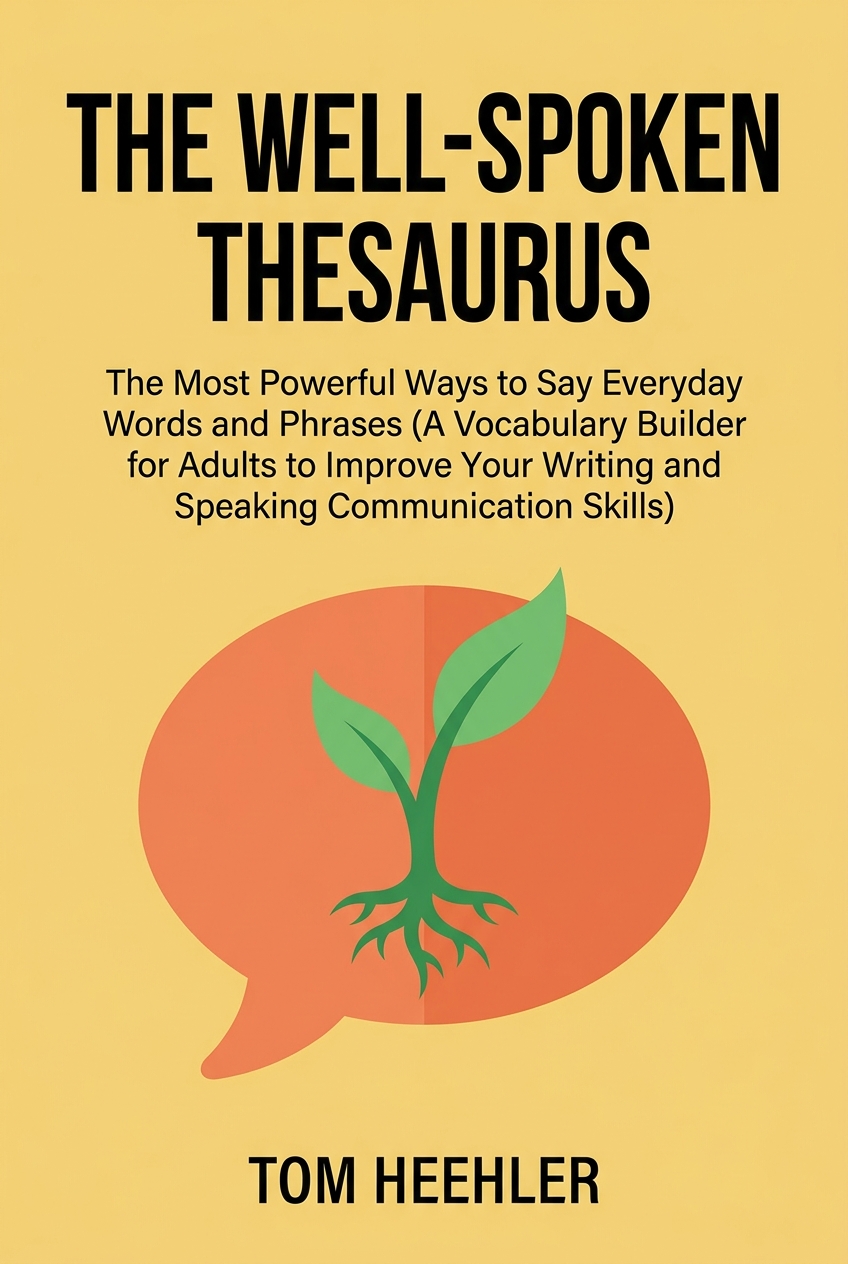
The Well-Spoken Thesaurus

The Most Powerful Ways to Say Everyday Words and Phrases (A Vocabulary Builder for Adults to Improve Your Writing and Speaking Communication Skills)

12 minTom Heehler

What's it about

Tired of your words falling flat? What if you could instantly elevate your vocabulary, command attention, and sound more articulate in any situation? This guide is your key to unlocking a more powerful and persuasive way of speaking and writing, ensuring your ideas are always heard. Discover the secret to sounding smarter isn't just knowing more words, but knowing the right ones. You'll learn how to replace common, overused phrases with sophisticated alternatives that make you sound more intelligent and confident, transforming your everyday communication from forgettable to formidable.

Meet the author

Tom Heehler is an award-winning writer and former master teacher at one of the nation’s top boys’ preparatory schools, where he taught English for over thirty years. His passion for language grew from helping thousands of students elevate their communication from the ordinary to the exceptional. Heehler created The Well-Spoken Thesaurus to provide everyone with the tools to articulate their thoughts with precision, power, and style, transforming everyday expression into an art form.
Listen Now

Opens the App Store to download Voxbrief

The Well-Spoken Thesaurus book cover

The Script

We've all been taught to see a bigger vocabulary as an arsenal to be deployed—a way to impress, to signal intellect, to win an argument. The common advice is to swap out simple words for more complex ones, like upgrading parts in a machine. This approach, however, often produces the opposite of the intended effect. Instead of sounding intelligent, we sound artificial. Instead of connecting, we create distance. The very act of reaching for a 'smarter' word becomes a performance, and audiences can always sense a performance. The real power of language is precision—choosing the word that unlocks a more specific feeling or a sharper image. It’s the difference between a blunt instrument and a surgical tool. The goal is to be understood with such clarity that the words themselves become invisible, leaving only the idea behind.

This gap between sounding impressive and being effective is exactly what fascinated Tom Heehler. As a writer and editor, he repeatedly saw talented people sabotaging their own ideas with clumsy, overwrought language picked from a standard thesaurus. He realized the problem wasn't a lack of words, but a lack of context. A traditional thesaurus offers synonyms without shades of meaning, giving you options that are technically similar but emotionally and tonally worlds apart. Heehler decided to build a different kind of resource, one organized not by alphabet, but by idea and intensity. His work charted the subtle emotional landscape of language, giving speakers and writers the ability to choose their words with the precision of an artist choosing a color.

Module 1: Words Shape Your Reality

The core premise of this book is that language is formative. The words you use don't simply reflect your reality—they actively create it. They influence how you see yourself, how others perceive you, and even what you are capable of achieving. This is about fundamentally re-architecting your cognitive world.

The first insight here is that vocabulary expansion directly alters cognitive perception. Think about how a child learns. At first, they might have one word, "bird," for everything that flies. A robin and an eagle are the same. But once they learn the word "predator," their mental model shifts. Now, an eagle and a bear can be grouped together. The new word creates a new category, a new way of seeing the world. For professionals, learning a term like de-familiarization—the technique of making language unusual to grab attention—changes how you interpret communication. A CEO using an expletive in a town hall is no longer just being vulgar. They might be strategically using de-familiarization to signal urgency or authenticity. You start seeing the hidden mechanics of language everywhere.

This leads to a powerful self-fulfilling prophecy. Using precise and authoritative language makes others see you as more competent. When you speak with clarity and intention, people listen differently. They assign you more authority and intelligence. This raises their expectations of you. In turn, you feel compelled to live up to those expectations, pushing you to become sharper, more prepared, and more thoughtful. Your improved language creates a feedback loop of rising competence and credibility. It’s about using language to unlock a more capable version of yourself.

But here’s the key. Eloquence is the fusion of authority and accessibility. Heehler points to Barack Obama as a prime example. His speeches are widely praised for their intelligence and power. Yet, his vocabulary is often simple enough for a child to understand. The power lies in the rhythm, the structure, and the precision of their use. Trying to impress people by dropping obscure, academic words often backfires. It can make you sound pretentious, awkward, or out of touch. The goal is to be clear and powerful, not formal and stuffy.

Module 2: The Art of Rhetorical Technique

Once you understand that word choice matters, the next step is learning how to arrange those words for maximum impact. This is about mastering a few simple, learnable rhetorical techniques that can transform your communication from flat to formidable. These are the secret weapons of the world's best writers and speakers.

A surprisingly powerful technique is strategic verb and preposition replacement. Small changes can have a huge effect on tone. For instance, instead of saying you had a "talk about a merger," try saying you had a "talk of a merger." The second version feels more timeless and serious. T.S. Eliot used this subtle shift to give his poetry a classic, resonant quality. Similarly, consider the verb. Instead of saying "He died in April," Ernest Hemingway might write "He is dead since April." This small change, called verb displacement, shifts the focus from a past event to an ongoing state, creating a more poetic and emotionally persistent feeling. These are deliberate stylistic choices.

Another powerful method is to make figurative language literal for creative effect. This sounds abstract, but it's a simple way to add depth and cleverness. Margaret Atwood is a master of this. You might say, "I fell in love and got my heart broken." Atwood might write something like, "I remember once how I let myself fall in love; now I always work with a net." By taking the metaphor of "falling" and extending it literally with the idea of a "net," she creates a much more memorable and insightful image. You can apply this in business. Instead of saying "We need to think outside the box," you could say, "This team has been living in a box for too long. It's time to knock down the walls and see what's outside."

And here's the thing, you can also reshape the structure of a common phrase to create a powerful aphorism. This is a favorite technique of persuasive orators like Martin Luther King, Jr. Instead of just saying "Solve problems," he might construct a phrase like, "Don't cause a problem; cause a solution." The parallel structure is pleasing to the ear and makes the idea feel more profound and memorable. It flips a negative command into a positive, proactive one. This works because it plays with the listener's expectations. It's clever, concise, and incredibly persuasive. By learning these simple structural patterns, you can start crafting your own powerful and sticky messages.

Read More