All Books
Self-Growth
Business & Career
Health & Wellness
Society & Culture
Money & Finance
Relationships
Science & Tech
Fiction
Topics
Blog
Download on the App Store

Too Much

A Guide to Breaking the Cycle of High-Functioning Codependency

13 minTerri Cole MSW LCSW

What's it about

Tired of being the go-to person for everyone else, while your own needs come last? Discover how to break free from the exhausting cycle of high-functioning codependency and finally reclaim your time, energy, and identity. It's time to stop overgiving and start living authentically. Learn psychotherapist Terri Cole's proven strategies to set empowered boundaries, decode your "Boundary Blueprint," and heal the root causes of people-pleasing. You'll gain the tools to express your true feelings and desires without guilt, transforming your relationships and prioritizing your own well-being, once and for all.

Meet the author

Terri Cole is a New York-based licensed psychotherapist, global relationship expert, and addiction specialist with over two decades of clinical experience helping clients transform their lives. After witnessing high-functioning codependency in her private practice and recognizing it in her own life, she developed the powerful, boundary-focused strategies shared in this guide. Terri now dedicates her work to teaching women worldwide how to stop over-giving and start living authentically, liberating them from the painful cycle of people-pleasing and burnout.
Listen Now

Opens the App Store to download Voxbrief

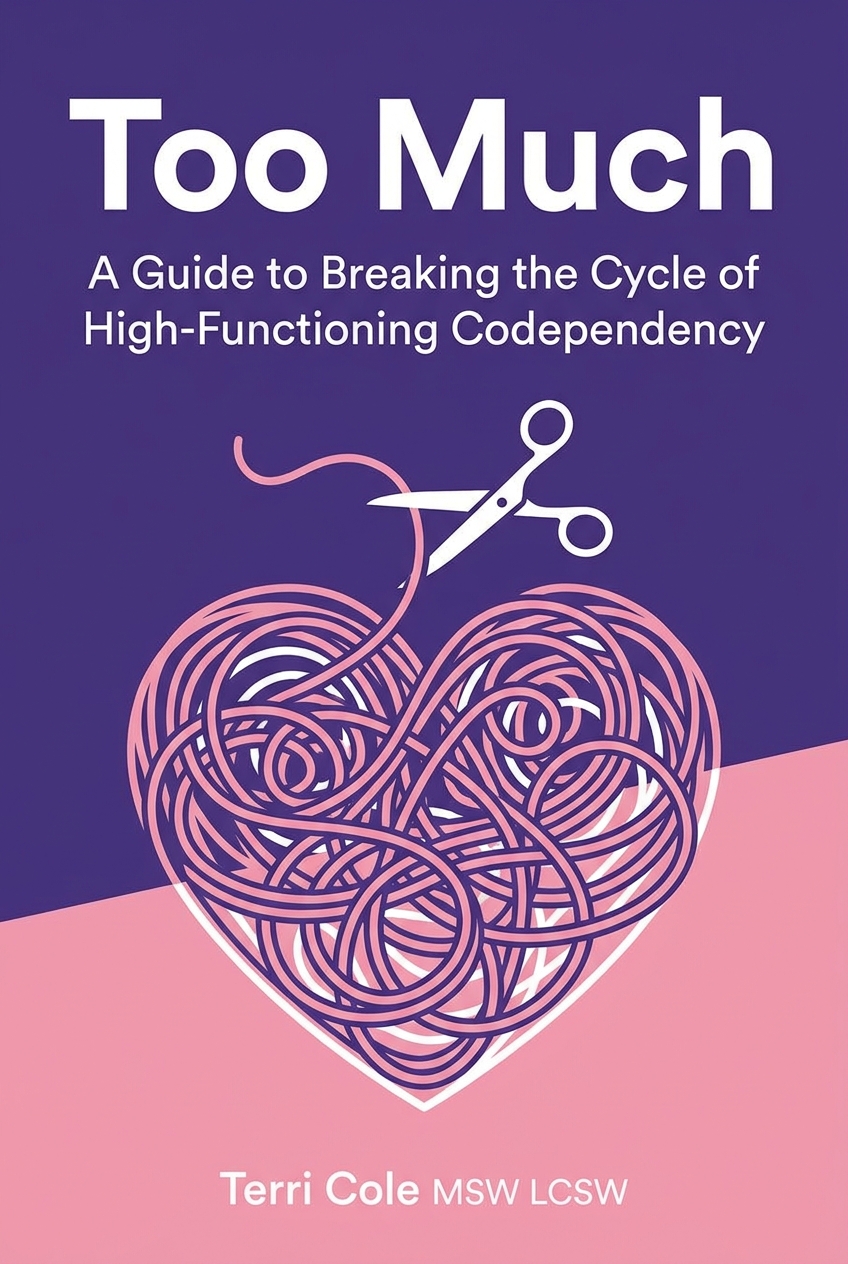
Too Much book cover

The Script

In a hospital maternity ward, two new mothers occupy adjacent rooms. Both are exhausted, both are overwhelmed, and both are deeply in love with their newborns. The first mother, when her baby cries, feels a surge of adrenaline. She scoops the child up, her body a coiled spring of readiness, her mind racing through a checklist: hungry, wet, cold, scared? She sees her child’s need as a direct command, an emergency she is uniquely equipped to handle. In the next room, the second mother hears her own baby cry. She, too, feels love and concern, but her physical response is different. It’s a gentle pull, a soft summons. She takes a slow breath, listens to the cry’s texture, and calmly moves to her child’s side, seeing the need as an invitation for connection. From the outside, their actions look nearly identical—they both soothe their babies. But internally, one is draining her own well to put out a fire, while the other is simply watering a garden.

This subtle but profound difference in internal response—the difference between being a high-functioning codependent and a securely attached caregiver—is the central mystery psychotherapist Terri Cole spent two decades untangling, first in her own life and then in her clinical practice. After years of being the go-to 'fixer' for her friends and family, she realized her compulsive need to help was actually a symptom of deep-seated, unresolved boundary issues. Her professional work as a licensed clinical social worker only magnified the pattern, revealing how many people, especially women, are conditioned to over-give, over-function, and override their own needs until they hit a wall of burnout and resentment. This book is the culmination of that personal and professional journey, a direct response to the thousands of clients who came to her saying the same thing: 'I feel like I’m doing everything for everyone, and I have nothing left for myself.'

Module 1: The Anatomy of "Loving Too Much"

So, what does it actually mean to "love too much"? It is a compulsive pattern where your relationship causes you pain, but you feel powerless to leave. The author defines it as an obsession with an inappropriate or unavailable person, where you mistake the intensity of your turmoil for the depth of your love.

This pattern has deep, predictable roots. Women who love too much often come from dysfunctional childhood homes where their emotional needs were unmet. In these families, feelings were often denied. A parent might be visibly angry but insist, "I'm not mad." This teaches a child to distrust their own perceptions. It damages their ability to see reality clearly. As adults, they are drawn to the familiar chaos of an unhealthy relationship because it feels like home. They are unconsciously trying to fix the past by healing their present partner.

Here’s where it gets really interesting. This behavior is a genuine addiction. The author argues that the relationship is used like a drug to avoid underlying pain, fear, and emptiness. Think about Jill's story from the book. She becomes obsessed with Randy, an emotionally distant lawyer. In the beginning, the relationship gives her a "high." But as he pulls away, she doesn't quit. She works harder. She makes more calls. She flies across the country to see him. Like an addict needing a bigger fix, she escalates her efforts, chasing a feeling that is no longer there. Being without the man brings on withdrawal symptoms—panic, emptiness, and intense emotional pain.

This leads to a specific kind of attraction. Women caught in this cycle are often bored by kind, stable, and reliable partners. They are drawn to a familiar type of emotionally unavailable person. Why? Because they are unconsciously trying to change them. Jill tried to change her cold father as a child. Then her distant husband. Then the unavailable Randy. Each man was a new project, a new chance to finally win the love she never received. The "nice" guy who is already available offers no such challenge. There's no emotional puzzle to solve, no one to "fix." For someone addicted to the struggle, that feels like boredom, not love.

Module 2: The Unconscious Dance of Dysfunction

Now we're going to dig into the psychology behind these choices. The process is guided by a powerful, unconscious script at play. People who love too much are choosing dance partners.

The author explains that people unconsciously select partners whose dysfunctions perfectly complement their own. She calls this the "pas de deux," a perfectly synchronized dance. For example, Melanie grew up taking care of her mentally ill mother. She learned her worth came from being responsible and sacrificing her own needs. As an adult, she marries Sean, an irresponsible man who needs her constant support. When he fails, she steps in. When he cheats, she distracts herself by caretaking even more. Their dynamic is a perfect, if painful, dance. His irresponsibility gives her a stage to be the hyper-responsible caregiver. It feels familiar. It feels like "love."

This attraction is powerful because it’s a chance for a do-over. The draw is to a symbolic opportunity to master childhood pain. Peggy grew up with a cruel, critical grandmother. She felt worthless. When she met Baird, a cold and arrogant man, her first thought wasn't "He's a jerk." It was, "I'll bet I could warm him up." She was instantly attracted to the challenge of changing an unloving person into someone who would finally love her. She was trying to win a victory she never could as a child. She was trying to fix her grandmother through Baird.

But what about the other side of this? Why are these men drawn to women who love too much? It's simple. The man is often seeking a "strong woman" to compensate for his own deficiencies. Tom, an alcoholic, was immediately drawn to Elaine. On a date, he caused a minor accident. Instead of getting angry, she smoothly took control and apologized for him. He felt a sense of safety. He felt looked after. Elaine continued to manage the consequences of his drinking for years, which allowed him to avoid facing his addiction. She was his "safe harbor," the person who would keep him from falling too far.

This is why recovery can be so destabilizing. When one partner starts to get healthy, it can destroy the relationship's equilibrium. When Elaine joined Al-Anon and stopped covering for Tom's drinking, he felt abandoned. He accused her of not loving him anymore. Her recovery broke their dance. She was no longer willing to play the role of enabler. Without that dynamic, the relationship that was built on it couldn't survive.

Read More