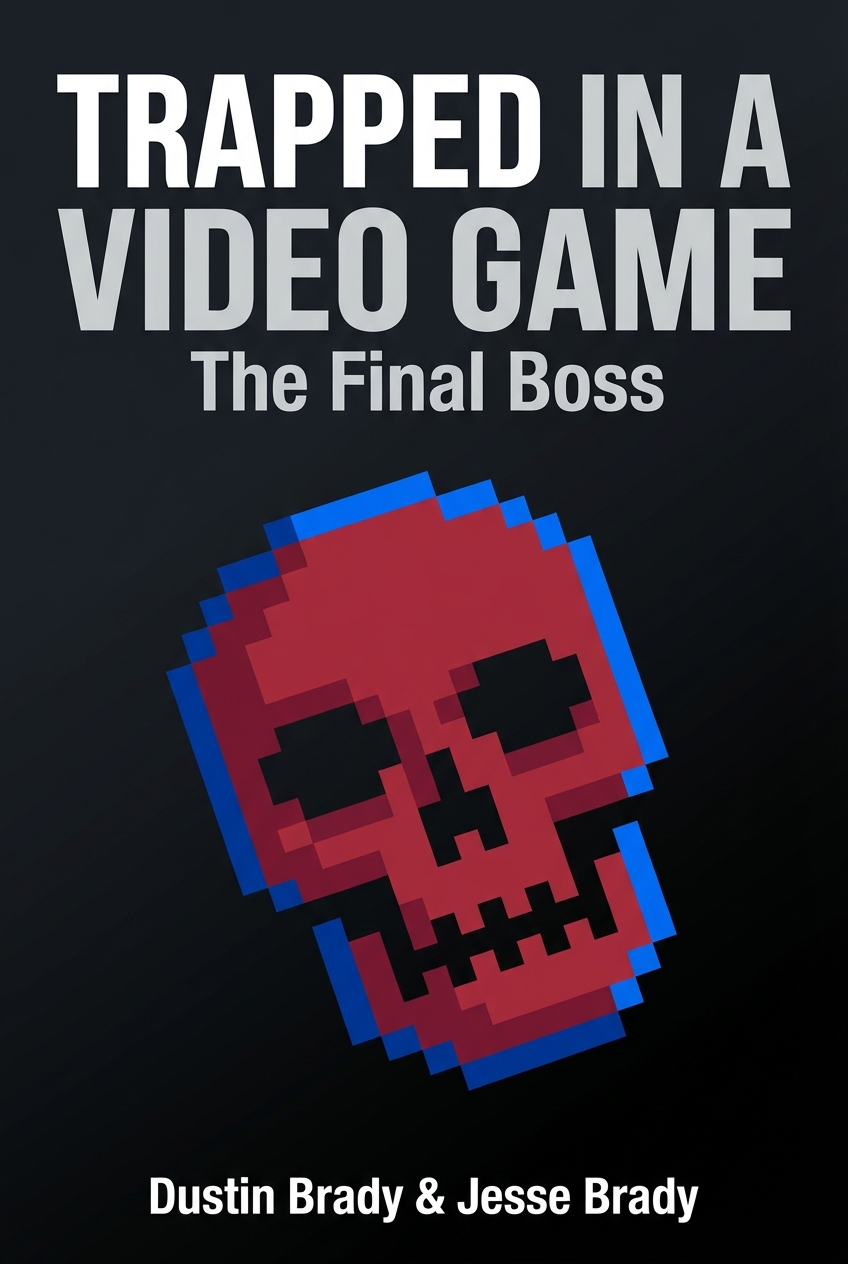
Trapped in a Video Game
The Final Boss
What's it about
Ready to face the final boss? Your favorite video game heroes, Jesse and Eric, are back for their most dangerous adventure yet. This time, they're not just playing to win—they're playing for their lives against a villain who knows their every move. Can you handle the ultimate showdown? You'll join the brothers as they navigate treacherous new levels and outsmart a seemingly unbeatable enemy. Discover how they use teamwork, quick thinking, and every power-up they can find to escape the game once and for all. Get ready for an epic, action-packed conclusion where every choice could be their last.
Meet the author
Dustin and Jesse Brady are the bestselling author-illustrator duo whose Trapped in a Video Game series has captivated over two million young readers worldwide. As brothers who grew up sharing a love for video games and storytelling, they combined their talents to create the action-packed worlds their readers adore. Dustin's clever writing and Jesse's dynamic illustrations spring from a shared childhood passion, turning their lifelong bond into a creative partnership that inspires kids to read.
Opens the App Store to download Voxbrief

The Script
Every kid who’s ever held a controller has felt that pull. The one that happens when the real world fades away and the digital one becomes all that matters. It’s the feeling of your thumbs knowing exactly which button to press without you even thinking, your eyes tracking every pixelated threat on screen. The line between you and the character you’re controlling starts to blur. Your mission becomes their mission. Their world becomes your world. It's a powerful, captivating feeling—so powerful that for a split second, you might wonder what would happen if that line dissolved completely. What if the screen wasn't a window, but a door? And what if, just once, that door swung open and pulled you through?
That exact question was the spark for a father-and-son team who lived and breathed video games. Jesse Brady, a young gamer, often found himself so lost in his favorite adventures that he’d joke with his dad about what it would be like to actually live inside one. His father, Dustin Brady, an author who was always searching for stories that could get reluctant readers as excited as a new game release, saw the potential. Together, they started brainstorming, blending Jesse's firsthand knowledge of gaming logic and culture with Dustin's knack for fast-paced storytelling. The result was a book built for kids who would rather be playing a video game—a story that feels like you're holding a controller from the very first page.
Module 1: The Unraveling of Reality
The story begins with a deeply unsettling glitch in reality. The protagonist, Jesse, wakes up to find a toy from his favorite video game, Full Blast, talking to him. This is the first sign that the barrier between his world and the game world is collapsing. The experience is disorienting. He questions his own sanity, a feeling that quickly escalates when he transforms into an invisible, intangible ghost.
This abrupt shift forces a total re-evaluation of his existence. Losing physical agency triggers primal fear and existential confusion. Jesse discovers his new state when his hands pass through a milk jug. His family can't see or hear him. His immediate reaction is panic. He screams, but no one responds. This is about the sudden, terrifying loss of control over his own body and his ability to interact with the world. His mind races with practical, unanswerable questions. What do ghosts eat? Do they go to school? The foundations of his life are gone, replaced by a new, terrifying set of rules he doesn't understand.
From here, the narrative introduces another critical element. Absurd, unexpected threats amplify suspense by destroying any sense of a predictable world. Just as Jesse is grappling with being a ghost, he turns to find an eight-foot-tall, bright blue Bigfoot calmly sitting in his bathtub. This is a surreal, almost comical image that makes the situation even more terrifying. The story is shattering the rules of reality. This moment teaches a key lesson about crisis: sometimes the most disarming threats are the ones that make no sense at all. They defy our frameworks for problem-solving and force us into a purely reactive state. Jesse is fundamentally lost in a new reality that operates without logic.
Module 2: Navigating the Augmented World
Now that Jesse is a ghost, the rules of his new existence start to become clear. He’s a digital entity trapped inside an augmented reality game called "Go Wild." This is where the book introduces its core mechanic. An adult player, Mr. Gregory, finds Jesse and explains the situation. Through Mr. Gregory's phone, Jesse can see the hidden digital layer overlaid on the real world—a world filled with collectible creatures, items, and battles invisible to the naked eye.
This brings us to a crucial insight. Being trapped inside an AR game creates unique physical and social dangers. Jesse is part of the game's digital layer. This means any player with the "Go Wild" app can see him, battle him, and potentially capture him forever. He is a rare prize in a global game. His survival now depends on avoiding detection. Mr. Gregory warns him to stay away from anyone staring at their phone, which, as Jesse bleakly notes, is "like everyone." He has to learn to read social cues for survival. A person engrossed in their screen is a potential enemy.
So, how does this game even work? The mechanics will feel familiar to anyone who has played a creature-collection game. AR game mechanics are built on collection and combat using strategic advantages. In "Go Wild," players find and capture creatures called "Wild Things." They use creatures they already own to battle new ones. Mr. Gregory demonstrates this by using his gecko-like monster to defeat and capture a snake-like one. He explains that his gecko is "really good against snakes," highlighting a system of type advantages. Winning captures the creature; losing knocks your creature out for 24 hours. These are the rules Jesse must now live by. He is, for all intents and purposes, a Wild Thing himself.
This new reality forces a complete shift in strategy. Survival in an AR world demands stealth and a keen awareness of player behavior. Jesse can no longer walk freely. He must hide, moving from shadow to shadow, constantly scanning his environment for threats. He learns to ride underneath a school bus by phasing through the floor, a clever use of his ghost-like abilities to remain unseen. This is about hiding from ordinary people who have the power to end his existence with a swipe of their finger. The constant tension comes from this inversion of the normal world. The most mundane places—a school bus, a library, a suburban street—become high-risk environments, and every person holding a phone is a potential hunter.
Module 3: Hacking the System
Being trapped is one thing. Being powerless is another. For a while, Jesse believes he has no special abilities. He’s just a ghost, an observer. But that changes. Through accidental experimentation, he discovers he can control ice. A simple yawn and stretch unleashes a blast of ice that freezes a tree solid. This is a turning point.
It reveals a fundamental principle of this new world: characters trapped in a game can discover and learn to control emergent, game-based abilities. Jesse is no longer just a victim. He is a player. He learns that a specific gesture—stretching his arms and spreading his fingers—triggers the power. He becomes like Elsa from Frozen, able to create ice on command. However, this power isn't infinite. In a fight with a T-Rex and the blue Bigfoot, he exhausts his ice ability. It dwindles from a powerful blast to a pathetic snowball, then nothing. This introduces another game-like constraint: resource management. In-game abilities are a finite resource that must be managed strategically. His power is a tool with a cooldown period, forcing him to think tactically about when and how to use it.
But what good are powers if you're alone? Jesse's only link to the real world is his friend, Eric, who he manages to contact through another player's phone. This is where the story explores another layer of its world. Communication between the game world and the real world is chaotic and unreliable. Eric is more excited about Jesse's situation than helpful. He’s fascinated by the game mechanics, asking about upgrades and rare creatures, while Jesse is desperately trying to communicate his peril. The game itself is the only medium for their interaction, and it's a flawed one.
Eventually, Jesse is captured and finds himself literally inside another player's phone. Here, the story offers a chilling look at the loss of autonomy. When he's released for a battle, his physical actions are controlled by the player's swipes. He is a puppet. His friend Eric challenges the player to a duel to win Jesse back, but the stakes are terrifying. If Eric wins, Jesse is free from that player but still trapped in the game. If Eric loses, his creature will be destroyed, and Jesse will remain a prisoner. The absurdity of his situation is matched only by the loyalty of his friend. This blend of high-tech horror and genuine friendship is what drives the narrative forward, showing that even within a cold, digital system, human connection remains the most powerful force.