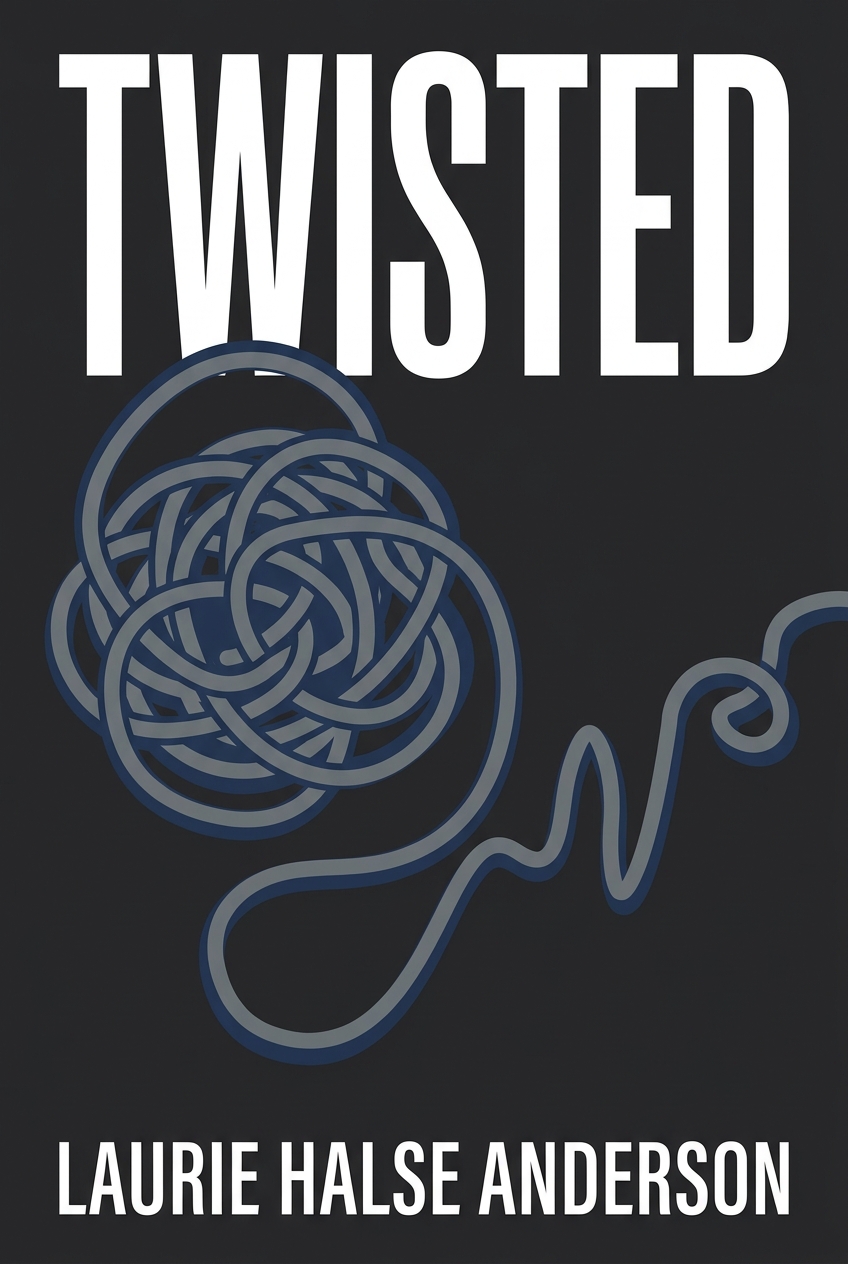
Twisted
What's it about
What if the worst thing you ever did came back to define you? For high school senior Tyler Miller, a stupid prank has led to a summer of isolation and a reputation he can't shake. Now he just wants to be invisible, but no one is willing to forget. Returning to school feels like a minefield of whispers and accusations. You'll follow Tyler's struggle to reconnect with his family, his friends, and a girl who might see the real him. But when a new crisis explodes, he's the prime suspect, and keeping quiet could cost him everything.
Meet the author
Laurie Halse Anderson is a New York Times bestselling author whose groundbreaking work has earned her the prestigious Margaret A. Edwards Award for her significant and lasting contribution to young adult literature. A fierce advocate for survivors of sexual assault and a champion of free speech, Anderson fearlessly tackles difficult subjects with honesty and compassion. Her dedication to exploring the complex emotional lives of teenagers, like Tyler in Twisted, stems from her belief that stories can foster understanding and create change.
Opens the App Store to download Voxbrief

The Script
You’re eighteen, and you’ve spent your entire life being the good kid. The quiet one. The guy who keeps his head down, does his homework, and never makes a wave. But one stupid, angry mistake one night, and suddenly, that’s not who you are anymore. The label changes overnight. Now you’re the bad kid. The delinquent. The one to watch out for. The worst part isn't the whispers in the hallway or the distrustful glances from teachers. The worst part is the silence. The silence from your own father, who seems to look right through you. The silence from friends who now cross the street to avoid you. It’s a silence that screams, a pressure that builds until you feel like you’re going to explode. You try to get back to being invisible, to just serve your time until graduation, but the world won’t let you. It keeps pulling you into situations where you have to choose: stay silent and safe, or speak up and risk everything, confirming the new, terrible story everyone has already written about you.
This suffocating pressure, this feeling of being trapped inside a reputation you didn’t ask for, is the exact territory Laurie Halse Anderson wanted to explore after the groundbreaking success of her novel Speak. Following its publication, she received countless letters from readers, but a surprising number came from boys. They wrote about their own pain, their own silences, and their own struggles with the rigid expectations of masculinity. They felt unheard. Anderson realized there was a parallel story that needed telling—one about a boy silenced by anger, confusion, and the impossible script of what it means to be a man. She wrote Twisted as a direct response, giving a voice to the boys in the back of the classroom who were hurting just as much, but in ways society refused to see.
Module 1: The Trap of a Predictable Life
We begin with Emily Snow. She’s a young woman whose life feels like a sentence she’s serving. Her world is the family funeral home, a business steeped in death and legacy. It’s her inheritance. But it’s also her prison.
This introduces a core tension of the story. Your sense of duty can become a cage. Emily feels bound to the mortuary. It was her mother’s legacy. Her father needs her to keep it running. Leaving feels like a betrayal. So she stays. Day after day, she preps bodies and comforts grieving families. Her friend Tessa mocks her grim reality. She jokes about Emily spending her life contouring dead grandmas until it’s her turn on the table. This hits a nerve. Emily loves her work, but her greatest fear is dying before she has ever truly lived.
This feeling of being trapped makes her vulnerable. It’s a quiet desperation. And that’s where the story finds its first major twist. The monotony is shattered by the arrival of a mysterious, intimidating man. He isn't there for a funeral. He's there to "dispose" of a body. This single word triggers Emily’s professional alarm. Bodies are interred or cremated. They are not "disposed of" unless they need to be hidden.
This stranger, Ruarc, is the complete opposite of her predictable world. He is dangerous. He is chaotic. And his presence forces Emily to confront a terrifying possibility. The people closest to you may be hiding the biggest secrets. Her father, the man she’s sacrificing her life for, might be involved in something criminal. The foundation of her world starts to crack. She's no longer just a mortician’s daughter. She's a witness. And the predictable life she once resented now seems like a paradise she can never get back.
Now, let's switch perspectives to understand the man who just shattered Emily's world.
Module 2: The Architecture of Control
Meet Ruarc. He is a man who doesn’t just live in the shadows; he built them. He owns Delirium, an exclusive, high-end club for society's elite. It's a place where politicians, businessmen, and even priests come to indulge their darkest desires. The club is his kingdom. And in his kingdom, control is everything.
Ruarc's philosophy is simple. Exclusivity is a form of power. Delirium’s waitlist rivals Ivy League colleges. Membership costs tens of thousands of dollars. Inside, phones are forbidden. Masks are mandatory. Members become faceless, nameless avatars. This anonymity is what they pay for. It’s a complete separation from their public lives. Ruarc controls this environment absolutely. He controls who gets in, what happens inside, and most importantly, he controls the secrets.
And here’s the thing about secrets. Knowledge of others' weaknesses is the ultimate currency. Ruarc knows the scandalous details of some of the most powerful men in the world. This knowledge places him above the very rules his clients write for society. He is a king in a court of carefully managed chaos.
This obsession with control extends to his criminal enterprise. He runs a network of escorts. But his operation is a fortress. His people work only in vetted hotels with trusted clients. He protects them. This is good business. It’s a calculated system designed to minimize risk and maximize profit. He contrasts his protective model with the exploitative world his own mother endured.
But what happens when this control is challenged? When the undertaker he pays for body disposal, Emily's father, tries to renegotiate his fee, Ruarc sees it as insubordination. He doesn't send an enforcer. He goes himself. He believes some messages must be delivered in person, punctuated by pain. This brings him back to the mortuary. And back to Emily. The moment he sees her, his obsession with control finds a new target. His desire for her is immediate and total. It is about possession. He sees her and thinks, "I had to have her." She becomes his next conquest.
This sets the stage for a collision of two worlds. Emily is trapped by duty. Ruarc is trapped by his need to dominate.