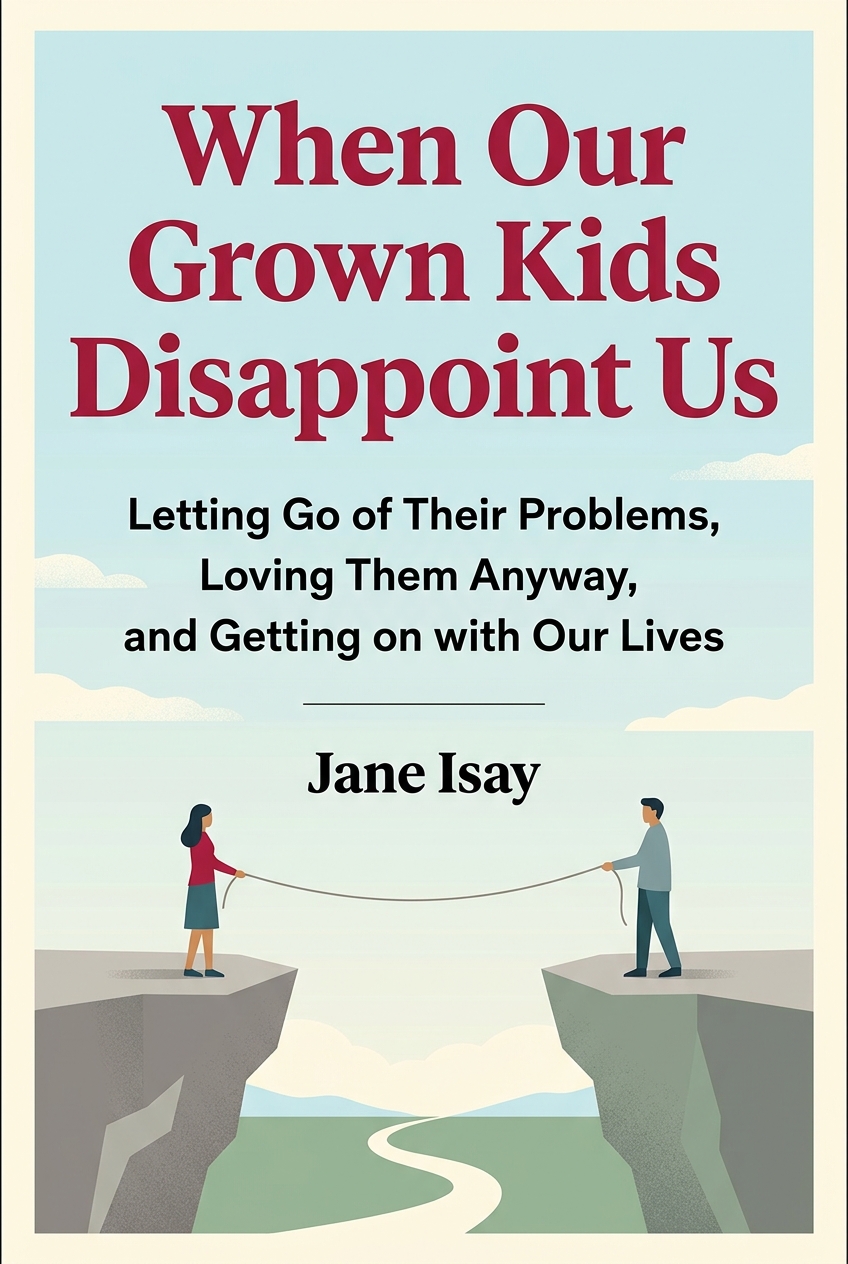
When Our Grown Kids Disappoint Us
Letting Go of Their Problems, Loving Them Anyway, and Getting on with Our Lives
What's it about
Do you feel a painful gap between the life you imagined for your grown children and their reality? Learn how to bridge that divide, stop agonizing over their choices, and rebuild a loving, respectful relationship that brings you peace, not constant worry. This summary unpacks Jane Isay's expert advice for navigating this difficult journey. You'll discover how to let go of blame, set healthy boundaries, and communicate effectively, even when you disagree. It’s time to get on with your own life while still loving your kids unconditionally.
Meet the author
Jane Isay is an acclaimed editor and author with over forty years of experience at the heart of the publishing industry, where she has shaped countless influential books on psychology and family dynamics. Drawing on her professional expertise and personal experiences as a mother and grandmother, Isay conducted extensive interviews with parents to explore the profound, often unspoken, challenges of loving adult children. Her work offers compassionate, practical guidance for navigating these complex relationships with grace and wisdom.
Opens the App Store to download Voxbrief

The Script
The old woman sat by the window, the half-knitted sleeve of a sweater resting in her lap. Outside, her small garden was a study in devotion—the dahlias staked, the weeds pulled, the soil turned. She had tended it for thirty years with the same patient care she had once given her son. She had watered his talents, staked his ambitions, and pulled the weeds of his bad habits. She had expected a sturdy, vibrant bloom. Instead, she got a perennial disappointment—a man in his forties who drifted from job to job, relationship to relationship, never quite taking root. She loved him, of course. That was the agonizing part. The love was a deep, underground spring, but every time it surfaced, it hit the rock of her unmet hopes. This was the long, slow ache of watching the person you raised become someone you barely understood, and feeling a forbidden sense of failure that was yours alone.
That feeling of private parental grief is precisely what Jane Isay began to notice in her own life and the lives of her friends. As a veteran book editor and the author of several acclaimed works on family relationships, she was accustomed to navigating complex emotional terrain. Yet, she found this particular subject—the quiet sorrow parents feel when their adult children's lives don't match the script they envisioned—was a conversation held only in whispers. Isay decided to bring it into the light. Drawing from her own experiences and conducting dozens of candid interviews with other parents, she wrote this book to give voice to a profound, often unspoken, aspect of lifelong love and to explore how parents can find peace and rebuild connection, even when their dreams for their children have been profoundly altered.
Module 1: The Great Inversion of Authority
Something has gone terribly wrong in modern parenting. Over the last few decades, a quiet but powerful shift has occurred. The authority that once belonged to parents has been handed over to children. This is abdication, pure and simple. And it’s at the root of many of the issues we see today, from disrespect to poor health. The author’s central argument is that parents must reclaim their role as loving authority figures, not friends. This is about providing the structure and guidance that children need to thrive. Without it, they are left adrift in a culture that prioritizes their whims over their well-being.
Consider the case of Tara, a 14-year-old with a diet-related rash. Her mother admits Tara eats only junk food. She refuses vegetables. The mother doesn't enforce healthier habits. She yields to her daughter's preferences, even as they cause physical harm. This is a small but telling example of a much larger trend. Parents are afraid to say "no." They are afraid to be unpopular with their own children.
This leads to a startling paradox. We see that despite parents investing more time and resources than ever, child outcomes are worsening. American children are heavier, less fit, and more likely to be diagnosed with behavioral disorders than they were 25 years ago. The author, drawing on over 90,000 office visits, saw this firsthand. Parents are uncertain. They are trying to be buddies, not leaders. They negotiate when they should command.
But what happens when parents do assert their authority? Look at Janet and Bill Phillips. They hosted parties for their teenagers but used a Breathalyzer to prevent underage drinking. At first, other parents called them controlling. But soon, their house became the go-to spot. Why? Because it created a safe space. It gave teens who didn't want to drink a socially acceptable out. This is proactive leadership. It demonstrates a crucial insight: effective parenting requires setting firm boundaries for long-term well-being, even if it’s unpopular in the short term. You have to learn to say "no." Especially when it feels hard. This is about providing the guardrails that allow children to grow into capable, resilient adults.
Module 2: The Culture of Disrespect and the Peer-Driven World
Why is childhood so long for humans? It is for enculturation. This is the process of learning the values, customs, and behaviors of a specific culture. A child in Kyoto learns Japanese and tea ceremonies. A child in Appenzell learns Swiss German and cheese-making. This process requires guides. Historically, those guides were parents. But today, something is interfering. A new culture has emerged, one that actively undermines parents.
The author argues that modern American culture systematically dismantles parental authority and outsources socialization to peers. This happens in a few ways. First, schools have narrowed their focus to academics, leaving social and moral education entirely to parents. At the same time, our society has grown uncomfortable with any power imbalance, a concept the sociologist Norbert Elias called "role confusion." This discomfort has weakened the parent-child hierarchy. Children are now "empowered," but often without the wisdom to handle that power. Popular media reinforces this. Disney shows routinely portray parents as clueless, absent, or incompetent, teaching children that adults are not to be taken seriously.
So what happens next? Children turn to their peers for guidance. They inhabit a peer-driven world defined by a "culture of disrespect." This is a pervasive mindset that devalues adults and prioritizes the opinions of other children. Think of the slogans on T-shirts worn by kids: "DO I LOOK LIKE I CARE?" Or consider the music, which has shifted from the innocent romance of The Beatles to the explicit hostility of modern rap. This is a coarsening of culture, aimed directly at the young. The result is that children's primary attachment shifts from family to friends, creating a fragile and conditional sense of self-worth. A girl named Cynthia, for example, becomes rude and secretive with her parents but is charming and open with her friends. Her loyalty has shifted. The family bond is broken.
But flip the coin. What's the solution? The author is clear: parents must prioritize the parent-child relationship over peer relationships to successfully transmit values. This means making unpopular decisions. It means insisting on family vacations, even when a child would rather stay with friends. Megan and Jim made this mistake. They let their 12-year-old daughter Courtney skip a family ski trip. They thought they were fostering independence. In reality, they were reinforcing her dependence on peers. An authoritative parent would have said, "You are coming with us." Because shared family experiences are not optional. They are the foundation upon which character is built. This is how you teach values: through lived, shared time together.