Have you ever looked up at the night sky and felt a profound sense of wonder? Have you pondered the big questions: Where did all of this come from? What is our place in the vastness of space? How will it all end? If so, you’ve been thinking like a cosmologist.
Cosmology is the scientific study of the universe as a whole—its origin, its evolution, and its ultimate fate. It’s a field that combines the grandest theories of physics with the most detailed astronomical observations to tell the most epic story of all. For anyone curious about these profound topics, finding good books on cosmology is the best way to start an incredible journey of discovery. This guide serves as an introduction to cosmology, breaking down key ideas to help you navigate this fascinating subject.
What is Cosmology? Unpacking the Basics
At its heart, cosmology seeks to build a coherent narrative of the cosmos based on physical laws. Think of it as cosmic archaeology, piecing together clues from light that has traveled for billions of years to understand the past and predict the future. This discipline is built upon several foundational ideas, or cosmology key concepts, that have revolutionized our understanding of reality.
The Big Bang Theory: Not Just an Explosion
One of the most misunderstood concepts is the Big Bang theory. It doesn't describe an explosion in an existing space, but rather the origin of space and time itself. As Stephen Hawking explains in his landmark book A Brief History of Time, the universe began in an incredibly hot, dense state and has been expanding and cooling ever since. This model is supported by overwhelming evidence, including the faint afterglow of the Big Bang, called the cosmic microwave background, and the observation that distant galaxies are speeding away from us. It’s the starting point for modern ideas on universe origins.
The Pillars of Modern Physics
Our entire understanding of the cosmos rests on two powerful but seemingly incompatible theories. In Seven Brief Lessons on Physics, Carlo Rovelli beautifully illustrates this divide. One pillar is Albert Einstein's theory of general relativity, which describes the universe on the grandest scales. It reveals a cosmos where gravity is not a force, but a curvature in the fabric of spacetime caused by mass and energy. This is the theory that governs planets, stars, and galaxies.
The other pillar is quantum mechanics, which describes the bizarre and probabilistic world of the very small—atoms and particles. It’s a realm where particles can be in multiple places at once and reality seems to shimmer with uncertainty. A major goal in modern astrophysics is to unite these two pillars into a single “theory of everything” that can describe all physical phenomena, from the Big Bang to the inner workings of black holes.
Dark Matter and Dark Energy: The Universe's Invisible Majority
For all that we can see—stars, galaxies, planets—it turns out we’re missing most of the picture. Observations of how galaxies rotate and cluster together reveal that there's far more gravitational pull than visible matter can account for. Scientists call this invisible substance dark matter. It acts as a cosmic scaffolding, an invisible glue holding galaxies and galactic clusters together.
Even stranger is dark energy. In the late 1990s, astronomers discovered that the universe's expansion isn't slowing down as expected; it's accelerating. This acceleration is attributed to a mysterious repulsive force inherent to the fabric of space itself, known as dark energy. Together, dark matter and dark energy are believed to make up about 95% of the universe. Understanding them is one of the biggest challenges in science today.
Why Exploring Good Books on Cosmology Matters
Why should someone who isn't a physicist care about cosmology? Because it's about more than just equations and distant galaxies. Cosmology provides context for our existence. It connects us to a story that began 13.8 billion years ago and will continue for trillions more. It’s a topic perfectly suited for a curious mind, even if you’re approaching cosmology for beginners and feel intimidated by the science.
Understanding Our Origins
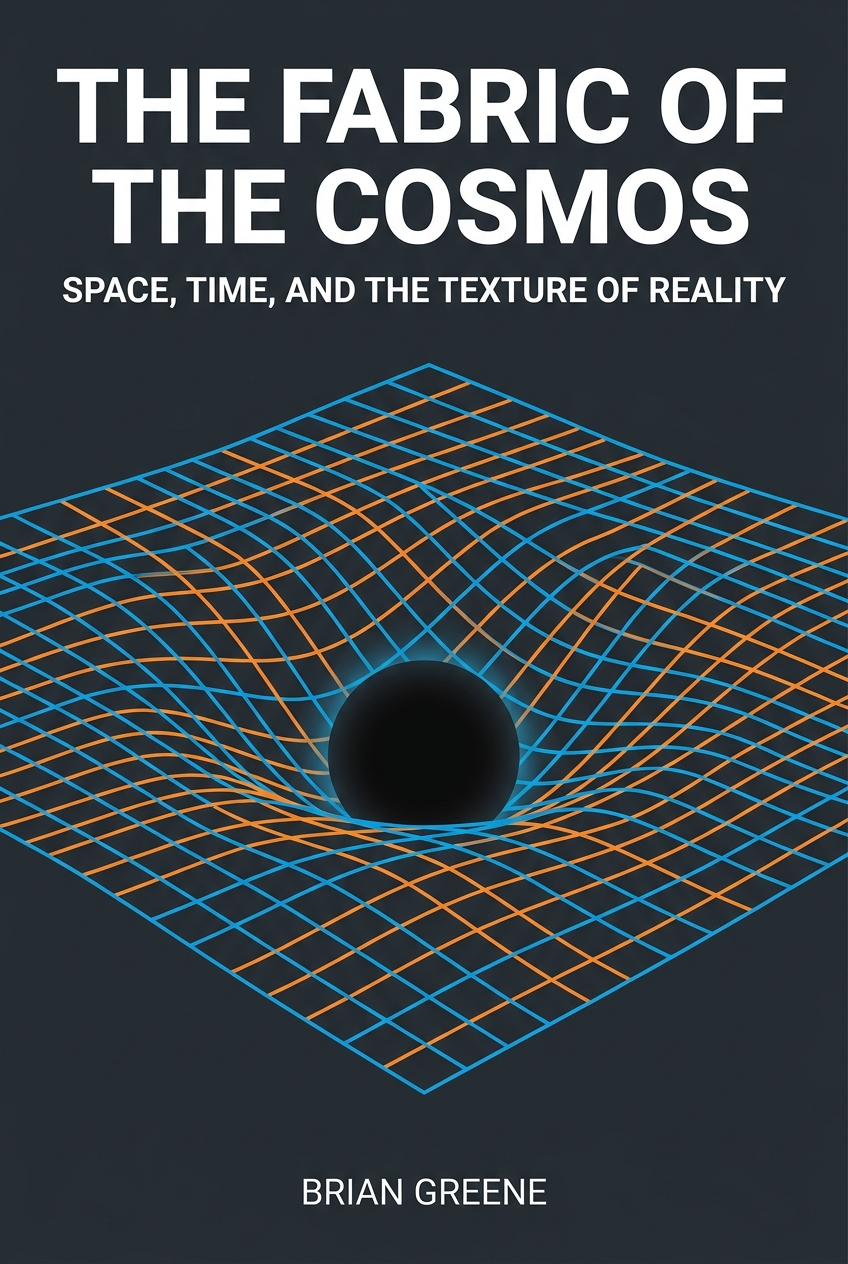
Cosmology is the ultimate origin story. It explains how the simple elements forged in the Big Bang were cooked into heavier elements inside stars, which were then scattered across the cosmos by supernova explosions. Those elements eventually formed new stars, planets, and, on at least one world, life. As Brian Greene explores in The Fabric of the Cosmos, the very arena of our existence—spacetime—is a dynamic entity shaped by matter and energy. Understanding this framework, as laid out by Einstein, is fundamental to grasping how the universe evolved to a state where life became possible. We are, quite literally, made of stardust.
Peering into Cosmic Mysteries: Black Holes and Beyond
Cosmology is filled with objects and ideas that push the limits of our imagination. No object captures this better than black holes—regions of spacetime where gravity is so strong that nothing, not even light, can escape. Books like A Brief History of Time brought the concept of black holes to the public consciousness, showing them as real, physical objects and not just theoretical curiosities. They are cosmic laboratories where our theories of physics are tested to their breaking point.
Beyond black holes, the field is rich with other mysteries, from the search for other universes (the multiverse) to the strange behavior of quantum particles. Exploring these topics through popular science writing makes complex astrophysics accessible and exciting.
Contemplating the End: The Ultimate Questions
The story of the universe has a beginning, but it also has an end. Thinking about the ultimate fate of the cosmos forces us to confront deep questions about time, existence, and meaning. In her book The End of Everything, astrophysicist Katie Mack walks readers through the leading scientific scenarios for the universe's demise. Will everything collapse back on itself in a fiery "Big Crunch," a reversal of the Big Bang? Or will it expand forever until it suffers a "Heat Death," a cold, dark, and empty future where all activity ceases?
Brian Greene's Until the End of Time takes this a step further, examining how life and consciousness can find meaning in a universe that is itself temporary. He argues that the fleeting nature of existence doesn't diminish its value but instead makes the emergence of art, story, and purpose all the more precious and remarkable. This is cosmology explained simply, but with profound philosophical weight.
Navigating Your Cosmic Journey: How Cosmology Works
So, how does cosmology work as a science? It’s a dynamic interplay between theory and observation. Cosmologists build mathematical models based on the laws of physics to describe the universe. These models then make specific, testable predictions.
Astronomers and astrophysicists use powerful instruments, like the Hubble and James Webb Space Telescopes, to observe the cosmos and gather data. They measure the distances to galaxies, map the cosmic microwave background, and search for the signatures of exotic phenomena. When observations match the predictions of a model, our confidence in that model grows. When they don't, it signals that something is missing, prompting theorists to refine their ideas or develop new ones.
This process has led to the latest cosmology discoveries, including the confirmation of gravitational waves and the ongoing puzzle over the precise rate of the universe’s expansion. The field is a living, breathing science where new data can change our picture of the cosmos overnight. For anyone starting out, the journey from an initial introduction to cosmology to a deeper understanding is one of constant wonder and intellectual thrill.
Your Place in the Cosmos
Cosmology is more than just a branch of science; it's a fundamental human endeavor. It is the modern-day expression of our ancient drive to understand the heavens and our connection to them. The universe is a vast and indifferent place, yet it has produced beings who can look back at it, marvel at its structure, and piece together its story.
By engaging with these ideas—whether through the elegant simplicity of Rovelli, the foundational insights of Hawking, the narrative sweep of Greene, or the candid explorations of Mack—you are participating in one of humanity's greatest adventures. You are learning the language of the cosmos and, in doing so, gaining a new perspective on your own existence.
Master key ideas in 15 minutes
Listen to audio summaries of these books on VoxBrief
Download Free