Have you ever looked at your daily routine—the commute, the emails, the endless to-do lists—and found yourself asking, "Is this it?" Do you feel a quiet, persistent yearning for a deeper sense of meaning and purpose? If so, you're not alone. You're brushing up against the great, terrifying, and ultimately liberating questions that form the heart of existentialism. This philosophy isn't about dwelling in despair; it's a powerful toolkit for building a life of authentic purpose. This article serves as an introduction to existentialism, showing how challenging but rewarding existential books can illuminate the path.
What is Existentialism? An Explanation for Beginners
At its core, existentialism is a school of thought that emphasizes individual freedom, responsibility, and the subjective experience of life. It rejects the idea that there is a preordained purpose or set of rules for humanity. Instead, it proposes that we are thrown into the world and left to figure it out for ourselves. For beginners, this can sound daunting, but it's also incredibly empowering. Let's break down some foundational existentialism principles.
Existence Precedes Essence
This is perhaps the most famous phrase in existential philosophy, popularized by Jean-Paul Sartre. It means that you are not born with a fixed nature, purpose, or "essence." A knife is created with an essence—its purpose is to cut. Humans, Sartre argued, are different. We are born first ("existence") and then, through our choices and actions, we create who we are ("essence"). You are not a 'shy person' or a 'natural leader' by default; you become those things through your repeated decisions. You are the artist of your own life, and every choice is a brushstroke.
Freedom and Responsibility
If you are responsible for creating your own essence, it means you are radically free. There are no excuses—not your upbringing, not your personality type, not your horoscope. Every moment presents a choice. This freedom, however, comes with a heavy burden of responsibility. Sartre called this being "condemned to be free." This isn't a negative condemnation, but a statement of fact: you cannot escape the necessity of making choices, and you are responsible for the consequences of those choices.
The Search for Meaning and Purpose
If the universe has no inherent meaning, where do we find it? Existentialists argue that meaning is not something you discover, but something you create. It is an active, ongoing process. This is precisely the lesson psychiatrist Viktor Frankl learned during his time in Nazi concentration camps, a journey he documented in Man's Search for Meaning. Frankl realized that even in the most horrific circumstances, individuals retained what he called "the last of the human freedoms": the power to choose one's own attitude. He observed that those who survived were often not the strongest physically, but those who held onto a purpose. He identified three primary paths to meaning: creating a work or doing a deed, experiencing something or encountering someone (love), and the attitude we take toward unavoidable suffering.
Navigating the Void: Core Concepts in Existential Books
Once you grasp the basics, you'll start to see existential themes everywhere, especially in literature and philosophy. The most powerful existential books don't just tell you about these ideas; they make you feel them. They explore the anxieties, paradoxes, and joys of living a self-created life.
Absurdism
Closely related to existentialism is absurdism, most famously articulated by Albert Camus. The Absurd is the conflict between our human desire for meaning and order, and the universe's silent, irrational indifference. It’s the feeling of shouting a question into the cosmos and hearing only silence in return. In his classic essay, Camus likens the human condition to the Greek myth of Sisyphus, who was condemned to eternally push a boulder up a hill, only for it to roll back down. Camus’s radical conclusion is that we must imagine Sisyphus happy. By embracing the futility of his task and doing it with rebellious joy, Sisyphus finds freedom in his meaningless struggle. To live an absurd life is to rebel, to be free, and to live with passion in the face of a meaningless world.
Authenticity vs. The Divided Self
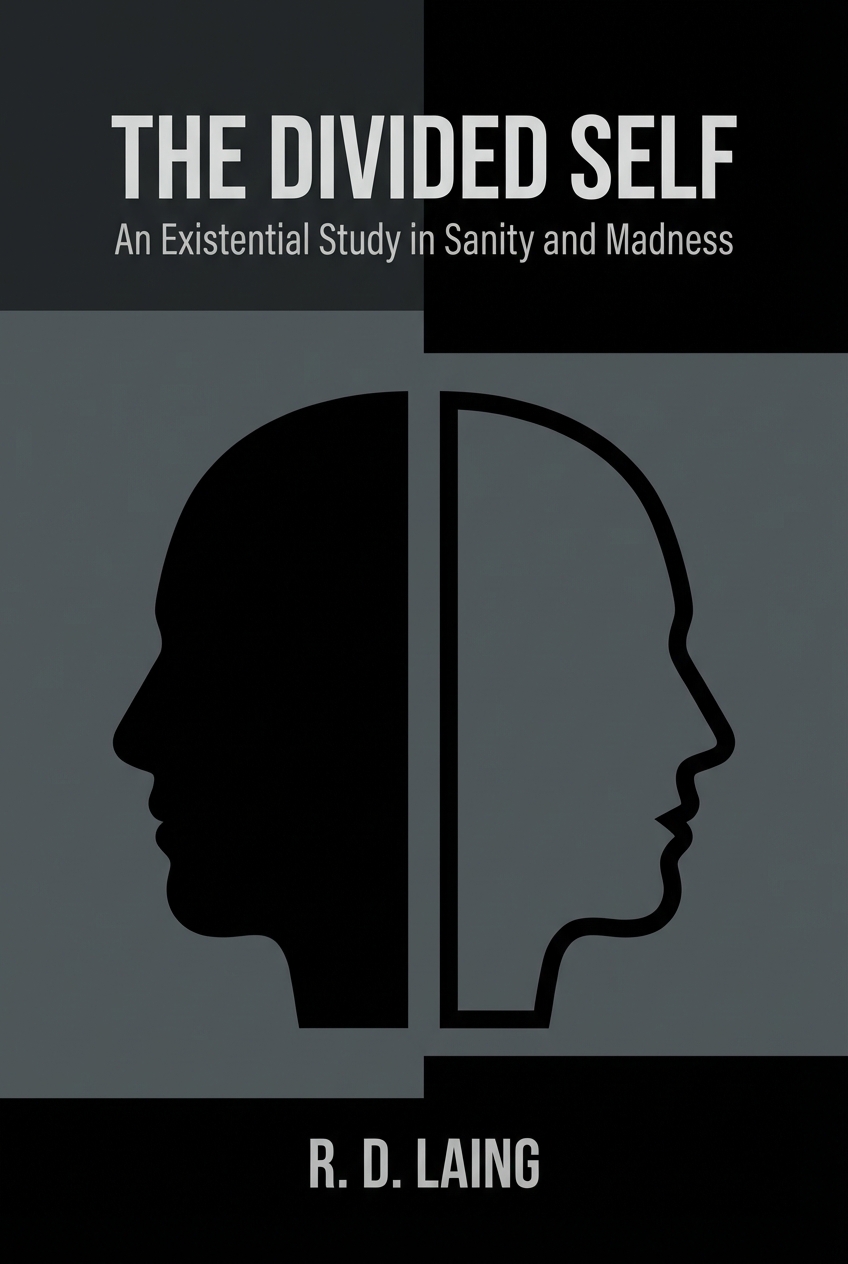
If we are free to create ourselves, how do we do it authentically? A major obstacle is the pressure to conform to society's expectations. We often wear masks, playing roles we think we're supposed to play—the diligent employee, the perfect parent, the happy-go-lucky friend. In his groundbreaking work The Divided Self: An Existential Study in Sanity and Madness, psychiatrist R. D. Laing explores this phenomenon. He introduces the concept of "ontological insecurity," a fundamental feeling of being unreal or disconnected from oneself. To cope, a person might develop a "false-self system," a protective mask that interacts with the world while the true, inner self remains hidden and safe. Laing shows that this division, while a survival strategy, ultimately leads to a profound sense of alienation. True existential living requires the courage to drop the mask and integrate your inner self with your outer actions.
Existential Risk and Responsibility
Existential anxiety isn't just a personal feeling; it can operate on a global scale. In The Precipice, philosopher Toby Ord argues that humanity is currently in its most dangerous period, an era where our technological power has far outpaced our wisdom. We now possess the means to cause our own extinction through threats like engineered pandemics or rogue AI. This places us at a unique historical moment, what Ord calls "The Precipice." This is a collective existential crisis. We are forced to confront our collective freedom and responsibility, not just for our own lives, but for the entire future of humanity. The decisions our generation makes could determine whether humanity has a future at all, making the existential themes of choice and responsibility more urgent than ever.
How to Practice Existentialism in Everyday Life
Learning about these concepts is one thing; living them is another. Existentialism is not just a philosophy to be debated in a classroom; it is a practice for living a more deliberate and meaningful life. This is a practical introduction to existentialism that you can start applying today.
Embrace Radical Ownership
The first step is to take full ownership of your life and your choices. It's easy to blame external factors—your boss, the economy, your past—for your unhappiness. An existential approach demands that you focus on what you can control: your responses, your attitude, and your actions. This idea is a central pillar of Stoicism, a philosophy with deep parallels to existentialism. In his private journal, Meditations, the Roman Emperor Marcus Aurelius constantly coached himself to build a "citadel of the mind." He practiced separating what he could control (his judgments, his intentions, his will) from what he couldn't (what other people did, his health, his reputation). This discipline of control is a profoundly practical tool for reducing anxiety and reclaiming your personal power.
Create Your Own Values
Living authentically means moving beyond a life of simple conformity. It requires introspection to understand what you truly value, separate from what your parents, friends, or society tells you to value. Do you prioritize security over adventure? Community over independence? Creativity over comfort? There are no right answers, only your answers. The process involves questioning the "shoulds" that dominate your inner monologue and replacing them with conscious, chosen commitments. Exploring books about existentialism can provide frameworks and inspiration, but the real work is the quiet, daily effort of aligning your actions with your self-defined principles.
Find Meaning in Action
Ultimately, an existential life is an active life. Purpose is not found in navel-gazing, but in engagement with the world. This is Frankl’s lesson in action. Find a project that matters to you and pour yourself into it. Cultivate deep relationships with others. When faced with challenges you cannot change, choose to face them with courage and dignity. By focusing on your actions, you shift your mindset from a passive victim of circumstance to an active creator of your own meaning.
Existentialism doesn't promise happiness or offer easy answers. It acknowledges that life is often difficult, absurd, and filled with anxiety. But within that challenging reality, it hands you the ultimate tool: the freedom to choose your own path and create your own meaning. It's a call to wake up, take responsibility, and live a life that is truly your own.
Master key ideas in 15 minutes
Listen to audio summaries of these books on VoxBrief
Download Free