All Books
Self-Growth
Business & Career
Health & Wellness
Society & Culture
Money & Finance
Relationships
Science & Tech
Fiction
Topics
Blog
Download on the App Store

2am Thoughts

Poetry that condenses an entire relationship into a single day

17 minMakenzie Campbell

What's it about

Have you ever felt the entire emotional rollercoaster of a relationship in just a few hours? This collection of poetry captures that intense journey, showing you how love, heartbreak, and healing can unfold from the dizzying highs of midnight to the quiet hope of dawn. Discover how to find beauty and understanding in your own emotional landscape. Campbell’s verses act as a mirror, reflecting the universal feelings of connection and loss. You'll learn to embrace the vulnerability of 2 a.m. and see your own experiences as part of a shared, poetic human story.

Meet the author

With over 100 million online poetry views, Makenzie Campbell is a prominent voice in modern literature, capturing the hearts of a generation with her viral works. She first began sharing her relatable poetry on Tumblr, transforming her quiet, late-night musings on love and heartbreak into a global conversation. Her debut collection, 2am Thoughts, distills the complex, universal emotions of an entire relationship into a single, poignant day, born from her unique ability to find the profound in the everyday.
Listen Now

Opens the App Store to download Voxbrief

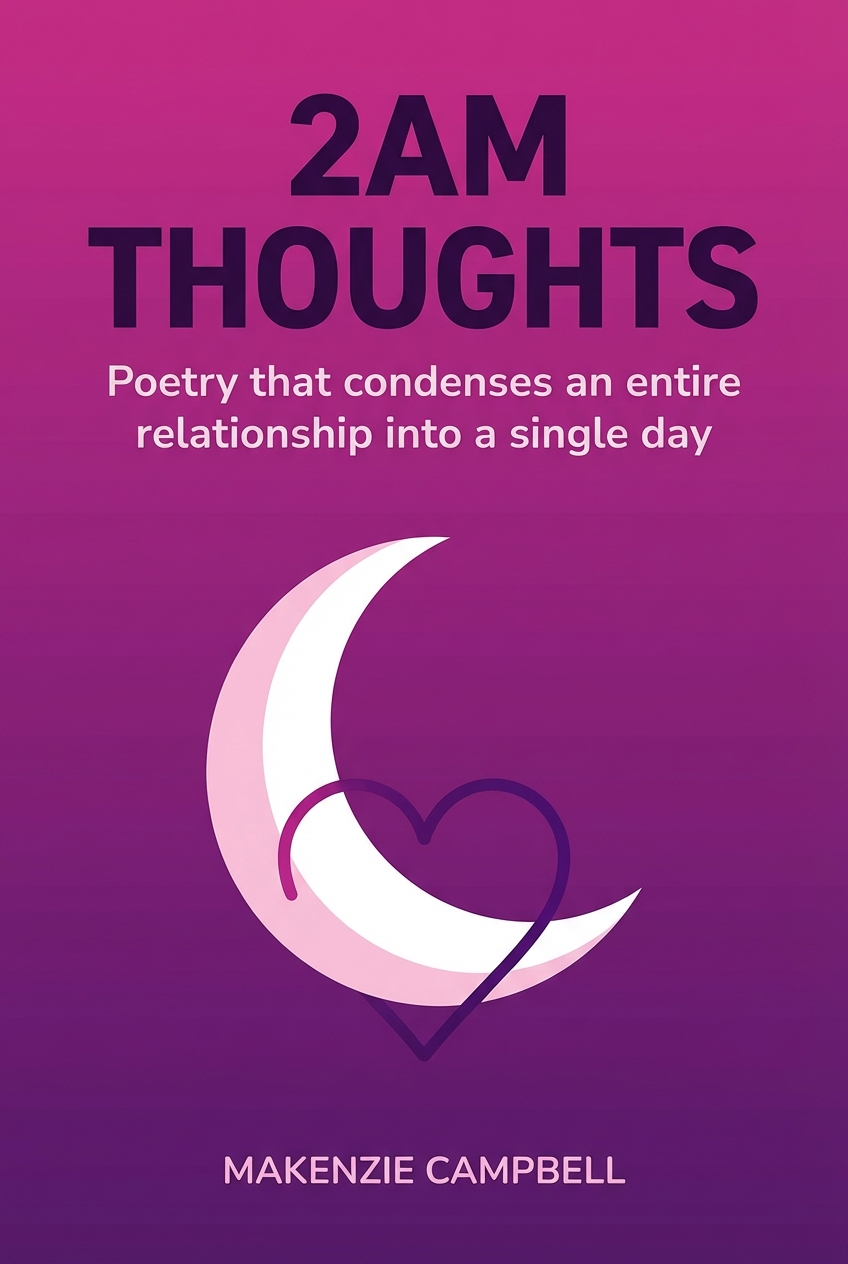
2am Thoughts book cover

The Script

Every city has its own secret schedule, a rhythm that only reveals itself after midnight. The daytime rush of deadlines and errands fades, replaced by the low hum of streetlights and the distant siren. The world outside your window goes quiet, but inside, another world awakens. This is the hour of the unsent text, the replayed conversation, the sudden, sharp memory of a summer that ended five years ago. It’s when the carefully constructed walls of the day crumble, leaving you alone with the questions you’re too busy to ask at noon and too tired to answer at dawn. It’s a space where every small feeling is amplified—a pang of loneliness, a flicker of hope, the ghost of a laugh. You’re the sole audience member in a theater of your own thoughts, watching the raw, unedited reel of your own heart.

This is the precise territory Makenzie Campbell began to chart, not as a formal project, but as a personal necessity. As a young writer navigating the complexities of growing up, she found herself using the quiet solitude of the late-night hours to process the world around her. She started sharing these brief, vulnerable fragments online—short poems and prose pieces that captured the specific ache of a feeling without a name. What began as a way to make sense of her own experiences of love, loss, and self-discovery quickly resonated with thousands of others who recognized their own 2am thoughts in hers. “2am Thoughts” is the collection of those moments, a book born from the universal, unspoken language of the sleepless and the heartsick.

Module 1: The Anatomy of Heartbreak and Longing

We begin with the universal search for profound connection. Campbell's work strips away superficial desires. It’s about a deeper, more transformative love.

The first insight is that true connection is about emotional depth, not surface-level perfection. The book dreams of a partner with "the patience to wait hours for the wind while floating in the middle of the eternal sea." This isn't a literal request. It's a metaphor for someone who understands that great things require patience. Someone who isn't rushing. Someone who has a "heavy soul so deep and so complex it could take years to understand." This is a direct challenge to the swipe-right culture of instant gratification. It suggests that the most meaningful relationships are the ones we invest time in exploring.

But flip the coin, and this intense desire for depth sets the stage for equally intense pain. When that connection is broken, the fallout is devastating. This brings us to a powerful truth. Heartbreak is a complete dismantling of the self. Campbell describes this feeling vividly. After a breakup, she feels "gutted." Her love drains away "until all that was left... was a heap of clattering bones." It’s a visceral image. It captures the feeling of being hollowed out, of losing a fundamental part of your structure. The pain isn't just emotional. It feels physical. It's an emptiness that echoes long after the person is gone.

And here's the thing. The memory of that person often lingers. It becomes a ghost. Campbell writes, "2 AM / you’re still here / in my head / haunting me." This is the essence of the book's title. The late-night hours are when defenses are down. It's when unresolved feelings surface and demand attention. The haunting isn't just a memory. It's an active presence that disrupts peace. It’s an obsession that can feel impossible to shake. This reveals a critical aspect of modern relationships. The digital echoes of a person, through texts and photos, can make it harder than ever to truly let go.

This leads to a final, brutal realization about betrayal. The book confronts this head-on. Betrayal is a moment of truth. When a partner is caught in a lie, the classic excuse is that it was a mistake, a lapse in judgment. Campbell refutes this. She writes about a partner who claimed to be working late but was with another woman. He called it a "moment of weakness." Her response is sharp. "It wasn’t. It was a moment of truth." This reframes the entire narrative. It was a choice that revealed the person's true character and priorities. For anyone who has been deceived, this is a validating and empowering perspective. It shifts the focus from the other person's excuse to the undeniable reality of their actions.

Module 2: The Inner Battle for Self-Worth

We've explored the pain of external relationships. Now we turn inward. The second module focuses on the private struggle with insecurity and the long, difficult journey toward self-love. This is often the hardest part of the healing process.

It starts with a deep-seated fear. A fear that many high-achievers secretly harbor. The fear of being fundamentally unlovable can create deep-rooted anxiety. Campbell recalls having panic attacks. They stemmed from the idea that she "might never have anybody to love." This fear became a self-fulfilling prophecy. She writes, "I eventually believed I was simply unlovable." This is a powerful look at how a narrative we tell ourselves can become our reality. It's about an internal belief system that convinces us we are not worthy of connection. This resonates in a professional world where imposter syndrome is rampant. The fear of not being good enough extends from the boardroom to our personal lives.

So what happens next? This insecurity becomes a lens through which we view ourselves after a relationship ends. We don't just mourn the loss of the other person. We question our own value. The book captures this with painful clarity. After a rejection, we often adopt the negative perception we believe our ex-partner had of us. Campbell looks back at a past relationship and sees a "boring and insecure version" of herself. She then internalizes this critique. "I can’t imagine anyone loving me," she writes, "if I couldn’t even be that person to you." This is a toxic feedback loop. The failure of the relationship becomes proof of our own inadequacy. It’s a cognitive distortion that many of us fall into. We take one data point, a breakup, and extrapolate it into a universal truth about our own worth.

Building on that idea, the book acknowledges a universal human driver. The need to be desired is a fundamental, almost primal, human impulse. Campbell states it plainly: "The necessity to be desired eats away at us all." This is presented as a fact of the human condition. In a world saturated with social media, this need is amplified. We are constantly exposed to curated versions of other people's lives. We see their relationships, their successes, their validation. This can intensify our own feelings of inadequacy if we feel we're falling short. Recognizing this drive as universal can be liberating. It’s not just you. It’s a shared struggle.

So here's what that means for the path forward. You can't wait for someone else to fix this. The journey must be internal. This is where the book pivots from pain to empowerment. Self-love is the fundamental requirement for survival. After a partner leaves, the speaker has a revelation. She realizes he taught her "how to tend my own garden rather than helplessly wait for someone else to do so." The lesson wasn't in the love he gave, but in his absence. "Only in your absence did I learn I can survive on my own just fine." This is a critical turning point. It shifts the source of validation from external to internal. The book makes a bold claim: "Self love is survival. Without that, oxygen won’t do a damn thing." It's a powerful statement. It argues that our relationship with ourselves is more critical to our existence than anything else. True resilience is built from the inside out.

Read More