All Books
Self-Growth
Business & Career
Health & Wellness
Society & Culture
Money & Finance
Relationships
Science & Tech
Fiction
Topics
Blog
Download on the App Store

Gender Trouble

Feminism and the Subversion of Identity (Routledge Classics)

11 minJudith Butler

What's it about

Ever feel like the rules of gender just don't fit? What if the categories of "man" and "woman" aren't as natural as we're taught? This book summary reveals why your identity is more powerful and fluid than you've been led to believe. You'll learn how gender is a performance you can rewrite, not a script you're forced to follow. Discover how to challenge rigid expectations and subvert outdated norms. This summary unpacks Judith Butler's groundbreaking ideas on performativity, giving you the tools to understand and express your true self with confidence.

Meet the author

Judith Butler is one of the most influential and provocative thinkers in contemporary philosophy, whose work has fundamentally reshaped feminist and queer theory. Drawing from post-structuralist philosophy and psychoanalysis, Butler’s early academic work interrogated the very foundations of identity. This critical inquiry led to their groundbreaking concept of gender performativity, a radical idea that argues gender is not an internal essence but a series of repeated, socially constructed acts, which became the central thesis of their landmark book, Gender Trouble.
Listen Now

Opens the App Store to download Voxbrief

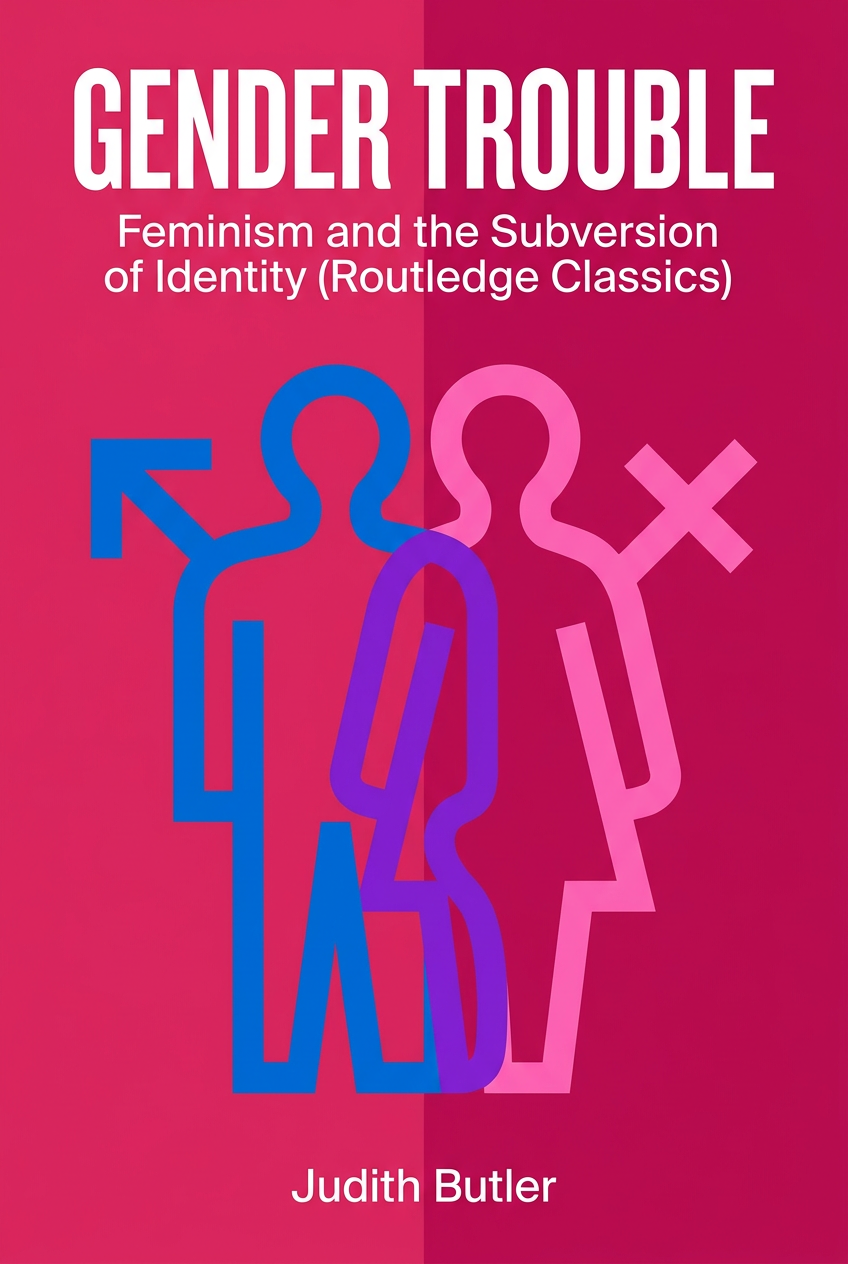
Gender Trouble book cover

The Script

We treat our identity like a house we inherit. The structure seems solid, the rooms are already named—this is the 'masculine' room, that is the 'feminine' hallway. We might redecorate, paint the walls, or change the furniture, but we rarely question the foundation itself. We accept that the blueprint for who we are was drawn up long before we arrived, a fixed architecture of biology and culture. This acceptance feels natural, inevitable. But what if this entire model is a trick of the light? What if the house isn't an inheritance at all, but a performance we put on every single day, and the very act of performing it is what makes the walls seem solid?

The conviction that our most deeply felt identities are actively constructed, moment by moment, is the intellectual earthquake at the heart of Judith Butler’s work. As a philosopher and gender theorist at UC Berkeley, Butler was wrestling with a puzzle that the feminist movements of the time couldn't quite solve. The push for 'women's liberation' seemed to rely on a stable, universal category of 'woman'—the very same category that felt like a cage to so many. Butler’s response was to dismantle the act of defining itself. "Gender Trouble" emerged from this critical impasse, a radical proposal that gender isn't something we are, but something we do, often unwittingly, repeating a script written by a culture that insists the performance is real.

Module 1: Gender is a Performance, Not an Essence

Let's begin with Butler’s most famous and perhaps most misunderstood idea. The central argument is that gender is performative.

This concept suggests gender is a much deeper phenomenon than a theatrical choice. Butler suggests that gender is constituted through a stylized repetition of acts. We learn and repeat certain gestures, behaviors, and ways of moving our bodies. These acts, repeated over time, create the illusion of a stable, natural gender identity. It's a ritualized practice. What we think of as an internal essence is actually an effect produced on the surface of the body.

Here's the thing. This performance is not done in a vacuum. It happens within a rigid social framework that punishes those who deviate. The "doer" is constituted in and through the deed. This is a radical departure from how we usually think about identity. We tend to believe there is a core "me" that has a gender. Butler flips this. The "me" doesn't exist before the gendered performance. The performance itself brings the gendered subject into being.

This leads to a powerful insight. Drag and other parodic performances reveal the imitative structure of all gender. When we see a drag queen perform an exaggerated femininity, it can be funny or entertaining. But Butler asks us to look deeper. A drag performance imitates the idea of "woman." It exposes that "real" femininity is also a kind of performance, a set of codes and gestures we've all learned to copy. Drag reveals that there is no original. There are only copies, all the way down. This unmasks the naturalized, hegemonic genders of "man" and "woman" as just as constructed as the parody.

Module 2: The Heterosexual Matrix

So, if gender is a performance, who writes the script? Who directs the show? This brings us to Butler's next major concept: the "Heterosexual Matrix."

This is the invisible cultural grid that makes certain kinds of lives intelligible and others nonsensical. A compulsory social order aligns sex, gender, and desire into a coherent, seemingly natural sequence. The matrix dictates that a "male" body should express a "masculine" gender and desire a "female" body, which in turn should be "feminine" and desire a "male." It's a regulatory framework that presents this specific alignment as natural, inevitable, and right.

Think about how this plays out. From birth, a body is assigned a sex. That assignment triggers a cascade of expectations about gender expression, social roles, and, eventually, sexual desire. This framework produces and reifies the binary categories of "men" and "women." It's the logic that makes us see a "butch" woman or an "effeminate" man as a "gender confusion." Their existence troubles the neat lines of the matrix.

Consequently, identities that disrupt this alignment are rendered culturally unintelligible or "abject." The term "abject," borrowed from Julia Kristeva, refers to what is violently cast out to preserve a clean and proper identity. People whose gender doesn't "follow" from their sex, or whose desire doesn't "follow" from their gender, are often seen as failures, impossibilities, or even monstrous. They don't fit the grid. Butler argues this is the matrix policing its own boundaries.

Building on that idea, the binary categories of "sex" are political constructs. Butler radically questions the traditional feminist distinction between sex as biological and gender as cultural. She argues that the very idea of "sex" as a pure, pre-cultural, biological fact is itself a product of this matrix. The scientific and medical discourses that define sex as a strict binary are not neutral. They are implicated in the same power structures that enforce compulsory heterosexuality. The decision to categorize a complex array of bodies into just two neat boxes is a political one, designed to uphold a specific social order.

Read More