All Books
Self-Growth
Business & Career
Health & Wellness
Society & Culture
Money & Finance
Relationships
Science & Tech
Fiction
Topics
Blog
Download on the App Store

Malice in Wonderland Bundle 1

The First Trilogy & Prequel (Malice In Wonderland Bundles)

13 minLotus Rose

What's it about

Tired of predictable fairy tales? Get ready to shatter the looking glass and dive into a Wonderland that's darker, deadlier, and more seductive than you ever imagined. This isn't the story you know; it's a twisted, psychological thriller where survival is the only rule. You'll follow a new Alice as she navigates a court of madness, uncovering conspiracies and confronting a dangerously alluring Mad Hatter. Discover how this prequel and trilogy reimagines the classic tale into an epic dark fantasy romance, exploring themes of power, obsession, and what happens when innocence is lost forever.

Meet the author

Lotus Rose is a bestselling author and pioneering scholar in psychological literature, having spent over a decade researching the archetypal patterns found in classic fairy tales. Her work began as a personal quest to understand the darker, often-ignored undercurrents of these stories from childhood. This unique background in mythology and psychology allowed her to deconstruct and brilliantly reimagine the world of Wonderland, offering readers a mature, thought-provoking, and unforgettable journey down the rabbit hole.
Listen Now

Opens the App Store to download Voxbrief

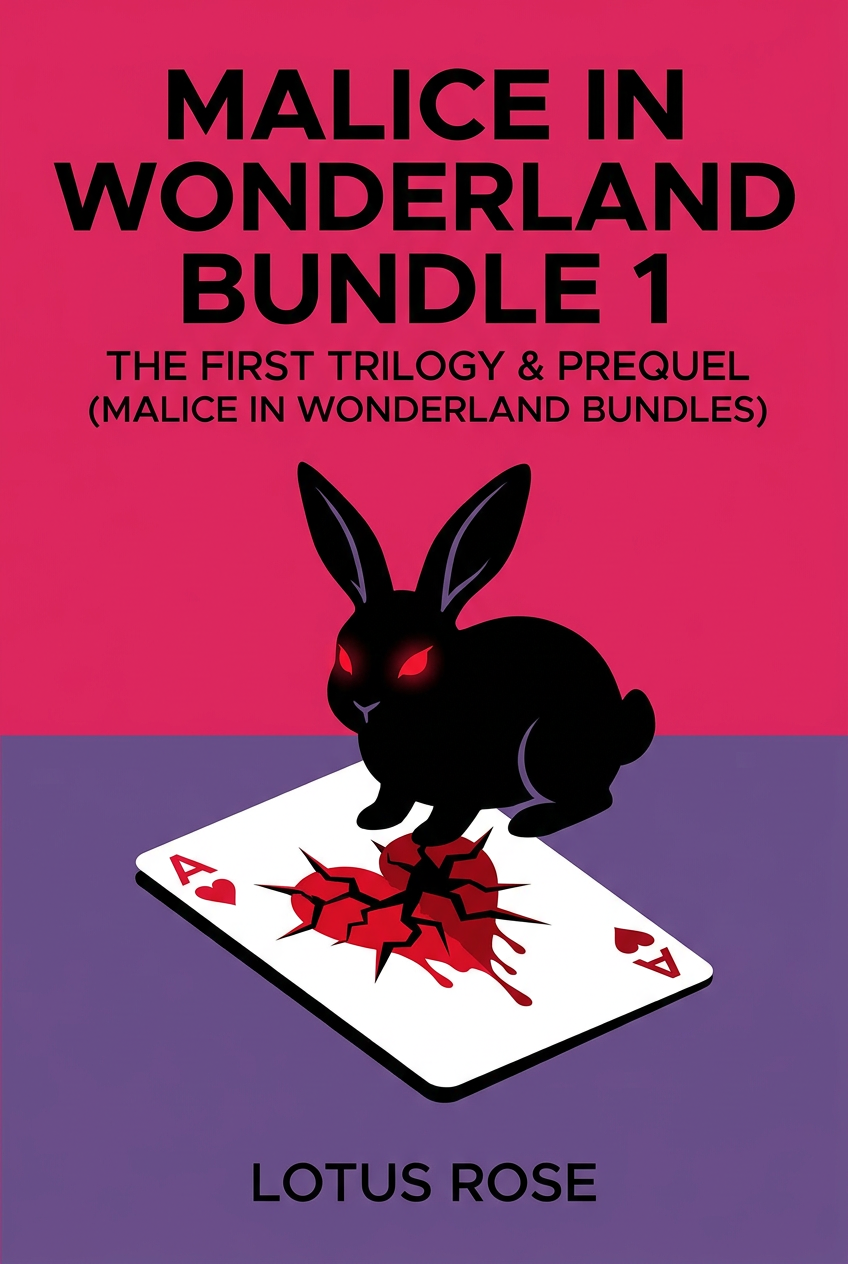
Malice in Wonderland Bundle 1 book cover

The Script

In a child’s game of make-believe, the rules are fluid and forgiving. The teacup is empty, but we pretend it’s full. The monster under the bed is fierce, but we know it will vanish with the morning light. It’s a world built on a shared, gentle agreement that the darkness is only temporary, the dangers are symbolic, and the story will always end with a return to safety. But what happens when one person at the tea party isn’t pretending? What if, for them, the teacup is brimming with a potent, intoxicating poison, and the monster isn’t under the bed, but sitting right across the table, smiling, and calling you by name? The game shifts. The familiar landscape of childhood fantasy warps into a place of genuine peril, where every nonsensical riddle is a threat and every invitation is a trap. The line between playful madness and true malice dissolves, leaving you in a wonderland where the only rule is survival.

This chilling transformation of the familiar into the terrifying is the creative obsession of Lotus Rose. Growing up, she was captivated by the unsettling undertones lurking just beneath the surface of fairytales—the predatory nature of the wolf, the possessiveness of the prince, the true darkness of the deep woods. She saw these stories as psychological landscapes where innocence is a liability and curiosity is a dangerous weapon. Her work, including the 'Malice in Wonderland' series, was born from a desire to strip away the child-friendly veneer and explore the primal, often disturbing, psychological truths she always sensed were hiding in plain sight within these timeless tales.

Module 1: The Psychology of Captivity and Control

The story opens with a stark reality. Alice is a prisoner in Wonderland. The Queen of Hearts exploits her, the other inhabitants torment her, and her only value seems to be the magical properties of her tears. This module examines the psychological tools used to control Alice and how she begins to adapt.

A core insight here is that coercive control strips away autonomy and forces compliance through fear. We see this immediately with the Jabberwock. He is not inherently evil. In fact, he feels sympathy for Alice. But he is bound to the Queen by debt and banishment. He enforces her will because he has no other choice. This creates a complex dynamic. The Jabberwock becomes both a perpetrator and a victim of the same oppressive system. He shows Alice kindness, then hands her over to the guards. This teaches Alice a brutal lesson. In Wonderland, even sympathy is a luxury that can’t be trusted.

This leads to another key idea. Oppression triggers a duality of anger and submission. When Alice is first captured, her reaction is pure rage. She threatens the Jabberwock, referencing the violent "Jabberwocky" poem. She wants to fight. She wants to kill. But her anger is quickly extinguished by overwhelming helplessness. She breaks down, sobbing and apologizing. This psychological shift from defiance to resignation is a recurring theme. It’s the mind’s way of coping when resistance seems utterly futile.

Yet, even within this oppressive structure, characters cling to their own internal logic. The book suggests that a rigid personal code of honor can justify violence and create moral complexity. The Jabberwock operates under the "jabberwock code." He killed a man named Herbert, but insists it was an honorable act of vengeance. Herbert had cheated and dishonorably murdered his own father. The Jabberwock’s code demanded retribution. When Herbert's daughter, Laricia, challenges the Jabberwock to a duel, he is honor-bound to accept. He doesn't want to fight her. He respects her. But the code is absolute. This creates a world where characters are driven by complex internal rules that often lead to tragic outcomes.

And here’s where it gets really interesting. These conflicts are fueled by competing narratives and personal grief. Laricia believes her father was a hero, a "Jabberwock Slayer" killed in cold blood. The Jabberwock knows Herbert was a dishonorable cheat. Both are driven by their version of the truth. Their conflict is about whose story wins. This shows how personal history and competing myths can perpetuate cycles of vengeance, locking characters in a seemingly endless battle for validation and justice.

Module 2: The Corruption of Innocence and the Birth of Malice

As Alice endures years of cruelty, her internal landscape begins to shift. The constant torment, neglect, and humiliation start to wear away at her innate goodness. This module tracks her descent into a darker mindset and the emergence of a new, more ruthless persona.

The turning point comes when Alice realizes that prolonged exposure to cruelty can erode one's spirit and cultivate a "black heart." A mysterious veiled girl, who is implied to be a future version of Alice, warns her of this exact fate. She explains how years of negativity caused her to seek revenge, to internalize the darkness around her. Alice initially resists. She insists she will "kill them with kindness." But the warning plants a seed of doubt. The narrative suggests that positivity alone is not a strong enough shield against sustained, systemic abuse. Your environment can, and will, change you.

So what happens next? Alice discovers that deception and malice can be powerful tools for gaining agency. For years, she was a passive victim. But after her heart is stolen, something inside her breaks. She learns to lie. She lies to the Cheshire Cat to get a pistol. The text notes how "thrilling" the deception feels. This is a critical moment. It's the first time Alice takes active, manipulative control of a situation. She then engineers the death of a guard who had tormented her, laughing as he burns. This is the Alice who has learned that in Wonderland, cruelty is a more effective tool than kindness.

This transformation is not just psychological; it's almost physical. The book posits that emotional numbness becomes a necessary defense mechanism against overwhelming trauma. By age nine, Alice is a shell of her former self. She is consumed by dark thoughts of revenge, but outwardly she appears numb and detached. This emotional shutdown is a survival strategy. When the pain is too much, the mind simply stops feeling. This numbness allows her to endure, but it also paves the way for more extreme actions. She is no longer constrained by guilt or empathy.

This leads to a fascinating development. The loss of innocence gives rise to a mirrored, heartless self: Malice. After Alice orchestrates the death of Humpty Dumpty, a new character, Malice, is "born" from his shattered shell. Malice is Alice's perfect physical double, but she is heartless, logical, and ruthlessly pragmatic. She represents what Alice is becoming—a being stripped of emotion, driven by pure, calculated self-interest. Malice sees hearts as a "burden." She is the ultimate expression of survival in Wonderland. She is what's left when all sentiment has been burned away. The two are now separate entities, setting the stage for a conflict with Wonderland and with Alice's own darker half.

Read More