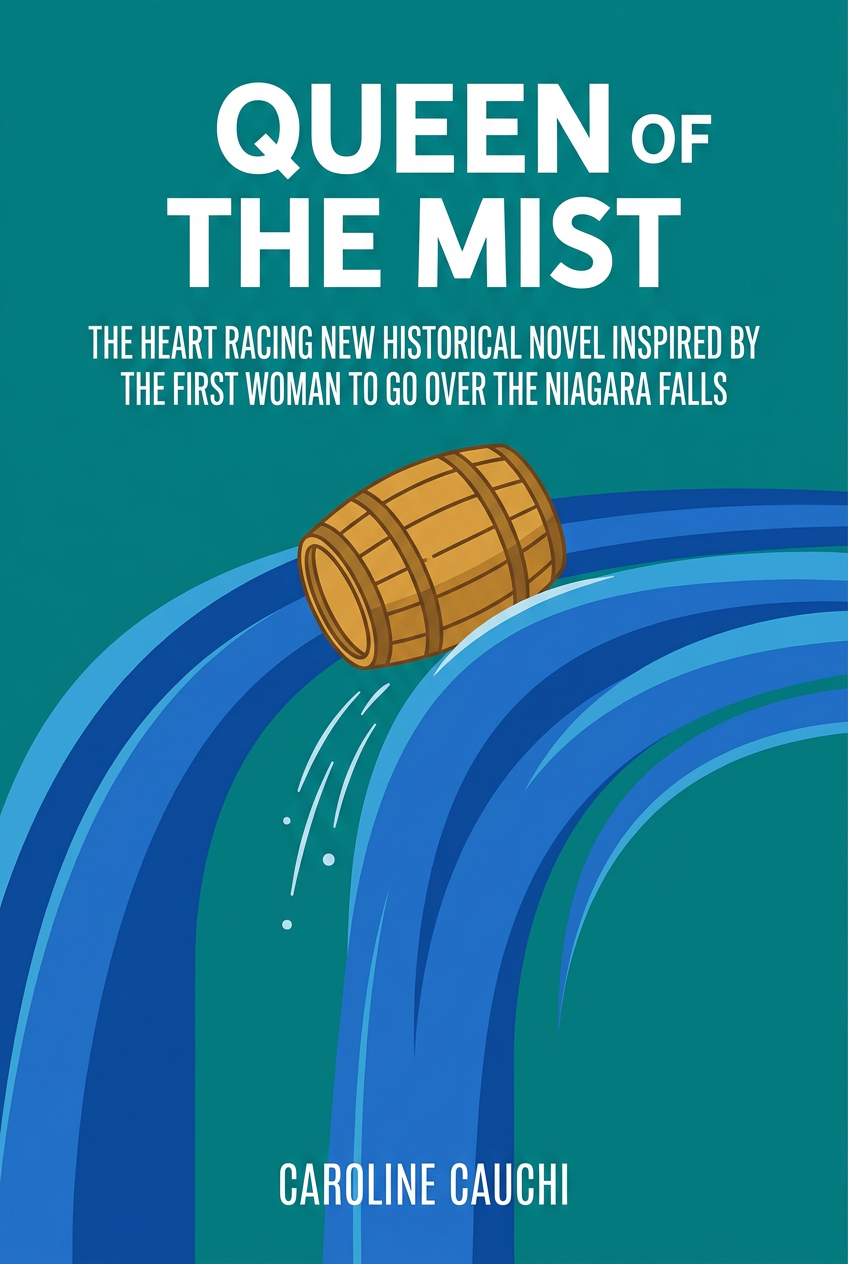
Queen of the Mist
The heart racing new historical novel inspired by the first woman to go over the Niagara Falls
What's it about
Have you ever felt invisible, desperate to make your mark on the world? Discover the heart-pounding true story of Annie Edson Taylor, a woman who risked everything for a moment of fame by becoming the first person to go over Niagara Falls in a barrel. This summary unpacks Annie's audacious journey from obscurity to legend. You'll learn about the relentless ambition that drove her, the meticulous planning behind her death-defying stunt, and the shocking aftermath of her quest for recognition in a world that wasn't ready for her.
Meet the author
Caroline Cauchi is a leading historical fiction author whose research into untold women's stories has won critical acclaim and captivated readers worldwide. Her lifelong fascination with figures who defy convention led her to the Niagara region, where she spent years uncovering the forgotten truth of Annie Edson Taylor. This deep-seated passion for resurrecting history's hidden heroines is the driving force behind the heart-pounding narrative of Queen of the Mist, bringing an extraordinary, real-life story to a new generation.
Opens the App Store to download Voxbrief

The Script
Two identical barrels are commissioned from the same cooper, built from the same stock of Russian oak, bound with the same gauge of iron hoops. One is filled with ballast, sealed, and sent over Niagara Falls on a test run. It emerges downstream, splintered and flooded, a testament to the river’s violent power. The second barrel, however, is different. It's padded with a mattress, weighted for a specific human occupant, and fitted with an anvil at its base for stability. This second barrel is a vessel of intention, a desperate gamble engineered for a second chance at life.
This single, audacious act—the difference between a trial run and the main event—is what captivated historian and author Caroline Cauchi. She became fascinated by the story of Annie Edson Taylor, the 63-year-old woman who climbed inside that second barrel in 1901. Cauchi saw a woman staring down the twin abysses of poverty and obscurity, deciding to risk a literal plunge to escape a figurative one. After years of sifting through sensationalized newspaper accounts and scant personal records, Cauchi felt compelled to write the story that the historical footnotes missed—the story of the woman inside the barrel, not just the spectacle of the barrel itself.
Module 1: The Sanctuary and the Struggle
This story begins within the walls of a struggling boarding house. It's a place that functions as a sanctuary. Here, we meet Annie Edson Taylor, a woman in her sixties, running this refuge with her friend, Mrs. Lapointe. The core tension is immediately clear. Found family provides essential emotional support, but it cannot survive on goodwill alone. The boarding house is a haven for "lost women," transients, and those fleeing difficult pasts. Annie and Mrs. Lapointe have created a community built on mutual care. But this compassion has a cost. Annie has been secretly housing vulnerable women for free, using her own dwindling funds to support them. This leads to a financial crisis, forcing a stark realization: their sanctuary is on the brink of collapse.
This module shows us that even the most noble endeavors are subject to practical realities. The friendship between Annie and Mrs. Lapointe is a partnership forged in shared widowhood and mutual respect. When the financial deficit is revealed, there's tension, but no true anger. Instead, they move to collaborative problem-solving. This introduces another key idea. Resilience is forged through practical action and mutual aid. They don't just worry; they act. They brainstorm placing a newspaper ad, pragmatically discussing how to "embellish the truth a little" to attract paying guests. They describe their worn parlor as "homely" and offer promotional rates. It's a raw look at the hustle required to keep a small, mission-driven enterprise afloat.
But what's driving Annie? It's about more than keeping the lights on. A defiant spirit can turn personal history into a driving force for a meaningful future. At sixty-two, Annie actively resists the notion that she should fade into the background. When courtship is suggested as a financial solution, she dismisses it, declaring she'd "rather wrestle a moose." She values her autonomy. Tapping her cheek, she says there's "still room on here for my best and most adventurous story yet." Her purpose is found in service to others, creating a legacy that defies the stereotype of the passive, elderly woman. This boarding house is the first stage for her ultimate, history-making performance.
Module 2: The Performance of Survival
Now, let's turn to the social world outside the boarding house. Here, the book explores the intricate dance of perception and performance. Every social gathering is a stage, and every character is playing a part. Annie finds herself at an opulent party, a world of excess that feels alien to her. She is acutely aware of the rigid expectations placed on women. Societal roles are constricting, forcing individuals to perform identities that are not their own. Annie is physically uncomfortable in a borrowed, ill-fitting dress. Its tight corset is a "nagging reminder of the ageing I attempt to hide." She observes how men in this society prefer women "tamed and docile," a stark contrast to her own assertive nature.
This brings us to a critical insight about navigating these environments. Social survival depends on mastering the art of perception management. Annie consciously performs to fit in. She pats her skirts "keen to appear busy and to detract from how alone I suddenly feel." Later, she captivates an audience with a dramatic, embellished story about the outlaw Jesse James. It's a calculated performance. She's not the only one. The wealthy Henry Hills performs a confidence "bought with money." Mrs. Lapointe performs a faux-vulnerability to charm him. It's a world of transactional relationships, where interactions are based on status and utility, not genuine connection.
So what happens when your true self clashes with these performances? It creates immense tension. Authentic individualism creates friction with a conformist society. Annie feels profoundly out of place, thinking, "This world isn't mine." But she doesn't just retreat. She asserts her identity through sharp wit and blunt honesty. She tells a man he's "rather full of yourself" and challenges reductive compliments like "You really are funny for a woman." Her story about Jesse James becomes a metaphor for her own spirit. She claims they "shared the same intentions... We both had nothing left to lose." She positions herself as a fearless outsider, an identity that will soon be tested in the most extreme way possible.
Module 3: The Genesis of a Daredevil
We've seen the financial pressure and the social friction. Next up: the spark that ignites the impossible idea. How does a sixty-two-year-old former schoolteacher decide to go over Niagara Falls in a barrel? The idea doesn't appear in a vacuum. A daring ambition emerges from a potent mix of folklore, personal desperation, and external inspiration. Annie's imagination is fired by two things. First, she rereads the story of Morgiana, a clever servant from The Blue Fairy Book who outwits thieves with her cunning. Second, she hears about a man planning a similar stunt at the Falls. She connects the fictional heroine's bravery to a real-world dare and begins to formulate a plan.
The idea crystallizes when she visits the Falls. The experience is overwhelming. The "thunderous" noise, the "mesmerising display of force and beauty." But instead of deterring her, this raw power galvanizes her resolve. Experiencing the sublime force of nature can be a catalyst for personal transformation. The grandeur of the Falls puts her own struggles into perspective. It makes her feel alive, and it solidifies her purpose. She feels the Falls are "urging me." This is a calling. Her motivation is a powerful cocktail: "Fame, foolishness and financial gain are going to dance hand in hand this time."
This wild ambition, however, requires a different kind of bravery back at the boarding house. Executing an audacious vision requires meticulous preparation and the ability to persuade skeptical gatekeepers. Annie approaches a cooper to build her custom barrel. He laughs, calling it a "suicide mission." But Annie is not deterred. She arrives with a detailed cardboard model and a written list of technical specifications. She has done her research. She needs Kentucky oak, a watertight seal, an internal harness, and an iron anvil at the base for stability. Her methodical approach and unwavering determination, backed by the promise of a manager, eventually win him over. This is a calculated, engineered risk.