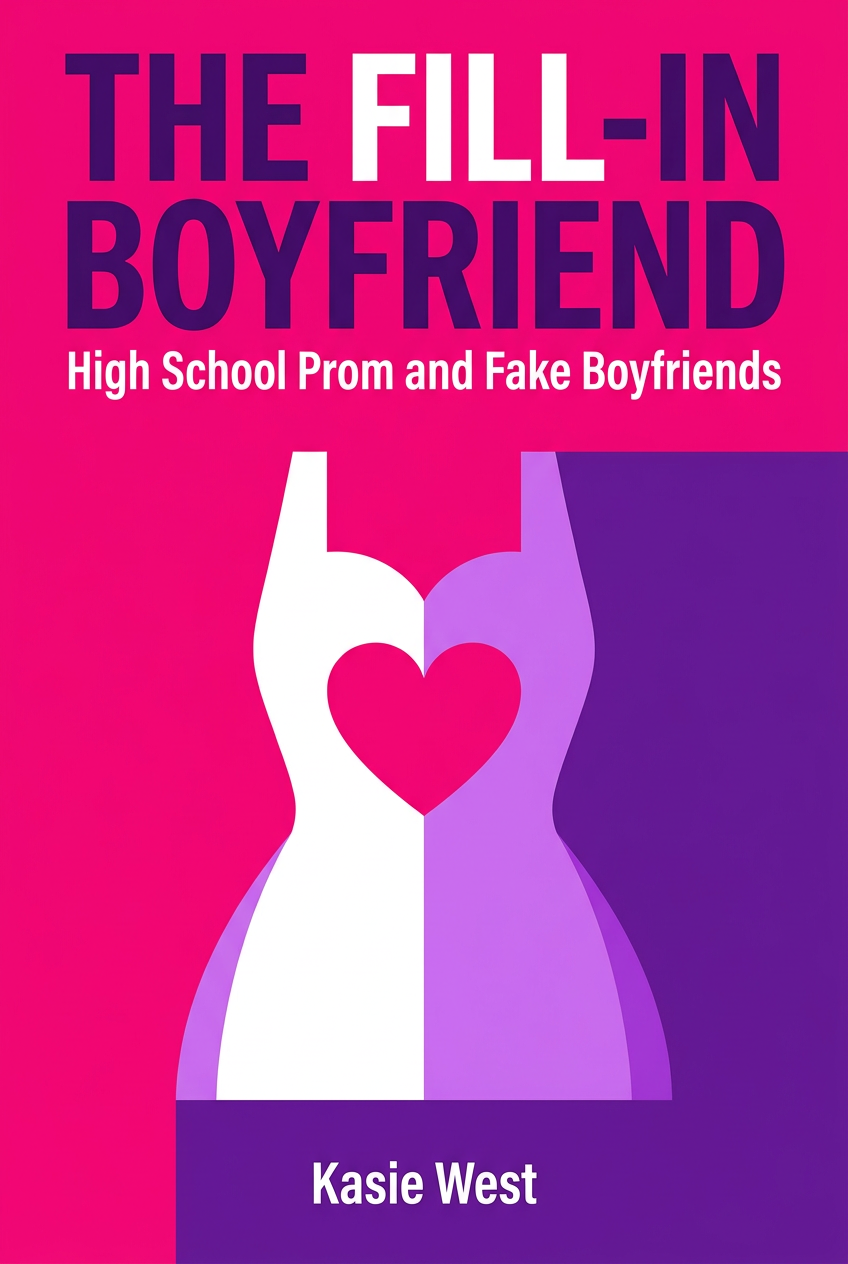
The Fill-In Boyfriend
High School Prom and Fake Boyfriends
What's it about
Ever been dumped right before a huge event? What if you had to find a fake date, fast, to save face in front of your ex? Dive into a story where one white lie about a perfect boyfriend spirals into a hilarious and heartwarming romantic tangle. You'll discover how a chance encounter with a charming stranger leads to a pact that could either solve all of Gia's problems or create a whole new set of them. Learn what happens when fake feelings start to feel surprisingly real, and the lines between the boy she made up and the boy who's standing right in front of her begin to blur.
Meet the author
Kasie West is a bestselling author renowned for crafting over twenty witty and heartfelt young adult romances that perfectly capture the delightful chaos of teenage life. Growing up in a house with four brothers, she developed a keen ear for clever banter and an appreciation for finding humor in everyday situations. This unique upbringing, combined with her love for swoon-worthy stories, infuses her writing with the authentic dialogue and relatable characters that have made her a beloved voice in contemporary YA fiction.
Opens the App Store to download Voxbrief

The Script
You're standing in front of your front door, key in hand, but you can't bring yourself to turn it. Inside is your family, waiting. Also waiting is a story you told them—a small, white lie that has since grown into a full-blown, life-sized problem. You told them about the perfect boyfriend. The one who gets good grades, has a charming smile, and adores you. The problem is, he just broke up with you. And in ten minutes, you're all supposed to be leaving for prom. Every part of you wants to confess, to admit the perfect picture has shattered. But the thought of their disappointment, the endless questions, the 'I told you so' looks… it's all too much. So you take a breath, and a wild, desperate idea sparks in your mind. What if you could just find a substitute? A temporary replacement to get you through the night. Someone, anyone, to play the part so you can survive the evening without your world collapsing.
That feeling of being trapped between a lie and a truth you're not ready to face is exactly what drove author Kasie West to write "The Fill-In Boyfriend." As a mother of four, West has spent years observing the social pressures teens navigate, especially the need to present a flawless, curated version of their lives to friends and family. She was fascinated by the extreme lengths someone might go to in order to maintain that facade, even for a single night. West wanted to explore what happens when a 'quick fix'—like hiring a handsome stranger from a parking lot to be your date—unexpectedly forces you to confront who you really are, and what you truly want, when the performance is over.
Module 1: The High Cost of Image Management
The story kicks off with a social catastrophe. The protagonist, Gia, gets dumped by her boyfriend, Bradley, in the parking lot of her own prom. Her immediate reaction isn't heartbreak. It's panic. Her main concern is how this will look to her friends, especially her rival, Jules, who has been questioning if Bradley even exists. This moment reveals a critical insight. When social perception becomes more important than personal feelings, we make desperate, short-term decisions.
Gia's solution is impulsive and extreme. She spots a guy in a nearby car and offers him cash to pretend to be Bradley for a few hours. This is a powerful illustration of a cognitive bias. We often prioritize avoiding immediate social pain over long-term emotional health. Gia is desperately patching a hole in her public image. For professionals, this translates directly to crisis management. Do you issue a vague, defensive statement to quell immediate public outcry? Or do you take the harder, more vulnerable path of admitting a mistake, even if it means short-term pain? Gia's choice to hire a "fill-in" is the equivalent of a shoddy PR fix. It might work for a moment, but the underlying problem remains, and the lie itself introduces new risks.
This leads to the second insight. Maintaining a lie requires more energy than facing the truth. Gia and her "fill-in"—who we later learn is named Hayden—have to immediately start managing a complex deception. They rehearse details. They invent backstory. They navigate probing questions from suspicious friends. The cognitive load is immense. Gia can't just enjoy her prom; she's constantly on edge, managing a performance. The story shows us that deception is a continuous, draining process. Every lie requires a dozen more to support it, creating a fragile web that can collapse at any moment. For anyone managing a team or a project, this is a lesson in transparency. Hiding a small project delay or a minor budget overrun seems easier in the moment. But it creates a cascade of workarounds and further deception that ultimately consumes more time and trust than owning the original problem would have.
Module 2: The Unraveling of a Curated Identity
So far, we've seen how social pressure leads to deception. Now let's explore the consequences. As Gia navigates this tangled situation, the story reveals how our carefully constructed identities can become prisons.
The first casualty of Gia's lie is her own self-awareness. She is so focused on managing others' perceptions that she loses touch with her own feelings. This brings us to a crucial point: An obsession with external validation erodes your internal compass. Gia's brother, Drew, creates a short film that goes viral, and it's a brutal critique of their generation's obsession with social media. The film features clips of Gia, without her full consent, checking her phone for likes and agonizing over her online image. She is publicly humiliated. But in that humiliation, she is forced to see herself as others see her. She realizes her brother isn't entirely wrong. She does care too much about likes. She does measure her worth by online engagement. This painful moment forces a reckoning. She has to confront the "brand" she has built and ask if it reflects who she truly wants to be.
This is a powerful metaphor for professional life. We all build a professional brand. We have a LinkedIn profile, a resume, a curated set of skills. But when does that brand stop being a tool and start becoming a cage? When does "personal branding" become an obstacle to genuine connection and personal growth? Gia's story suggests that the moment happens when we start believing our own hype and lose the ability to self-critique.
Which brings us to the next point. As Gia's lies are exposed, her relationships begin to fracture. Her best friend, Claire, feels betrayed not by the breakup, but by the deception. She asks Gia, "Why didn’t you trust in our friendship?" This highlights a profound truth. Deception makes the other person question their own judgment. Claire is hurt because Gia's lie implies that Claire isn't a safe person to be vulnerable with. This is a critical lesson in any collaborative environment. When you aren't transparent with your team, you are subtly communicating a lack of faith in them. You are telling them you don't trust them to handle the truth. This breeds resentment and disengagement far more effectively than any single mistake ever could.