All Books
Self-Growth
Business & Career
Health & Wellness
Society & Culture
Money & Finance
Relationships
Science & Tech
Fiction
Topics
Blog
Download on the App Store

The Last Train to London

A Novel

12 minMeg Waite Clayton

What's it about

How far would you go to save a child who isn't yours? Imagine the courage it takes to risk everything for a stranger's family amidst the rising threat of Nazi-occupied Europe. This is the heart-pounding reality for one woman leading a life-or-death rescue mission. Based on true events, this story follows the Kindertransport, a daring operation to save thousands of children. You'll witness the impossible choices faced by parents, the bravery of the rescuers, and the resilience of the children fighting for a chance at a new life. It's a powerful tale of love, sacrifice, and hope against all odds.

Meet the author

Meg Waite Clayton is a New York Times and USA Today bestselling author whose novels often illuminate forgotten histories and the untold stories of remarkable women. A graduate of the University of Michigan Law School, she uses her keen research skills to unearth the past, exploring themes of courage and resilience. Her own family’s history as Jewish immigrants who fled persecution in Eastern Europe provided a personal and profound connection to the harrowing, heroic events depicted in The Last Train to London.
Listen Now

Opens the App Store to download Voxbrief

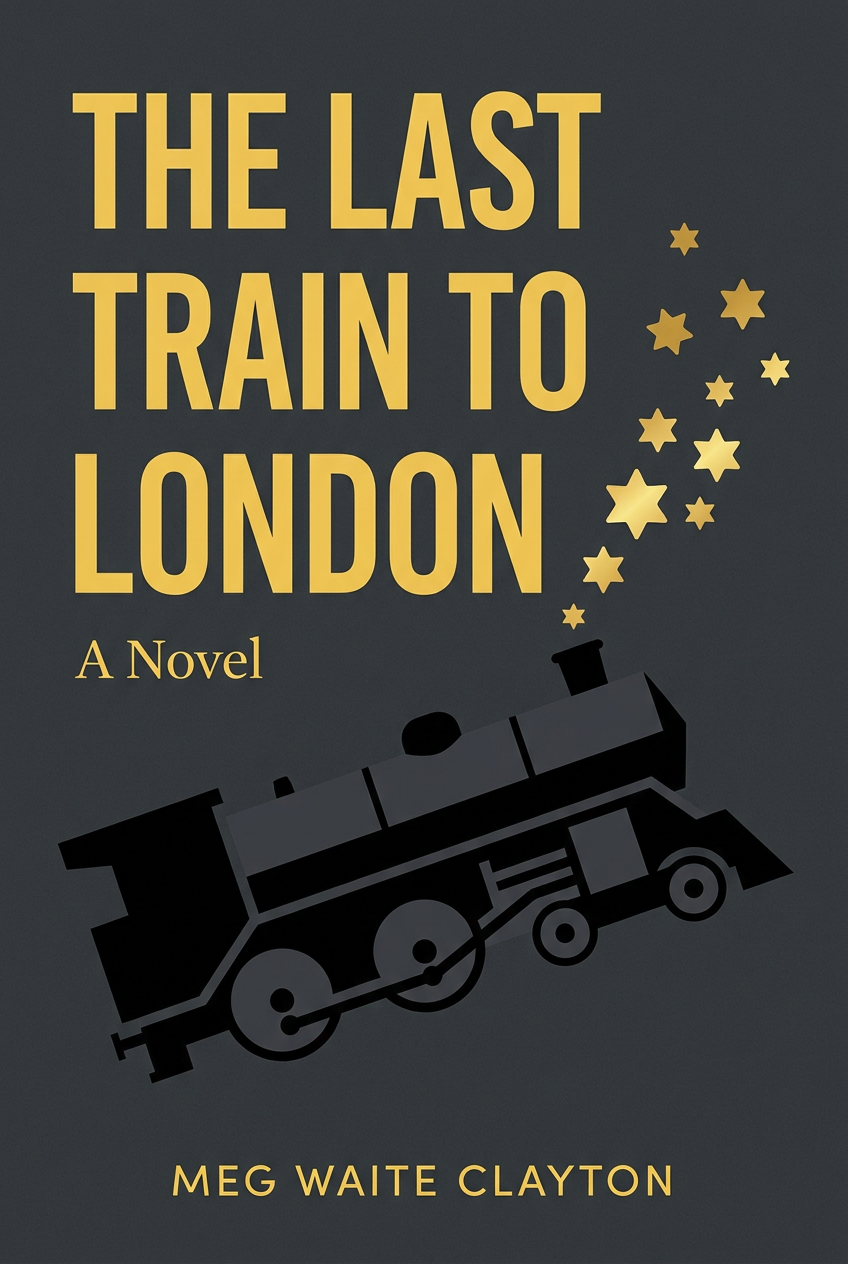
The Last Train to London book cover

The Script

Think of two identical, empty suitcases standing side-by-side on a train platform. One is packed meticulously by a parent, filled with warm clothes, a favorite toy, and a carefully wrapped sandwich—a vessel of love and desperate hope. The other is packed by a stranger in a frantic rush, holding only what could be grabbed in a moment of crisis—a single shoe, a thin blanket, a stranger’s spare shirt. From the outside, they are just two suitcases on a journey. But inside, one carries the entire world of a family’s love, while the other carries the stark, hollow echo of a world that has been lost. The weight of what's inside has nothing to do with pounds and ounces; it has to do with the story each object tells and the future it’s meant to secure.

This profound difference between an object and its meaning is what Meg Waite Clayton explores in “The Last Train to London.” The idea for the novel sparked when she heard a brief radio story about the Kindertransport, the real-life rescue effort that saved nearly ten thousand children from Nazi-occupied territories. Clayton, a bestselling novelist known for excavating the hidden histories of women in wartime, was captivated by a single, haunting detail: a woman who put her own child on a train to safety and then spent the rest of her life working to save other people's children. This act of unimaginable sacrifice became the emotional core of the book, driving Clayton to spend years researching the intricate logistics and the heart-wrenching personal stories behind those fateful train journeys, transforming the abstract history of a rescue into the deeply personal story of the suitcases, both full and empty, that were sent away to save a generation.

Module 1: The Anatomy of Courage

In a world sliding into chaos, the novel argues that courage is the decision to act despite fear. We see this through Truus Wijsmuller, a woman who makes rescuing children her life's work. Her story provides a powerful framework for understanding effective, compassionate action under pressure.

One of her core methods is that effective persuasion requires strategic empathy, not just moral righteousness. Truus needs to persuade powerful, often prejudiced, Dutch officials to bend the rules. She doesn't lecture them. She finds their human connection. When an official, Mr. Tenkink, balks at helping "Jewish children," Truus doesn't argue. She pivots. She shows him a photo of his own daughter and asks if even the coldest heart wouldn't warm to a baby. By reframing the victims as children, not a political category, she connects to his identity as a father. This is a crucial lesson. To move people to action, you must meet them where they are. You must speak to their values, not just your own.

This leads to her next principle. Lower the barrier to "yes" by making compliance easy. Truus understands that bureaucracy breeds inertia. So, she does the work for them. She arrives at meetings with pre-drafted authorizations that only need a signature. She presents complete files with all the necessary information, making it easier for officials to agree than to object. This is a masterclass in navigating organizational friction. Don't just present a problem. Present the solution, pre-packaged and ready to execute. The less effort required from the decision-maker, the more likely you are to get the outcome you want.

Finally, Truus's story teaches us that courage often requires a calculated performance. At the German border, she uses a coded phrase to meet her contact. She coaches her companion to feign confusion and use just enough German to flatter a guard's ego. She even carries a paste copy of a ruby ring, a prop for potential bribes. This is about recognizing that in a hostile environment, your true intentions must be shielded. You must control the narrative. You must manage how you are perceived to protect your mission. It’s a sobering reminder that sometimes, the most courageous acts are the quietest, hidden behind a carefully constructed facade.

Module 2: The Two Worlds of Vienna

The novel masterfully contrasts two Viennas. One is the city of art, music, and intellectual debate. The other is a city of rising fear, systemic persecution, and public humiliation. The story unfolds in the space between these two worlds, where personal lives are violently interrupted by political catastrophe.

The characters Stephan and Žofie-Helene embody this contrast. They are brilliant teenagers. Stephan is a budding playwright, obsessed with the works of Stefan Zweig. Žofie-Helene is a mathematical prodigy, working on proofs with the famous logician Kurt Gödel. Their story reminds us that intellectual and creative pursuits are acts of identity preservation under threat. They meet in secret to rehearse Stephan's play. They debate the Liar's Paradox in underground tunnels. They are clinging to a world of ideas and beauty while the world of jackboots and slogans closes in. For them, a new play or a complex theorem is an assertion of a reality worth saving. It's a way to prove they are more than the labels the regime wants to impose on them.

But the novel is unflinching in showing how this private world is fragile. We see how oppression advances through the passive complicity of ordinary people. Before the Anschluss, the annexation of Austria, many Viennese citizens were "too wrapped up in their own lives to see the politically darkened clouds." They had businesses to run and parties to attend. This willful normalcy created a vacuum that the Nazi regime eagerly filled. After the annexation, this apathy curdles into active participation. When Jewish citizens are forced to scrub streets, neighbors jeer. This is the work of a society that, through fear or conformity, chose to look away and then to join in.

The story also shows how persecution is a cold, bureaucratic machine. We are introduced to Adolf Eichmann, not as a ranting ideologue, but as a career-driven bureaucrat. His office at the SD, the Nazi intelligence agency, is focused on a single task: making Jewish emigration systematic and profitable for the Reich. He builds a massive card index, identifying and tracking every Jew. He develops a strategy to strip them of their assets, so they have no choice but to leave with nothing. This chilling depiction reveals a terrifying truth. The greatest atrocities are planned in conference rooms, documented in files, and executed with chilling efficiency.

Read More