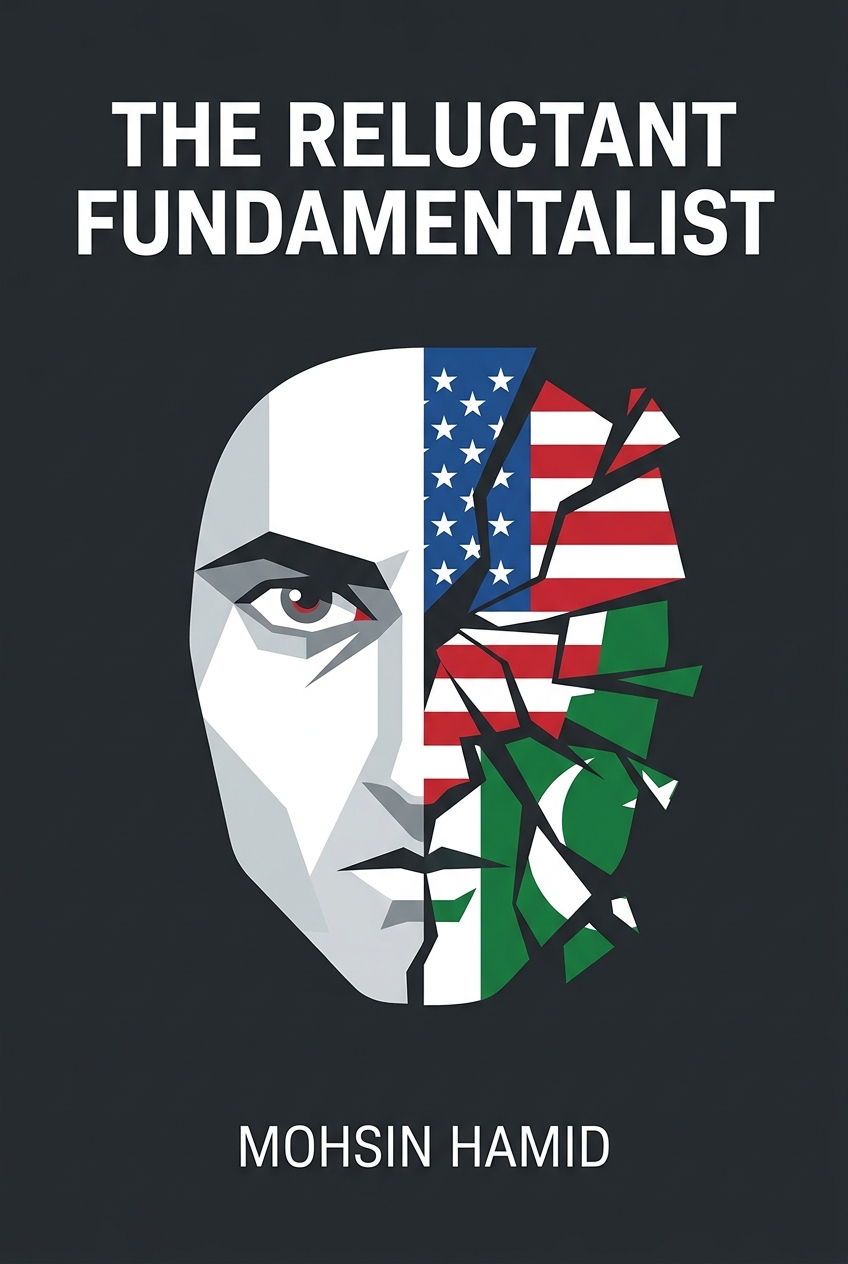
The Reluctant Fundamentalist
A Man Booker Prize-Shortlisted Literary Novel of Love, Identity, and the American Dream
What's it about
Have you ever felt caught between two worlds, struggling to reconcile your ambition with your identity? Discover the story of a young man who achieves the American Dream—a Princeton education, a high-powered job, and a passionate love affair—only to find himself questioning everything after 9/11. This gripping narrative reveals how a promising star on Wall Street becomes a sharp critic of the very system that created him. You'll explore the subtle shifts and major shocks that transform his love for America into a deep-seated resentment, forcing you to confront difficult questions about belonging, prejudice, and the true cost of success.
Meet the author
Mohsin Hamid is a critically acclaimed, Man Booker Prize-shortlisted author whose fiction explores the complex interplay of globalization, identity, and fundamentalism with profound insight. Born in Pakistan and educated at Princeton and Harvard, his own transatlantic journey informs his powerful storytelling. Hamid's experiences living between Lahore and New York provided the unique perspective necessary to write a novel that so brilliantly captures the anxieties and fractured loyalties of a post-9/11 world, making his work essential for understanding our contemporary age.
Opens the App Store to download Voxbrief

The Script
You are at a dinner party, years after a major life change. A promotion, a move, a new relationship. You’re telling a story from your past, one you’ve told a hundred times. It’s polished, funny, maybe a little self-deprecating. But as you speak, you notice a flicker in the eyes of an old friend across the table. A slight, almost imperceptible shift. They aren’t just hearing the story; they are remembering the context, the messy details, the person you were before. For them, your carefully constructed narrative is just one layer of a much deeper, more complicated history. Suddenly, your own story feels foreign in your mouth. You see yourself through their eyes, and a chasm opens between the person you present to the world and the person someone, somewhere, remembers you to be.
This gap—between the life we build and the life we left behind, between our new identity and our old allegiances—is the space Mohsin Hamid wanted to explore. Born in Pakistan, educated in the United States, and having worked as a corporate consultant in New York, Hamid lived the life of a global citizen. He experienced firsthand the magnetic pull of American opportunity and the subtle, then sudden, shifts in perception after 9/11. He saw how a person’s identity, once a private affair, could become a public performance, judged and misjudged by an anxious audience. To capture this feeling of being seen through a distorted lens, he chose to create a dramatic monologue, a one-sided conversation that forces the reader to sit in the place of the listener, constantly questioning who is telling the truth and what story is being left unsaid.
Module 1: The Seduction of Meritocracy
The book opens with a powerful exploration of the American system's allure. It’s presented as a hyper-efficient engine. A machine for identifying and recruiting the world's best talent. Changez is a product of this system. He wins a coveted spot at Princeton. He is one of only two Pakistanis in his class. He gets a full scholarship. In return, he is expected to contribute his talents to America.
This leads to the first core idea. Meritocracy offers a clear path to success, but it demands assimilation. Changez is hand-picked. He's evaluated through standardized tests and "painstakingly customized evaluations." He then enters the ultimate arena: corporate recruiting. He lands a job at Underwood Samson, an elite valuation firm. The starting salary is over eighty thousand dollars. It’s a golden ticket. It practically guarantees a future spot at Harvard Business School. The system works. It identifies hunger. It rewards performance.
But here's the catch. To succeed, you have to play the part. Changez learns this quickly. At Princeton, he projects an image of a "young prince, generous and carefree." In private, he works three jobs. He studies all night. He hides his family’s declining financial status. This performance is a necessity. It’s the price of admission. His interviewer at Underwood Samson, a man named Jim, sees right through it. He clocks Changez's "hunger." He values it. Jim, a man from a humble background himself, recognizes a fellow warrior.
This brings us to a critical insight. Your perceived identity becomes your most valuable, and vulnerable, asset. Changez is constantly aware of how he is seen. At Underwood Samson, he joins a class of trainees. They are diverse in race and gender. But they are homogenous in every other way. They are all from elite schools. They are all confident. None are short or overweight. As his friend Wainwright jokes, "Beware the dark side, young Skywalker." They are being molded into a specific type of professional. Changez even realizes his foreignness can be an advantage. His polished, Anglicized accent and formal manners are associated with wealth and power. They help him navigate the corporate hierarchy. He is assimilating, but he is also using his difference as a tool.
Module 2: The Cracks in the Facade
So far, Changez is winning the game. He's a star performer in New York. He feels like a "young New Yorker with the city at my feet." He’s dating a captivating, intelligent woman named Erica. But as his journey continues, the smooth facade of his new life begins to crack. The conflict between his ambition and his identity starts to surface.
This introduces a key theme. Proximity to power reveals uncomfortable truths about your own position. Changez travels to the Philippines on business. In a Manila traffic jam, he looks at a hostile local driver. He feels a sudden, shocking kinship. He realizes he feels more foreign among his American colleagues than with this stranger. He is, in his own words, a "servant of the American empire." This is a jarring realization. He has become part of a system that extracts value from places like the one he came from. To cope, he learns to perform a more assertive "American" identity. He cuts in line. He name-drops New York. It brings him a flicker of respect, but a deep sense of shame.
And it doesn't stop there. The personal and the political are about to collide in the most dramatic way possible. While in Manila, Changez watches the September 11th attacks on television. His reaction is not what you’d expect. He smiles. It’s a smile of symbolic satisfaction. He was pleased to see America "brought to her knees." This is a deeply unsettling confession. It reveals a reservoir of resentment he didn't even know he had. It’s the moment his carefully constructed identity shatters.
This leads to the most confronting insight of the book. Personal trauma and public tragedy can become dangerously intertwined. Changez’s relationship with Erica becomes a microcosm of this. Erica is haunted by the death of her childhood love, Chris. The 9/11 attacks amplify her grief, plunging her into a deep depression. She withdraws. She can't connect with Changez. She is lost in a powerful nostalgia for a past he can never be a part of. In a desperate, misguided attempt to reach her, Changez suggests she pretend he is Chris. The act is physically intimate but emotionally devastating. He feels he has erased himself. He has become a ghost in his own relationship, a stand-in for a memory. He realizes he is powerless to save her from her own past, just as he is powerless to reconcile the two halves of his own identity.