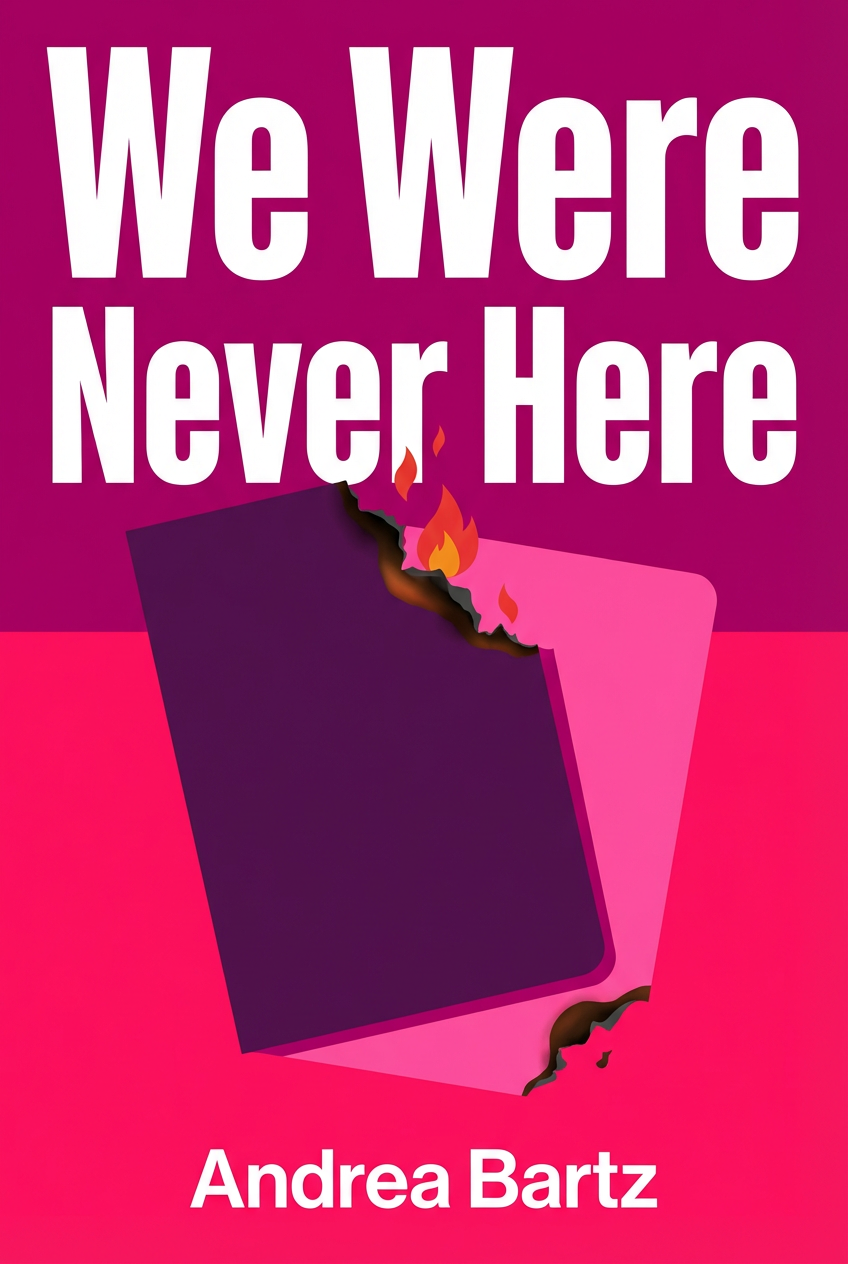
We Were Never Here
Reese's Book Club: A Novel
What's it about
What if your best friend was the most dangerous person you know? Imagine your annual backpacking trip with your closest confidante takes a horrifying turn when a man ends up dead. It happened last year, and now, it’s happened again. This time, you're forced to question everything. As you grapple with the chilling reality of your situation, you'll uncover a tangled web of lies and toxic codependency. Can you trust your own memories, or has your friendship been a carefully constructed trap from the very beginning? The truth might be more terrifying than the crime itself.
Meet the author
Andrea Bartz is a bestselling author and National Magazine Award-winning journalist whose work has appeared in The Wall Street Journal, Marie Claire, Vogue, and Cosmopolitan. Drawing on her extensive experience as an editor for psychology, travel, and women's health publications, she crafts gripping psychological thrillers that explore the dark complexities of female friendships. Her real-world insights into human behavior and exotic locales lend a chilling authenticity to her suspenseful, globetrotting novels.
Opens the App Store to download Voxbrief

The Script
You’re in a foreign city with your best friend, the one person who knows you better than anyone. It’s the final night of your annual reunion trip. A backpacker you met at the bar comes back to your room. There’s a flirtatious energy, then a sudden shift. A scream. When you rush in, the man is dead on the floor, and your friend is standing over him, claiming self-defense. It’s a horrific, surreal echo of what happened on last year’s trip. You helped her cover it up then, burying the body and the secret. Now, lightning has struck twice. Every instinct screams that this is an impossible coincidence, a pattern too neat to be random. But this is your person. The one who holds your shared history, your deepest vulnerabilities. Doubting her feels like doubting a part of yourself. So you help her again.
Back home, the carefully constructed walls of your life begin to crack. A text message arrives that seems innocent, but lands with the weight of a threat. A small, misplaced object in your apartment feels like a violation. The paranoia is a slow-creeping vine, strangling the trust that once felt as natural as breathing. You start to question every memory, every shared story. Was her loyalty a shelter or a cage? Was your friendship a bond, or was it a carefully laid trap from the very beginning? You are forced to confront the terrifying possibility that the person you trusted most in the world might be a monster—and that you were her willing accomplice.
This spiral of doubt and psychological dread is precisely the territory Andrea Bartz explores. A journalist and editor with a background at publications like Glamour and SELF, Bartz has long been fascinated by the intensity and potential toxicity of female friendships. She was inspired to write We Were Never Here after a conversation about the unsettling power dynamics that can exist within these bonds—how the person who knows all your secrets is also the person with the most power to destroy you. Bartz wanted to push that idea to its most extreme conclusion, crafting a story that weaponizes the fierce loyalty of friendship against itself, leaving readers to question how well they truly know the people closest to them.
Module 1: The Illusion of the Perfect Friendship
The story introduces us to Emily and Kristen, best friends with a decade-long tradition of annual international trips. On the surface, their bond seems idyllic. Kristen is Emily’s "aerosolized Xanax," the one person who can calm her anxiety. Their shared history is a fortress of inside jokes and rituals. But beneath this perfect facade, cracks are already showing. Bartz immediately establishes that even the closest friendships can harbor toxic undercurrents of dependency and control. Kristen subtly dismisses Emily’s career and enforces a strict "digital detox" rule on their trips, taking Emily’s phone. Emily, in turn, hides a new romance from Kristen, fearing her judgment. This dynamic is a quiet power struggle.
This brings us to a critical insight. Secrecy is a corrosive agent in any relationship, creating distance even in moments of perceived intimacy. Emily's decision to hide her new boyfriend, Aaron, is a symptom of a deeper fear. She knows Kristen’s love can feel possessive. She's seen Kristen subtly undermine her past relationships. So, Emily creates a secret space in her life, a small act of self-preservation that ironically introduces a crack in the very friendship she's trying to protect.
Here's the thing. Their friendship is also haunted by a shared, unspoken trauma from a previous trip to Cambodia. Emily experiences vivid, violent flashbacks to an event where "life cracked neatly into Before and After." This shared secret is the dark gravity holding them together. This leads to the core idea of this module: Shared trauma can forge an unbreakable bond, but it can also become a cage of mutual obligation. Emily feels she owes Kristen for saving her in Cambodia. This sense of debt becomes a powerful tool of emotional leverage. It forces Emily to suppress her own needs and anxieties to maintain the peace, setting the stage for the disastrous events to come. Their bond is a trauma bond, built on a foundation of violence and silence.
Module 2: When the Past Repeats Itself
We've established the fragile foundation of Emily and Kristen's friendship. Now, let's turn to how that foundation shatters. During their trip in Chile, the nightmare from Cambodia repeats itself, but with the roles reversed. Kristen kills a man named Paolo, claiming it was self-defense against a sexual assault. In the immediate, terrifying aftermath, Kristen frames their choice: call the police in a foreign country and risk being blamed, or handle it themselves. She invokes the case of Amanda Knox, an American student who was wrongfully convicted in Italy, to argue that the system would destroy them.
This is where the book's central psychological drama ignites. Faced with an impossible choice, crisis forces a pragmatic, survival-oriented response that overrides conventional morality. Emily and Kristen shift into logistical problem-solving. How do they move the body? How do they clean the evidence? How do they avoid suspicion? Their conversation becomes chillingly practical. They refer to Paolo's body as "it." The immediate need for self-preservation silences the horror and guilt. It's a stark look at how ordinary people can make extraordinary and terrible decisions under extreme pressure.
And here's the kicker. This second trauma cements a toxic dynamic of reciprocal rescue. Emily remembers how Kristen took charge in Cambodia when she fell apart. Now, it's her turn. She feels a profound obligation to protect Kristen, thinking, "Only one of us could fall apart at a time." This creates a powerful, if twisted, sense of purpose. The act of covering up a crime becomes a perverse expression of loyalty. Emily is repaying a debt. This role reversal locks them into a codependent cycle. Each has saved the other. Each has seen the other at their worst. And each now holds the other's life in her hands.
But even in this moment of intense partnership, seeds of doubt are sown. Emily notices that Kristen has no defensive wounds, unlike her own experience in Cambodia. She also knows a secret Kristen doesn't: she briefly connected to the hotel Wi-Fi, leaving a digital footprint. This leads to a final, chilling point. Shared secrets amplify individual anxieties. The cover-up forces them together, but it also creates new, private fears that begin to erode the very trust they are relying on to survive. They are partners in a crime, but they are also alone in their individual paranoia.