What is African American History? An Introduction for Beginners
Did you ever get the feeling that your school history classes left out the most important parts? For many of us, the story of America was presented as a simple tale of progress, with a few uncomfortable details glossed over. But what is African American history? It’s not a separate or optional subject; it is the central, unvarnished story of America itself—its contradictions, its tragedies, and its profound capacity for resilience. For anyone seeking a deeper understanding, this article is an introduction to African American history, explaining its key themes and demonstrating how powerful black history books can be in illuminating the past and present.
Understanding this history is essential for every American. It provides the necessary context for the world we live in today, from the layout of our cities to the persistent inequalities we see in headlines. As James W. Loewen points out in Lies My Teacher Told Me, many textbooks have historically failed to grapple with the centrality of racism, instead offering a sanitized narrative of constant improvement. To truly learn, we must move beyond these simplified stories and engage with the more complex, challenging, and ultimately more truthful history.
Why African American History is American History
To understand the United States is to understand that its history is fundamentally intertwined with the history of its Black citizens. From the nation's economic foundations to its cultural innovations, African American history is not a sidebar—it's the main text. Answering the question 'why is African American history important' begins with acknowledging this truth. It forces a re-examination of the country's founding narratives, which often omit the foundational role of Black people.
In his book Black AF History, Michael Harriot directly challenges the whitewashed origin story of America. He argues that the nation wasn’t born from a singular, noble ideal but from a collision of European imperial ambitions, technological advancements, and, most critically, a brutal economic system. The transatlantic slave trade was not an unfortunate footnote; Harriot describes it as a “meticulously constructed global business” that financed empires and built immense wealth for the new nation. The American economy, from its earliest days, was built on the backs of enslaved Africans. Understanding this fact is a crucial first lesson in any introduction to African American history.
This reframing shows that African American history explained properly reveals the intertwined destinies of all Americans. The fight for Black liberation has consistently forced the nation to confront the gap between its stated ideals of freedom and equality and its reality. The most important African American history facts aren't just dates and names; they are the moments where this confrontation pushed the entire country forward.
Slavery History and Its Economic Engine
It is impossible to discuss the history of the United States without a deep dive into the history of slavery. This was not a passive institution but an active, brutal, and highly profitable system of forced labor that lasted for centuries. It was the economic engine of the colonial era and the young republic, particularly in the South, where the cotton industry fueled global industrialization.
The system was designed to dehumanize and commodify people, stripping them of their names, families, and cultures. Yet, within this horrific system, enslaved people constantly resisted. They developed rich cultural traditions, formed resilient communities, and fought for their freedom through countless acts of defiance, both small and large. Understanding slavery history is not just about acknowledging the brutality; it is also about recognizing the incredible strength and humanity of those who endured and resisted it.
The Legacy of Segregation and Systemic Inequity
If slavery was the nation's founding sin, its legacy has continued to shape the country long after the Civil War. The period of Reconstruction was followed by the rise of Jim Crow laws, which enforced racial segregation and disenfranchised Black voters for nearly a century. This era cemented a system of racial hierarchy that continues to have profound effects today. This is a key part of how African American history shaped today.
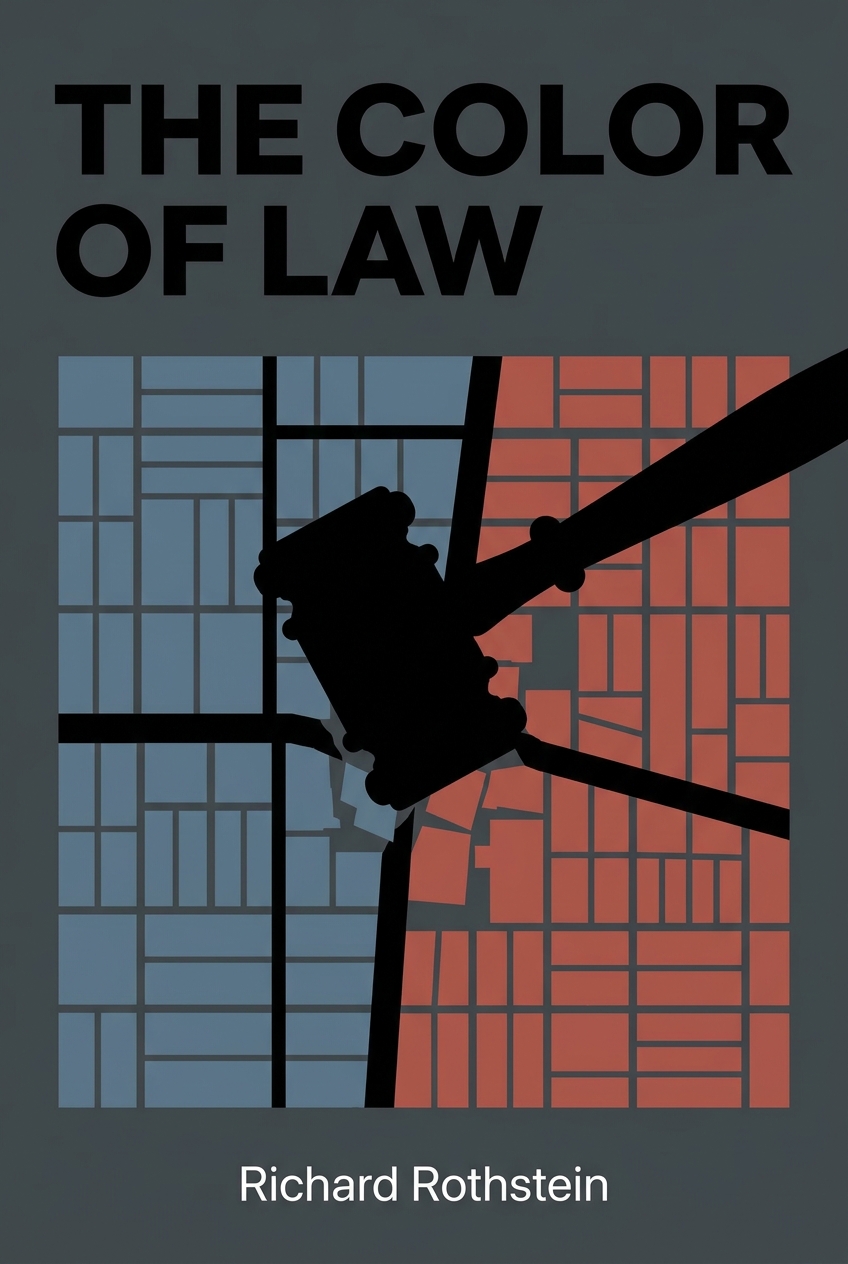
Many people believe that after the Civil Rights Act of 1964, segregation became a thing of the past, with any remaining residential separation being a matter of private choice or economic status. However, in The Color of Law: A Forgotten History of How Our Government Segregated America, Richard Rothstein delivers a stunning rebuttal to this myth. He meticulously documents how federal, state, and local governments actively and intentionally created the segregated cities we live in today. Rothstein argues that what we call 'de facto' segregation (as if it just happened by chance) was, in fact, 'de jure' segregation—a direct result of explicit government policy.
From Legal Chains to Economic Chains
Rothstein's research provides a powerful explanation for the persistent racial wealth gap in America. He shows how the federal government created what he terms a “Blueprint for a Divided Nation” through agencies like the Federal Housing Administration (FHA), which refused to insure mortgages in and near African American neighborhoods—a practice known as redlining. Local governments then used their own “Machinery of Exclusion,” like zoning ordinances and racially restrictive covenants, to enforce this segregation on the ground.
This system created an “Economic Chokehold” on Black families. By locking African Americans out of the primary engine of middle-class wealth creation in the 20th century—homeownership in appreciating suburban neighborhoods—the government engineered a multi-generational economic disadvantage that persists to this day. This is one of the most important African American history lessons: that systemic inequality is not an accident, but a product of historical design.
Illuminating Resistance, Identity, and Culture
The story of African American history is one of relentless oppression, but it is equally a story of profound creativity, resistance, and the forging of identity against all odds. From the spirituals sung in slavery times to the vibrant explosion of the Harlem Renaissance, Black culture has been a powerful force for survival and expression. It has also been the driving force behind American popular culture for over a century.
This history is populated by visionary Black leaders, groundbreaking artists, and ordinary people who demanded their humanity be recognized. The Civil Rights Movement of the 1950s and 60s is perhaps the most well-known example, but it was just one chapter in a much longer fight for racial justice.
The Battle for Dignity and Selfhood
How do you build a self when society tells you that you are less than human? This is a central question explored in some of the most powerful works of African American literature. In her novel Beloved, Toni Morrison confronts the deep psychological trauma of slavery head-on. The story of Sethe, a woman who is haunted by the ghost of the child she killed to save her from a life in bondage, is a profound exploration of what Morrison calls “the battle for the self.” The novel argues that healing, both for an individual and a nation, cannot happen until the deepest pains of the past are confronted and reckoned with.
Similarly, Lorraine Hansberry's play A Raisin in the Sun captures the struggle for dignity in the Jim Crow era. Set in Chicago, the Younger family's debate over how to use a life insurance check becomes a powerful allegory for the different paths to Black liberation. The character of Beneatha, with her exploration of her African roots, highlights the tension between assimilation and embracing an authentic identity, a theme that resonates throughout African American history and continues today.
Redefining the American Timeline
A true introduction to African American history for beginners means re-learning the standard American history timeline. Certain key events must be understood through the lens of the Black experience to grasp their full significance. For example, the end of the Civil War didn’t just mean the preservation of the Union; it marked the beginning of a chaotic and ultimately failed experiment in multi-racial democracy known as Reconstruction. The Great Migration, which saw millions of African Americans move from the rural South to Northern cities, was not just an economic migration but a mass political and social movement that reshaped the nation.
The Harlem Renaissance in the 1920s wasn't just a literary movement; it was the birth of a new Black consciousness and a declaration of cultural independence. And the Civil Rights Movement was not a smooth, triumphant march led by a single leader. As writers like Michael Harriot detail, it was a complex and often dangerous struggle involving many grassroots organizations and competing strategies, from nonviolent protest to armed self-defense. Understanding these key events on their own terms is crucial to seeing the complete picture.
To study African American history is to commit to a more honest, more complex, and more complete understanding of America. It’s a journey that challenges comfortable myths and demands critical thinking, but it offers a profoundly enriching reward: a clearer view of who we are, how we got here, and the work that still needs to be done.
Master key ideas in 15 minutes
Listen to audio summaries of these books on VoxBrief
Download Free