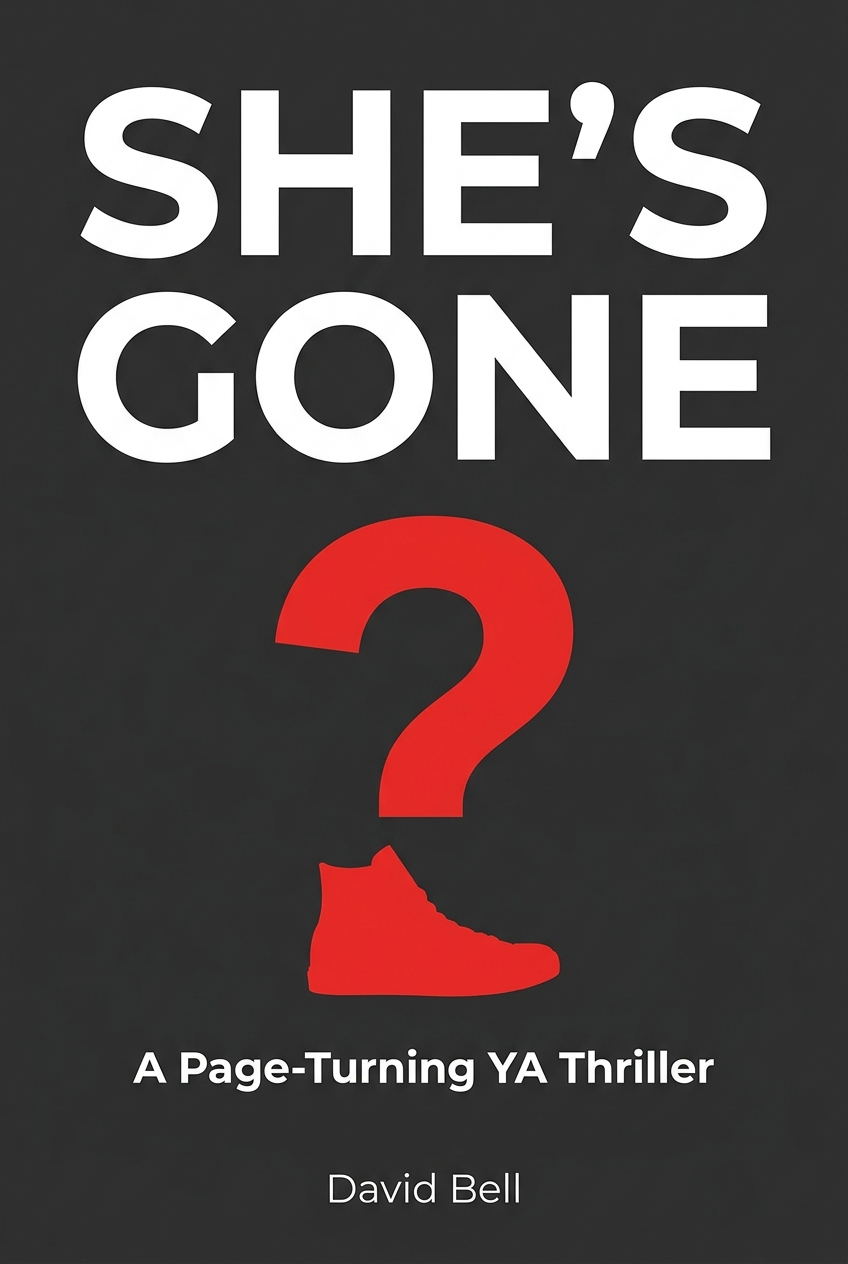
She's Gone
A Page-Turning YA Thriller
What's it about
What would you do if your best friend vanished without a trace? For Hunter, this nightmare becomes reality when his friend Chloe disappears. Now, he's the only one who can piece together the cryptic clues she left behind, but doing so might just make him the prime suspect. Dive into a gripping mystery where every secret has a price. You'll follow Hunter's desperate search through a maze of lies, betrayal, and digital trails. Uncover the dark truths hidden beneath the surface of a seemingly perfect town and find out what really happened to Chloe before it's too late.
Meet the author
David Bell is a USA Today bestselling author and an award-winning writer whose previous work has been nominated for the Edgar Allan Poe Award for Best Novel. His fascination with the secrets lurking beneath the surface of everyday life began in his own seemingly quiet Midwestern hometown. This lifelong curiosity about hidden dangers and complex relationships fuels his gripping, psychologically-driven thrillers, exploring how ordinary people react when faced with extraordinary circumstances.
Opens the App Store to download Voxbrief

The Script
You wake up in a hotel room, the morning light cutting through a gap in the curtains. The other side of the bed is empty, the sheets cold. You call her name. No answer. You check the bathroom. Empty. You figure she just went to get coffee, or maybe ice from the machine down the hall. But then you notice her phone is still on the nightstand. Her wallet is on the dresser. Her car keys are right where she left them. The minutes stretch into an hour, the knot in your stomach tightening with each sweep of the clock's second hand. The front desk hasn't seen her. Security footage shows nothing. It's as if she was never there at all, a ghost who shared your bed for a night and then dissolved into the air.
This is the moment when the world tilts. Every choice you made leading up to this point is suddenly thrown under a harsh, interrogating light. The small, forgotten arguments, the half-truths you both told, the secrets you kept from each other—they are now potential clues in a police investigation where you are the primary suspect. This sudden, terrifying evaporation of a person from your life is the central obsession for author David Bell. A professor of English, Bell is fascinated by the way ordinary lives can be shattered in an instant, leaving the people left behind to piece together a puzzle from the fragments of a shared past. He wrote She's Gone to explore that specific, chilling moment when the person you thought you knew best becomes the greatest mystery of your life, and your own innocence becomes the hardest thing to prove.
Module 1: The Anatomy of a Public Witch Hunt
When a crisis hits, the court of public opinion convenes instantly. And its judgment is swift, brutal, and often wrong. The story opens with Hunter Gifford, a high school senior who wakes up in a hospital with a concussion. His girlfriend, Chloe, is missing. The last thing he remembers is being with her at the homecoming dance. The ninety minutes that follow are a complete blank. This memory gap becomes the seed of public suspicion.
First, in the absence of facts, people invent their own narrative, and it’s rarely a kind one. Hunter, desperate for answers, posts a video online pleading for information about Chloe. The response is immediate and vicious. Comments flood in: "You killed her." "You're a liar." The public doesn't see a grieving boyfriend. They see a guilty party. The ambiguity of his memory loss is interpreted as a sign of deception. This digital mob justice quickly bleeds into the real world. A rubber skeleton with the note "CHLOE KILLER" appears on his locker. Dog feces is smeared on his family’s porch. The digital whispers become real-world threats.
From this foundation, the story shows that public scrutiny transforms personal grief into a performance. Hunter is advised to attend a candlelight vigil for Chloe. His friends warn him that not showing up will make him look guilty. He is forced to perform his grief for an audience that has already condemned him. At the vigil, Chloe’s own mother, shattered by loss, points a finger at Hunter and publicly accuses him. The crowd turns on him, throwing drinks and rocks. He becomes a scapegoat, a target for the community’s collective pain and anger. It’s a powerful illustration of how a desperate need for answers can override reason and compassion.
Finally, the book reveals a chilling truth: every action you take to defend yourself can be twisted into evidence of guilt. Hunter’s second video, meant to show his authentic self, is seen as manipulative. His search for Chloe's journal is framed as tampering with evidence. Even his desire to be a writer is used against him. Chloe's mother suggests he might be exploiting the tragedy for a future book. In this environment, every move is scrutinized. Every word is dissected. Innocence becomes impossible to prove when the narrative of guilt is already set.
Module 2: The Fracture of Memory and Trust
What if you were the only witness to a crime, but your memory was a black hole? This is Hunter's reality. His concussion creates what he calls a "blind spot," a complete void where the truth of Chloe's disappearance resides. This module explores how unreliable memory shatters not just an investigation, but a person's sense of self.
The first critical point is that traumatic memory loss makes you a suspect in your own life. Hunter can't provide an alibi. He can't confirm or deny what happened in the car. This void is filled by the suspicions of others. The police, his friends, and the public see his amnesia as a convenient excuse. This forces Hunter into an impossible position. He has to solve a mystery while simultaneously defending himself against accusations he can't disprove. His internal reality becomes a battleground. He replays the night over and over, trying to force a memory that isn't there, a process that only deepens his anxiety and self-doubt.
Building on that idea, when your memory fails, you are forced to rely on the stories of others, and those stories are never neutral. Hunter's friends and acquaintances offer conflicting accounts. His ex-girlfriend Hannah claims Chloe was crying and afraid of Hunter's anger that night. His teacher, Ron Hartman, confirms seeing them argue. Hunter has no memory of this, and it clashes with his perception of his relationship with Chloe. He is forced to question everything. Was his relationship as perfect as he thought? Was he angry? Could he have done something terrible? He becomes a stranger to himself, his identity reshaped by the narratives of those around him.
And here's the thing: memory is a fragile, sensory reconstruction. The book powerfully illustrates this when Hunter visits the crash site. The physical location triggers a fragmented flashback. He gets a sensory burst: "headlights," "the tree," "Chloe screaming his name." It’s a chaotic, emotional impression. This shows that recovering from trauma is about piecing together broken shards of sensory data, a process that is both painful and unreliable. The fragility of this process leaves him vulnerable, unable to build a solid defense or find personal peace.